Department of Convergence Medicine, School of Medicine, Pusan National University, Yangsan 50612, Republic of Korea.
School of Biomedical Convergence Engineering, Pusan National University, Yangsan 50612, Republic of Korea.
Int J Mol Sci. 2024 Jun 21;25(13):6837. doi: 10.3390/ijms25136837.
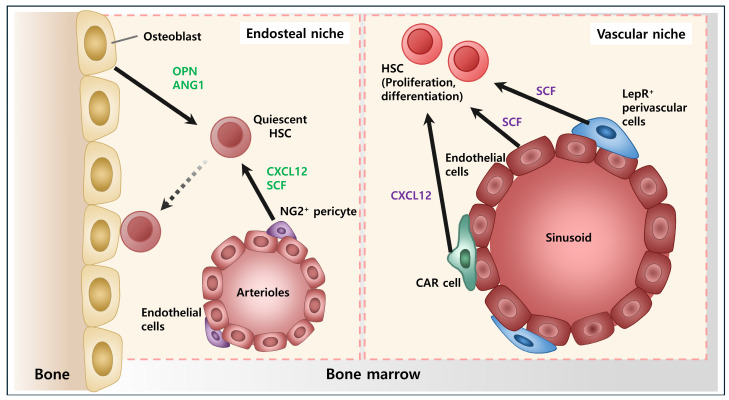
Extensive research has explored the functional correlation between stem cells and progenitor cells, particularly in blood. Hematopoietic stem cells (HSCs) can self-renew and regenerate tissues within the bone marrow, while stromal cells regulate tissue function. Recent studies have validated the role of mammalian stem cells within specific environments, providing initial empirical proof of this functional phenomenon. The interaction between bone and blood has always been vital to the function of the human body. It was initially proposed that during evolution, mammalian stem cells formed a complex relationship with the surrounding microenvironment, known as the niche. Researchers are currently debating the significance of molecular-level data to identify individual stromal cell types due to incomplete stromal cell mapping. Obtaining these data can help determine the specific activities of HSCs in bone marrow. This review summarizes key topics from previous studies on HSCs and their environment, discussing current and developing concepts related to HSCs and their niche in the bone marrow.
大量研究探索了干细胞和祖细胞之间的功能相关性,特别是在血液中。造血干细胞(HSCs)可以自我更新并在骨髓中再生组织,而基质细胞则调节组织功能。最近的研究验证了哺乳动物干细胞在特定环境中的作用,为这一功能现象提供了初步的经验证据。骨骼和血液之间的相互作用一直是人体功能的关键。最初有人提出,在进化过程中,哺乳动物干细胞与周围的微环境形成了一种复杂的关系,称为生态位。由于基质细胞图谱绘制不完整,研究人员目前正在争论分子水平数据对于识别单个基质细胞类型的重要性。获得这些数据可以帮助确定骨髓中 HSCs 的特定活性。本综述总结了之前关于 HSCs 及其环境的研究中的关键主题,讨论了与 HSCs 及其骨髓生态位相关的当前和发展中的概念。