Wang Nannan, Jiang Wenbin, Yang Jing, Feng Haisong, Zheng Youbin, Wang Sheng, Li Bofan, Heng Jerry Zhi Xiong, Ong Wai Chung, Tan Hui Ru, Zhang Yong-Wei, Wang Daoai, Ye Enyi, Li Zibiao
Institute of Sustainability for Chemicals, Energy and Environment (ISCE2), Agency for Science, Technology and Research (A*STAR), 1 Pesek Road, Jurong Island, Singapore, 627833, Republic of Singapore.
Institute of Materials Research and Engineering (IMRE), Agency for Science, Technology and Research (A*STAR), 2 Fusionopolis Way, Innovis #08-03, Singapore, 138634, Republic of Singapore.
Nat Commun. 2024 Jul 13;15(1):5913. doi: 10.1038/s41467-024-50118-1.
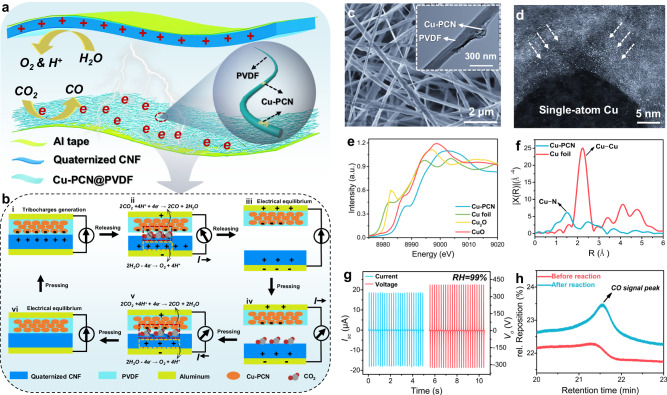
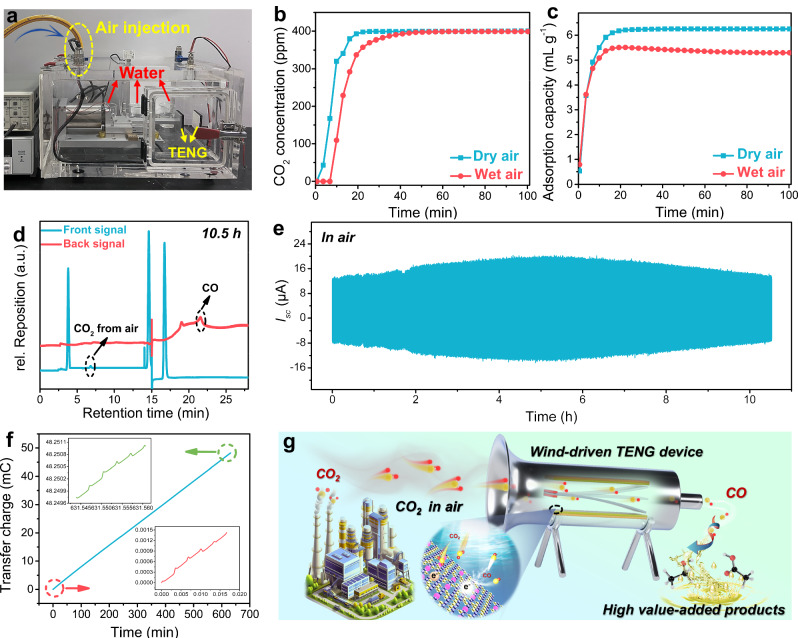
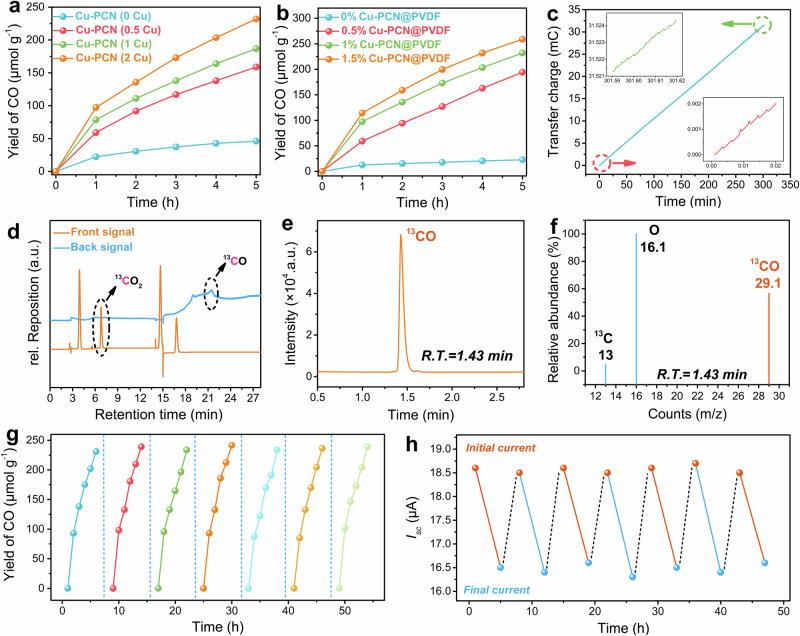
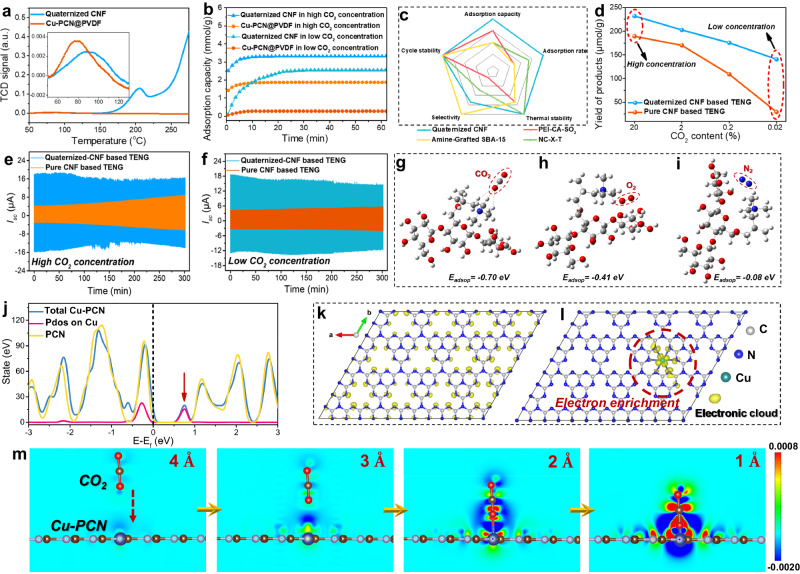
Traditional catalytic techniques often encounter obstacles in the search for sustainable solutions for converting CO into value-added products because of their high energy consumption and expensive catalysts. Here, we introduce a contact-electro-catalysis approach for CO reduction reaction, achieving a CO Faradaic efficiency of 96.24%. The contact-electro-catalysis is driven by a triboelectric nanogenerator consisting of electrospun polyvinylidene fluoride loaded with single Cu atoms-anchored polymeric carbon nitride (Cu-PCN) catalysts and quaternized cellulose nanofibers (CNF). Mechanistic investigation reveals that the single Cu atoms on Cu-PCN can effectively enrich electrons during contact electrification, facilitating electron transfer upon their contact with CO adsorbed on quaternized CNF. Furthermore, the strong adsorption of CO on quaternized CNF allows efficient CO capture at low concentrations, thus enabling the CO reduction reaction in the ambient air. Compared to the state-of-the-art air-based CO reduction technologies, contact-electro-catalysis achieves a superior CO yield of 33 μmol g h. This technique provides a solution for reducing airborne CO emissions while advancing chemical sustainability strategy.
传统催化技术在寻求将一氧化碳转化为高附加值产品的可持续解决方案时常常遇到障碍,因为它们能耗高且催化剂昂贵。在此,我们介绍一种用于一氧化碳还原反应的接触电催化方法,实现了96.24%的一氧化碳法拉第效率。接触电催化由一个摩擦纳米发电机驱动,该发电机由负载有单原子铜锚定的聚合氮化碳(Cu-PCN)催化剂的电纺聚偏二氟乙烯和季铵化纤维素纳米纤维(CNF)组成。机理研究表明,Cu-PCN上的单原子铜在接触起电过程中能有效富集电子,促进其与吸附在季铵化CNF上的一氧化碳接触时的电子转移。此外,一氧化碳在季铵化CNF上的强吸附使得能够在低浓度下有效捕获一氧化碳,从而在环境空气中实现一氧化碳还原反应。与最先进的基于空气的一氧化碳还原技术相比,接触电催化实现了33 μmol g h的优异一氧化碳产率。该技术为减少空气中一氧化碳排放提供了一种解决方案,同时推进了化学可持续发展战略。