Reyes Guillermo, Andrade Betsy, Betancourt Irma, Panchana Fanny, Preciado Cristhian, Bayot Bonny
Centro Nacional de Acuicultura e Investigaciones Marinas, CENAIM, Escuela Superior Politécnica Del Litoral, ESPOL, Guayaquil, Ecuador.
Facultad de Ingeniería Marítima y Ciencias Del Mar, FIMCM, Escuela Superior Politécnica Del Litoral ESPOL, Guayaquil, Ecuador.
Heliyon. 2024 Jun 15;10(12):e33034. doi: 10.1016/j.heliyon.2024.e33034. eCollection 2024 Jun 30.
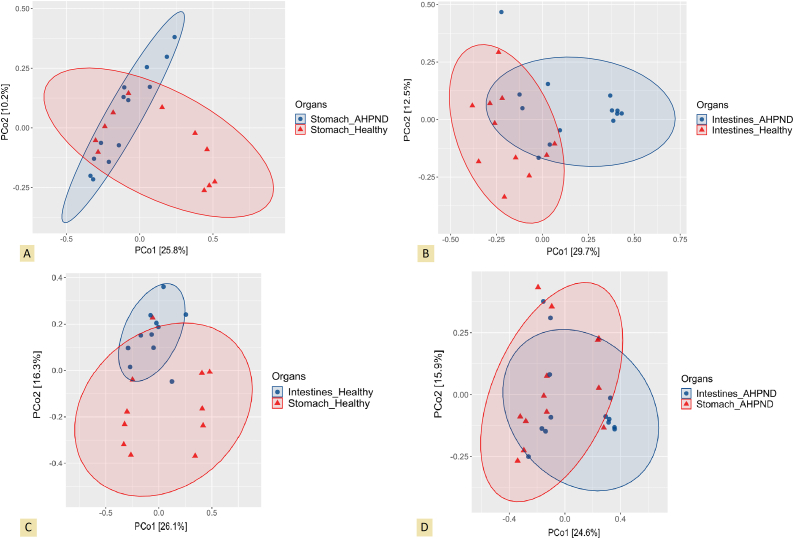
Acute hepatopancreatic necrosis (AHPND) is a severe bacterial disease affecting farmed shrimp. Although various pathogenic bacteria associated with AHPND-affected shrimp have been described, little is known about the bacterial signatures in the stomachs and intestines when the disease occurs naturally. In this study, we characterized the microbiome of by high-throughput sequencing (HTS). Shrimp samples were collected from a commercial farm and divided into two groups: healthy and affected by AHPND, confirmed by PCR. Stomach and intestine samples were subjected to microbiome analysis targeting the V3-V4 region of the gene. PERMANOVA analysis revealed a significant disparity in the bacterial diversity between the stomach and intestine microbiomes of these two health conditions. Our results suggest that the significant abundance of and in the intestines of affected shrimp plays a role in AHPND infection. This imbalance could be mitigated by the presence of , and other members of the phylum Pseudomonadota such as Cellvibrionaceae, Psychromonadaceae, and Halieaceae, which showed significant abundance in healthy intestines. This study highlights the significance of the microbial community in the differentiation of specific microbial signatures in different organs of . These findings offer a deeper understanding of the intricate dynamics within the shrimp microbiome under these conditions, enriching our view of AHPND progression and paving the way toward future identification of probiotics tailored for more efficient management of this disease.
急性肝胰腺坏死病(AHPND)是一种影响养殖对虾的严重细菌性疾病。尽管已经描述了与感染AHPND的对虾相关的各种病原菌,但对于该疾病自然发生时胃和肠道中的细菌特征却知之甚少。在本研究中,我们通过高通量测序(HTS)对[对虾名称未给出]的微生物组进行了表征。从一个商业养殖场收集对虾样本,并分为两组:健康组和经PCR确认感染AHPND的组。对胃和肠道样本进行针对[16S rRNA基因未给出]基因V3 - V4区域的微生物组分析。PERMANOVA分析显示,这两种健康状况下胃和肠道微生物组的细菌多样性存在显著差异。我们的结果表明,感染AHPND的对虾肠道中显著丰富的[细菌名称未给出]和[细菌名称未给出]在AHPND感染中起作用。健康肠道中显著丰富的[细菌名称未给出]、[细菌名称未给出]以及假单胞菌门的其他成员(如纤维弧菌科、嗜冷单胞菌科和盐海菌科)的存在可能会缓解这种失衡。本研究强调了微生物群落对于[对虾名称未给出]不同器官中特定微生物特征分化的重要性。这些发现为深入了解这些条件下对虾微生物组内的复杂动态提供了帮助,丰富了我们对AHPND发病过程的认识,并为未来鉴定用于更有效管理该疾病的益生菌铺平了道路。