School of Physical Education, Nanchang University, Nanchang, China.
Jiangxi Sports Science and Medicine Center, Nanchang, China.
Front Public Health. 2024 Jun 27;12:1345566. doi: 10.3389/fpubh.2024.1345566. eCollection 2024.
It has been suggested that higher levels of fundamental motor skills (FMS) promote the physical health of preschool-aged children. The impacts of structured and unstructured interventions on FMS in children aged 10-16 years have been widely acknowledged in previous studies. However, there is a lack of relevant studies in preschool-aged children.
This meta-analysis aimed to compare the effects of structured and unstructured interventions on FMS in preschool-aged children.
The PubMed, Web of Science, and Google Scholar databases were searched from inception to 1 November 2023 to identify experiments describing structured and unstructured interventions for FMS in preschool-aged children. The Downs and Black Checklist was used to assess the risk of bias. A random effects model was used for the meta-analysis to evaluate the pooled effects of interventions on FMS. Subgroup analyses based on the duration and characteristics of the intervention were conducted to identify sources of heterogeneity.
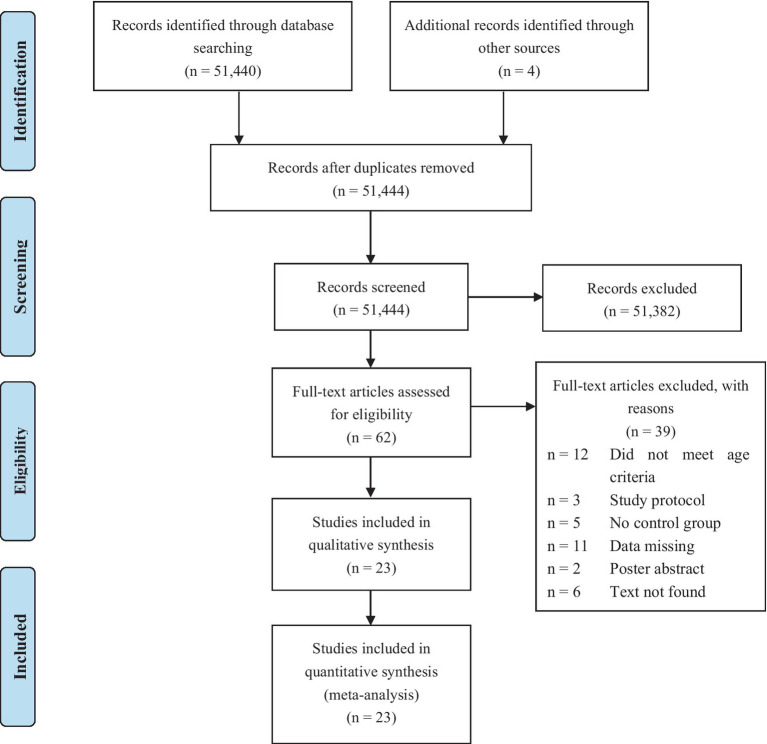
A total of 23 studies with 4,068 participants were included. There were 12 studies examining structured interventions, 9 studies examining unstructured interventions, and 6 studies comparing structured vs. unstructured interventions. The risk of bias in the included studies was generally low. All interventions significantly improved FMS in preschool-aged children compared to control treatments ( < 0.05). Structured interventions had more significant effects on locomotor skills (LMSs) in preschool-aged children than unstructured interventions (Hedges' = 0.44, = 0.04). The effects of structured interventions were strongly influenced by the total intervention duration, such that long-term interventions were more effective (Hedge's = 1.29, < 0.001).
Structured interventions play a crucial role in enhancing FMS among young children, especially when considering LMSs. These interventions require consistent and repeated practice over time to reach proficiency.
PROSPERO, identifier number CRD42023475088, https://www.crd.york.ac.uk/prospero/display_record.php?ID=CRD42023475088.
有人认为,基本运动技能(FMS)水平较高有助于促进学龄前儿童的身体健康。先前的研究广泛承认,结构和非结构干预措施对 10-16 岁儿童 FMS 的影响。然而,学龄前儿童的相关研究却很少。
本荟萃分析旨在比较结构和非结构干预措施对学龄前儿童 FMS 的影响。
从建库到 2023 年 11 月 1 日,我们检索了 PubMed、Web of Science 和 Google Scholar 数据库,以确定描述学龄前儿童 FMS 的结构和非结构干预的实验。采用 Downs 和 Black 清单评估偏倚风险。采用随机效应模型对干预措施对 FMS 的汇总效应进行评估。根据干预的持续时间和特征进行亚组分析,以确定异质性的来源。
共纳入 23 项研究,涉及 4068 名参与者。其中 12 项研究观察结构干预,9 项研究观察非结构干预,6 项研究比较结构与非结构干预。纳入研究的偏倚风险总体较低。与对照治疗相比,所有干预措施均显著提高了学龄前儿童的 FMS( < 0.05)。结构干预对学龄前儿童运动技能(LMSs)的影响明显大于非结构干预(Hedges' = 0.44, = 0.04)。结构干预的效果强烈受到总干预持续时间的影响,即长期干预更为有效(Hedge's = 1.29, < 0.001)。
结构干预在提高幼儿 FMS 方面发挥着重要作用,特别是在考虑运动技能时。这些干预措施需要随着时间的推移持续、反复地进行练习,才能达到熟练程度。
PROSPERO,注册号 CRD42023475088,https://www.crd.york.ac.uk/prospero/display_record.php?ID=CRD42023475088。