Department of Kinesiology, Recreation, and Sport Studies, University of Tennessee, 1914 Andy Holt Ave, Knoxville, TN, 37996, USA.
Washington University of St. Louis, One Brookings Drive, St. Louis, MO, 63130, USA.
BMC Pediatr. 2023 Sep 9;23(1):455. doi: 10.1186/s12887-023-04260-2.
Preschool children are not meeting recommended levels of physical activity (PA) nor are they proficient in fundamental motor skills (FMS), which are the foundation for PA. As such, interventions are needed to increase PA and FMS in young children. This trial examined the effects of an environmental ("painted playgrounds") and capacity-building (written toolkit) intervention on child FMS, PA, and sedentary behavior at early childhood education (ECE) centers and examined feasibility.
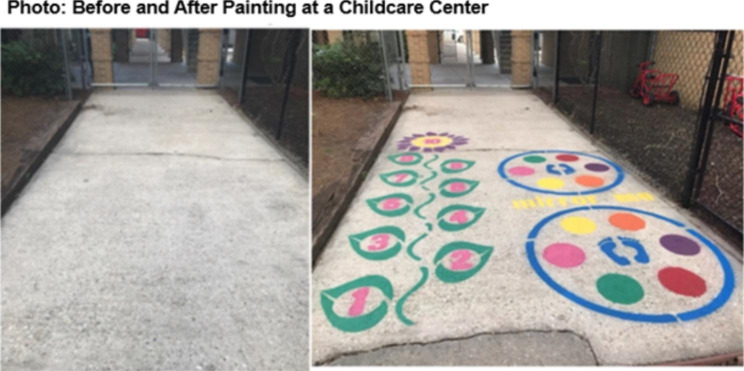
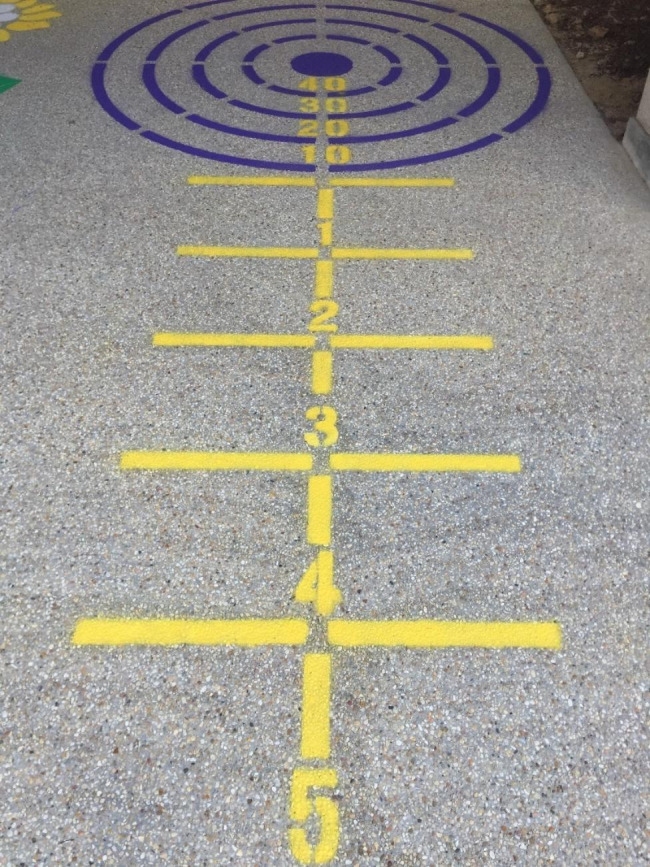
In a randomized controlled trial, four ECE centers were randomly assigned to an intervention group or wait-list control. For intervention centers, stencils were spray painted adjacent to playgrounds and teachers were provided material for using stencils for FMS practice. Follow-up assessments were conducted six to eight weeks after baseline. Time spent in PA and sedentary behavior was assessed via accelerometry and FMS were evaluated using the Test of Gross Motor Development (TGMD-3) at baseline and follow-up. A repeated measures linear model was performed to test the effects of the painted playgrounds on the primary outcomes of interest. Feasibility was measured by stencil engagement via direct observation and satisfaction surveys.
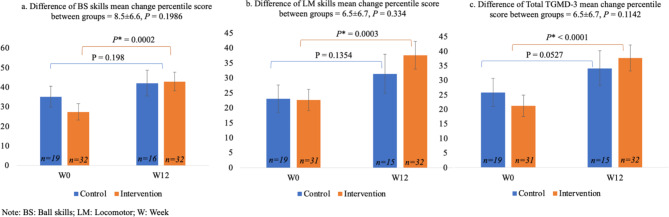
A total of 51 preschoolers completed baseline assessments (4.3±0.6 years; 43.1% male). There were no significant changes in PA or sedentary behavior (all confidence intervals contain 0) between control and intervention groups. Intervention children significantly improved ball skill, locomotor, and overall TGMD-3 percentile scores at follow-up (all (all confidence intervals contain 0), which was not observed in control group. However, there was no significant change in FMS between the control and intervention groups (confidence intervals contain 0). For stencil use, boys and girls interacted with different stencils during their free play. Directors and teachers reported children incorporated academic concepts and initiated games, and teachers prompted more PA opportunities on the playground.
This intervention did not show statistically significant changes in children's PA, FMS, or sedentary behavior compared to a control group; however, small FMS improvements for the intervention group were found from baseline to follow-up. Further work should examine intervention fidelity as well as inexpensive supplies, teacher training, or other strategies to increase preschool children's PA and improve FMS at ECE centers.
学龄前儿童的身体活动(PA)水平未达到推荐标准,也未熟练掌握基本运动技能(FMS),而 FMS 是 PA 的基础。因此,需要采取干预措施来提高幼儿的 PA 和 FMS。本试验研究了环境(“彩绘操场”)和能力建设(书面工具包)干预措施对幼儿 FMS、PA 和久坐行为的影响,并检验了其可行性。
在一项随机对照试验中,将 4 所幼儿教育中心随机分配到干预组或候补对照组。对于干预中心,会在操场附近喷涂模板,并为教师提供使用模板进行 FMS 练习的材料。在基线后 6 至 8 周进行随访评估。通过加速度计评估 PA 和久坐行为的时间,在基线和随访时使用《粗大运动发育测试(TGMD-3)》评估 FMS。采用重复测量线性模型来检验彩绘操场对主要研究结果的影响。通过直接观察和满意度调查来评估模板使用的可行性。
共有 51 名学龄前儿童完成了基线评估(4.3±0.6 岁;43.1%为男性)。在对照组和干预组之间,PA 或久坐行为没有显著变化(所有置信区间均包含 0)。干预组儿童在随访时的球技、移动和总体 TGMD-3 百分位数评分显著提高(所有置信区间均包含 0),但对照组儿童的 FMS 没有显著变化(置信区间包含 0)。在模板使用方面,男孩和女孩在自由游戏中与不同的模板互动。主任和教师报告说,儿童将学术概念融入游戏中,并发起游戏,教师在操场上提示更多的 PA 机会。
与对照组相比,该干预措施并未显示出在儿童 PA、FMS 或久坐行为方面有统计学意义的变化;然而,干预组从基线到随访时 FMS 有较小的改善。进一步的工作应该检查干预措施的一致性,以及廉价的用品、教师培训或其他策略,以增加幼儿在幼儿教育中心的 PA 并改善 FMS。