Student Research Committee, Shiraz University of Medical Sciences, Shiraz, Iran.
Recombinant Proteins Laboratory, Department of Biochemistry, School of Medicine, Shiraz University of Medical Sciences, Shiraz, Iran.
PLoS Negl Trop Dis. 2024 Jul 15;18(7):e0012320. doi: 10.1371/journal.pntd.0012320. eCollection 2024 Jul.
The sensitivity of parasitological and molecular methods is unsatisfactory for the diagnosis of strongyloidiasis, and serological techniques are remaining as the most effective diagnostic approach. The present study aimed to design and produce a chimeric recombinant antigen from Strongyloides stercoralis immunoreactive antigen (SsIR) and Ss1a antigens, using immune-informatics approaches, and evaluated its diagnostic performance in an ELISA system for the diagnosis of human strongyloidiasis.
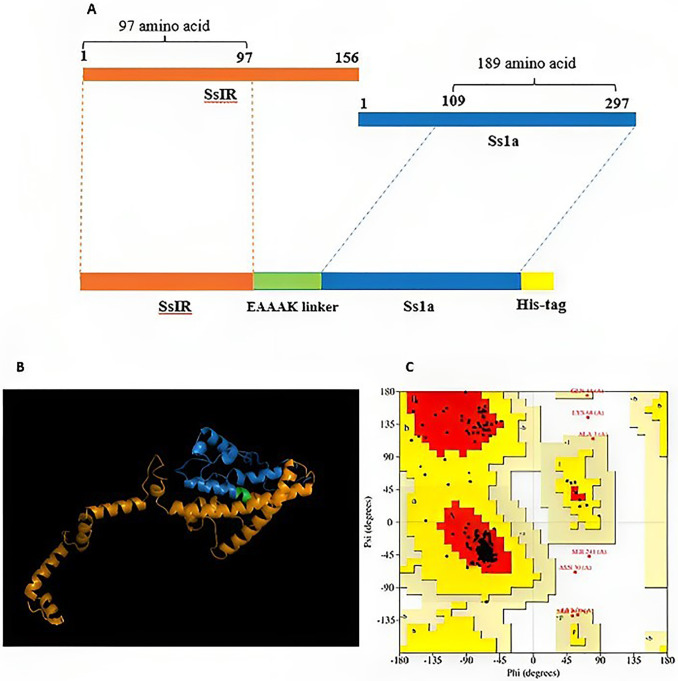
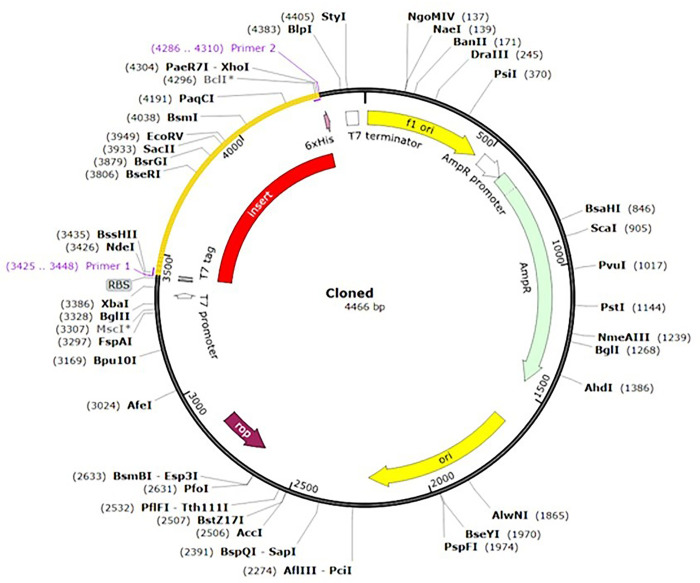
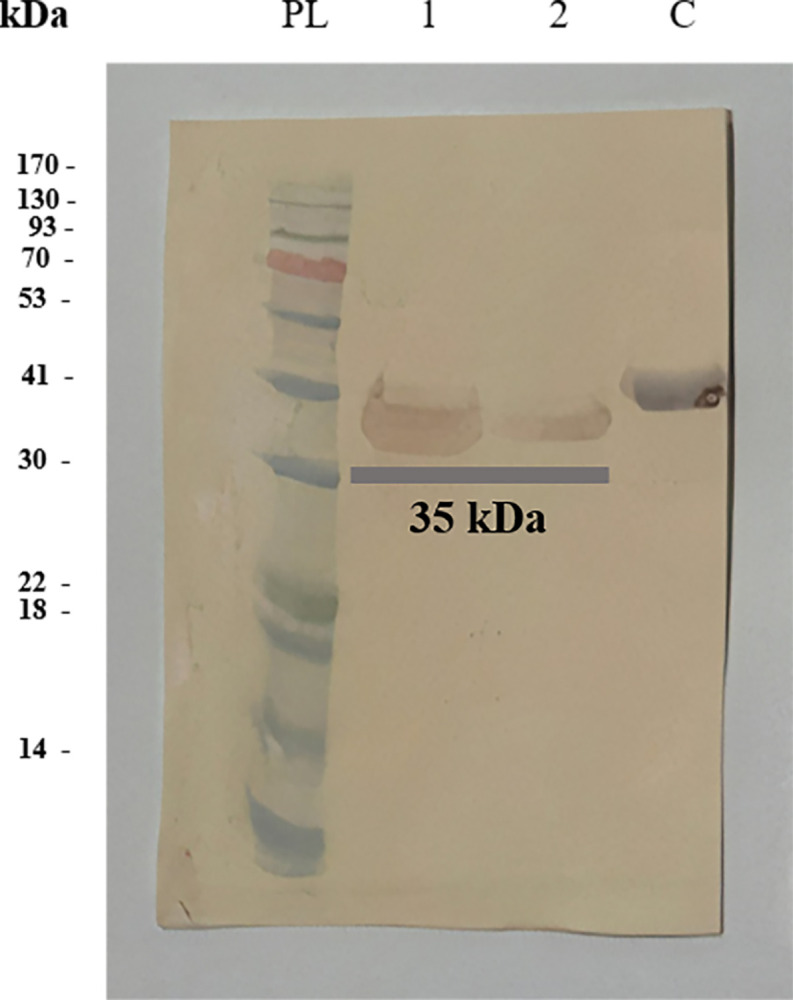
METHODOLOGY/PRINCIPAL FINDINGS: The coding sequences for SsIR and Ss1a were selected from GenBank and were gene-optimized. Using bioinformatics analysis, the regions with the highest antigenicity that did not overlap with other parasite antigens were selected. The chimeric recombinant antigen SsIR- Ss1a, was constructed. The solubility and physicochemical properties of the designed construct were analyzed and its tertiary structures were built and evaluated. The construct was expressed into the pET-23a (+) expression vector and the optimized DNA sequences of SsIR-Ss1a (873 bp) were cloned into competent E. coli DH5α cells. Diagnostic performances of the produced recombinant antigen, along with a commercial kit were evaluated in an indirect ELISA system, using a panel of sera from strongyloidiasis patients and controls. The physicochemical and bioinformatics evaluations revealed that the designed chimeric construct is soluble, has a molecular with of 35 KDa, and is antigenic. Western blotting confirmed the immunoreactivity of the produced chimeric recombinant antigen with the sera of strongyloidiasis patients. The sensitivity and specificity of the indirect ELISA system, using the produced SsIR-Ss1a chimeric antigen, were found to be 93.94% (95% CI, 0.803 to 0.989) and 97.22% (95% CI, 0.921 to 0.992) respectively.
CONCLUSIONS/SIGNIFICANCE: The preliminary findings of this study suggest that the produced SsIR-Ss1a chimeric antigen shows promise in the diagnosis of human strongyloidiasis. However, these results are based on a limited panel of samples, and further research with a larger sample size is necessary to confirm its accuracy. The construct has potential as an antigen in the ELISA system for the serological diagnosis of this neglected parasitic infection, but additional validation is required.
寄生虫学和分子方法的敏感性不能令人满意地诊断类圆线虫病,而血清学技术仍然是最有效的诊断方法。本研究旨在使用免疫信息学方法从类圆线虫免疫反应抗原(SsIR)和 Ss1a 抗原设计和生产嵌合重组抗原,并在 ELISA 系统中评估其对人类类圆线虫病的诊断性能。
方法/主要发现:从 GenBank 中选择 SsIR 和 Ss1a 的编码序列,并进行基因优化。使用生物信息学分析,选择抗原性最高且不与其他寄生虫抗原重叠的区域。构建嵌合重组抗原 SsIR-Ss1a。分析设计构建体的可溶性和物理化学性质,并构建和评估其三级结构。将构建体表达到 pET-23a(+)表达载体中,并将优化的 SsIR-Ss1a(873bp)DNA 序列克隆到感受态 E.coli DH5α细胞中。在间接 ELISA 系统中,使用类圆线虫病患者和对照的血清进行评估,评估产生的重组抗原和商业试剂盒的诊断性能。理化和生物信息学评价表明,设计的嵌合构建体是可溶性的,分子量为 35kDa,具有抗原性。Western blot 证实了产生的嵌合重组抗原与类圆线虫病患者血清的反应性。使用产生的 SsIR-Ss1a 嵌合抗原的间接 ELISA 系统的灵敏度和特异性分别为 93.94%(95%CI,0.803 至 0.989)和 97.22%(95%CI,0.921 至 0.992)。
结论/意义:本研究的初步结果表明,产生的 SsIR-Ss1a 嵌合抗原在诊断人类类圆线虫病方面有很大的希望。然而,这些结果是基于有限的样本组,需要进一步的研究,用更大的样本量来确认其准确性。该构建体具有作为 ELISA 系统中用于诊断这种被忽视的寄生虫感染的血清学诊断的抗原的潜力,但需要进一步验证。