Department of Infectious Tropical Diseases and Microbiology, IRCCS Sacro Cuore Don Calabria Hospital, 37024, Negrar, Verona, Italy.
Clinical Research Unit, IRCCS Sacro Cuore Don Calabria Hospital, 37024, Negrar, Verona, Italy.
Parasit Vectors. 2022 Apr 23;15(1):142. doi: 10.1186/s13071-022-05249-z.
Strongyloidiasis, a nematode infection which is mainly caused by Strongyloides stercoralis in humans, can lead to a fatal syndrome in immunocompromised individuals. Its diagnosis is challenging due to the absence of a diagnostic gold standard. The infection is highly prevalent in migrants from endemic countries in tropical and subtropical areas, and a rapid diagnostic test would be helpful for screening purposes. The aim of this study was to estimate the accuracy of a novel immunochromatographic test (ICT) for the diagnosis of S. stercoralis infection.
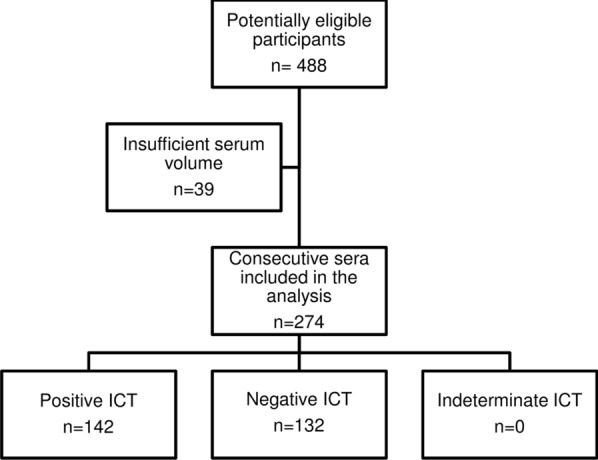
A single-centre diagnostic accuracy study was undertaken using well-characterized frozen sera available from the biobank of a referral hospital for parasitic diseases in Italy. The included sera were from migrants from sub-Saharan Africa, and matching results were available for agar plate culture and/or polymerase chain reaction for S. stercoralis; moreover, the results of both a commercial enzyme-linked immunosorbent assay test and an in-house immunofluorescence test for strongyloidiasis were made available. Laboratory staff who read the ICT results were blinded as regards the results of the other tests. Two readers independently read the ICT, and a third one was involved when results were discrepant. The accuracy of the ICT was assessed both against the results of the panel of faecal tests and by latent class analysis (LCA).
Agreement between the readers was excellent [Cohen's κ = 92.7%, 95% confidence interval (CI) 88.3-97.1%]. When assessed against the results of the faecal tests, the sensitivity and specificity of the ICT were 82.4% (95% CI 75.7-89.0%) and 73.8% (95% CI 66.8-80.9%), respectively. According to the LCA, the sensitivity and specificity were 86.3% (95% CI 80.1-92.5%) and 73.9% (95% CI 67.0-80.8%), respectively.
The results of the ICT demonstrated ease of interpretation. The accuracy proved good, though the sensitivity might be further improved for screening purposes.
旋毛虫病是一种主要由人体中的 Strongyloides stercoralis 引起的线虫感染,可导致免疫功能低下个体发生致命综合征。由于缺乏诊断金标准,其诊断具有挑战性。该感染在来自热带和亚热带流行国家的移民中高度流行,快速诊断测试将有助于筛查目的。本研究旨在评估一种新型免疫层析检测(ICT)诊断 S. stercoralis 感染的准确性。
采用意大利寄生虫病转诊医院生物库中具有明确特征的冷冻血清进行单中心诊断准确性研究。纳入的血清来自撒哈拉以南非洲移民,与琼脂平板培养和/或聚合酶链反应检测 S. stercoralis 的结果相匹配;此外,还提供了商业酶联免疫吸附试验检测和用于旋毛虫病的内部免疫荧光检测的结果。读取 ICT 结果的实验室工作人员对其他检测结果不知情。两位读者独立读取 ICT,当结果不一致时,第三位读者参与。通过对粪便检测结果和潜在类别分析(LCA)评估 ICT 的准确性。
两位读者之间的一致性极好[Cohen's κ=92.7%,95%置信区间(CI)88.3-97.1%]。当与粪便检测结果进行比较时,ICT 的敏感性和特异性分别为 82.4%(95%CI 75.7-89.0%)和 73.8%(95%CI 66.8-80.9%)。根据 LCA,敏感性和特异性分别为 86.3%(95%CI 80.1-92.5%)和 73.9%(95%CI 67.0-80.8%)。
ICT 的结果易于解释。准确性证明良好,尽管为了筛查目的,敏感性可能会进一步提高。