School of Public Health (Shenzhen), Shenzhen Campus of Sun Yat-sen University, Shenzhen, Guangdong, China.
Department of Rehabilitation Medicine, Dongguan Eighth People's Hospital, Dongguan, Guangdong, China.
CNS Neurosci Ther. 2024 Jul;30(7):e14859. doi: 10.1111/cns.14859.
The objective of this study is to explore potential differences in brain functional networks at baseline between individuals with progressive subjective cognitive decline (P-SCD) and stable subjective cognitive decline (S-SCD), as well as to identify potential indicators that can effectively distinguish between P-SCD and S-SCD.
Alzheimer's Disease Neuroimaging Initiative (ADNI) database was utilized to enroll SCD individuals with a follow-up period of over 3 years. This study included 39 individuals with S-SCD, 15 individuals with P-SCD, and 45 cognitively normal (CN) individuals. Brain functional networks were constructed based on the AAL template, and graph theory analysis was performed to determine the topological properties.
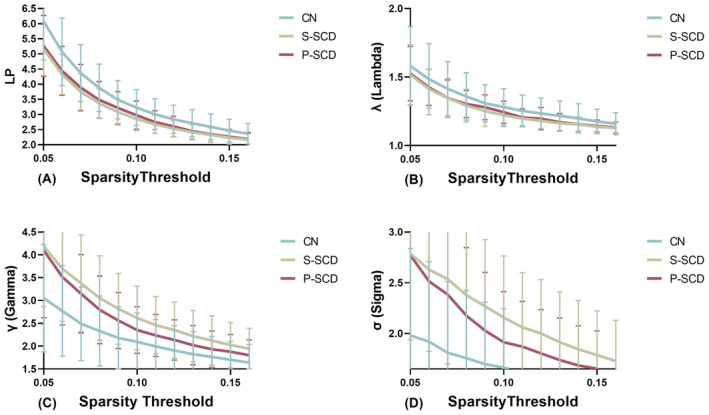
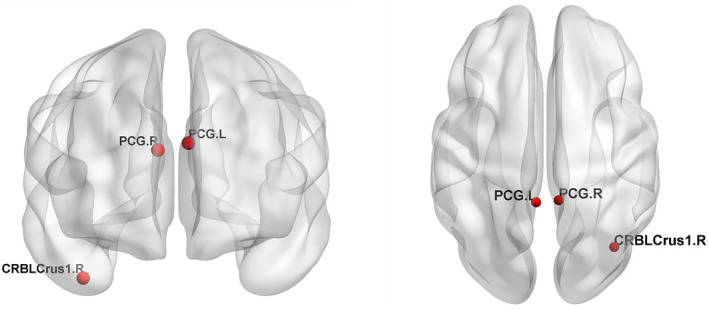
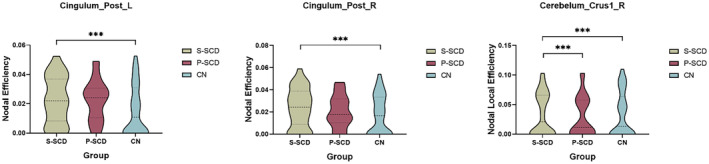
For global metric, the S-SCD group exhibited stronger small-worldness with reduced connectivity among nearby nodes and accelerated compensatory information transfer capacity. For nodal efficiency, the S-SCD group showed increased connectivity in bilateral posterior cingulate gyri (PCG). However, for nodal local efficiency, the P-SCD group exhibited significantly reduced connectivity in the right cerebellar Crus I compared with the S-SCD group.
There are differences in brain functional networks at baseline between P-SCD and S-SCD groups. Furthermore, the right cerebellar Crus I region may be a potentially useful brain area to distinguish between P-SCD and S-SCD.
本研究旨在探索基线时进展性主观认知衰退(P-SCD)和稳定主观认知衰退(S-SCD)个体之间大脑功能网络的潜在差异,并确定可有效区分 P-SCD 和 S-SCD 的潜在指标。
利用阿尔茨海默病神经影像学倡议(ADNI)数据库招募随访时间超过 3 年的 SCD 个体。本研究纳入了 39 名 S-SCD 患者、15 名 P-SCD 患者和 45 名认知正常(CN)个体。基于 AAL 模板构建脑功能网络,并进行图论分析以确定拓扑特性。
在全局度量方面,S-SCD 组表现出更强的小世界特性,节点间连接减少,信息传递能力加快。在节点效率方面,S-SCD 组双侧后扣带回的连接性增加。然而,在节点局部效率方面,与 S-SCD 组相比,P-SCD 组右侧小脑 Crus I 的连接性显著降低。
P-SCD 和 S-SCD 组之间在基线时的大脑功能网络存在差异。此外,右侧小脑 Crus I 区域可能是区分 P-SCD 和 S-SCD 的一个潜在有用的脑区。