Ong Clarence, Cook Alex R, Tan Ker-Kan, Wang Yi
Saw Swee Hock School of Public Health, National University of Singapore and National University Health System, Singapore, Singapore.
Department of Surgery, Yong Loo Lin School of Medicine, National University of Singapore, Singapore, Singapore.
JMIR Public Health Surveill. 2024 Jul 17;10:e53200. doi: 10.2196/53200.
Colorectal cancer (CRC) is the second most deadly form of cancer, inducing an estimated 1.9 million incidence cases and 0.9 million deaths worldwide in 2020. Despite the availability of screening tests, their uptake remains suboptimal. However, blood-based tests that look for signs of cancer-specific markers in the body are increasingly available as an alternative for more invasive tests for cancer. Compared with existing tests, the benefits of blood-based tests for CRC include not needing pretest preparation, stool handling, and dietary or medication restrictions.
This study aims to explore the population's preferences for CRC screening tests, with a focus on blood-based tests, and investigate the factors influencing test uptake.
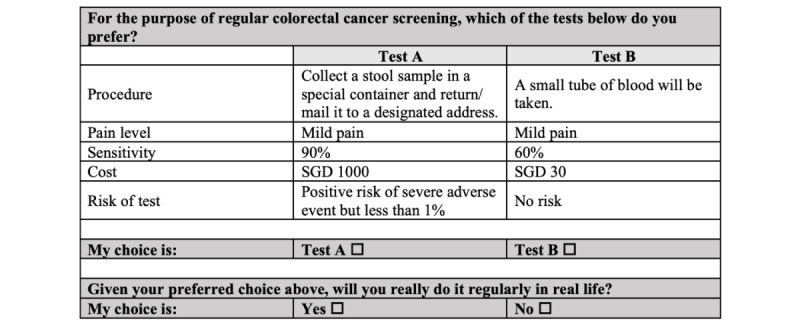
We used a mixed methods approach, combining semistructured interviews and a discrete choice experiment (DCE) survey. Interviews were analyzed using thematic analysis to identify salient attributes for CRC screening tests. These attributes informed the design of the DCE survey. The DCE data were analyzed using mixed logit and mixed-mixed multinomial logit models.
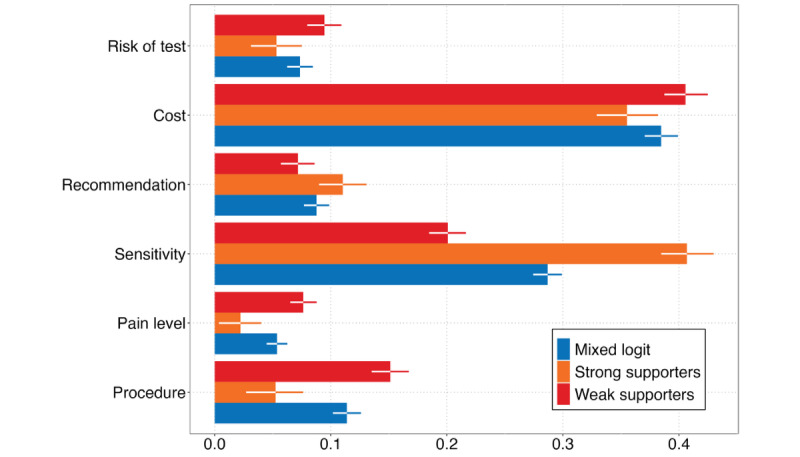
Qualitative findings from 30 participants revealed that participants preferred blood-based tests due to their perceived low risk, minimal pain, and ease of sample collection. However, concerns about the test's lower accuracy were also expressed. The DCE survey was completed by 1189 participants. In the mixed logit model, participants demonstrated a stronger preference for blood-based tests over a 2-day stool-based test. The mixed-mixed multinomial logit model identified 2 classes, strong supporters and weak supporters, for CRC screening. Weak supporters, but not strong supporters, had a higher preference for blood-based tests. Women, ethnic Chinese, and people aged 40 to 60 years were more likely to be weak supporters. Both models highlighted the high influence of cost and test sensitivity on participants' preferences. Transitioning from a 2-day stool-based test to a blood-based test, assuming a national screening program at a base price of Singapore $5 (US $3.75), was estimated to have the potential to increase the relative uptake by 5.9% (95% CI 3.6%-8.2%).
These findings contribute to our understanding of CRC screening preferences and provide insights into the factors driving test uptake. This study highlights the perceived advantages of blood-based tests and identifies areas of concern regarding their accuracy. Further research is needed to determine the actual increase in uptake rate when blood-based tests are made available.
结直肠癌(CRC)是第二大致命癌症形式,2020年全球估计有190万例发病病例和90万例死亡病例。尽管有筛查测试,但它们的接受程度仍不理想。然而,检测体内癌症特异性标志物迹象的血液检测作为侵入性更强的癌症检测替代方法越来越普遍。与现有检测相比,用于结直肠癌的血液检测的好处包括无需检测前准备、粪便处理以及饮食或药物限制。
本研究旨在探讨人群对结直肠癌筛查测试的偏好,重点关注血液检测,并调查影响检测接受度的因素。
我们采用混合方法,结合半结构化访谈和离散选择实验(DCE)调查。使用主题分析对访谈进行分析,以确定结直肠癌筛查测试的显著属性。这些属性为DCE调查的设计提供了依据。使用混合逻辑模型和混合混合多项逻辑模型对DCE数据进行分析。
30名参与者的定性研究结果表明,参与者因认为血液检测风险低、疼痛小且样本采集容易而更喜欢血液检测。然而,也有人对检测准确性较低表示担忧。1189名参与者完成了DCE调查。在混合逻辑模型中,与为期两天的粪便检测相比,参与者对血液检测表现出更强的偏好。混合混合多项逻辑模型确定了结直肠癌筛查的两类人群,即强烈支持者和微弱支持者。微弱支持者而非强烈支持者对血液检测的偏好更高。女性、华裔和40至60岁的人更有可能是微弱支持者。两个模型都强调了成本和检测敏感性对参与者偏好的高度影响。假设以新加坡5新元(3.75美元)的底价开展全国性筛查项目,从为期两天的粪便检测过渡到血液检测,估计有可能使相对接受度提高(95%置信区间为3.6%-8.2%)。
这些发现有助于我们理解结直肠癌筛查偏好,并提供对推动检测接受度的因素的见解。本研究突出了血液检测的感知优势,并确定了对其准确性的关注领域。需要进一步研究以确定提供血液检测时接受率的实际提高情况。