Huzhou Central Hospital, Affiliated Central Hospital Huzhou University, Huzhou, Zhejiang Province, China.
Fifth School of Clinical Medicine of Zhejiang Chinese Medical University (Huzhou Central Hospital), Huzhou, Zhejiang Province, China.
BMC Microbiol. 2024 Jul 18;24(1):264. doi: 10.1186/s12866-024-03416-z.
More than 90% of colorectal cancer (CRC) arises from advanced adenomas (AA) and gut microbes are closely associated with the initiation and progression of both AA and CRC.
To analyze the characteristic microbes in AA.
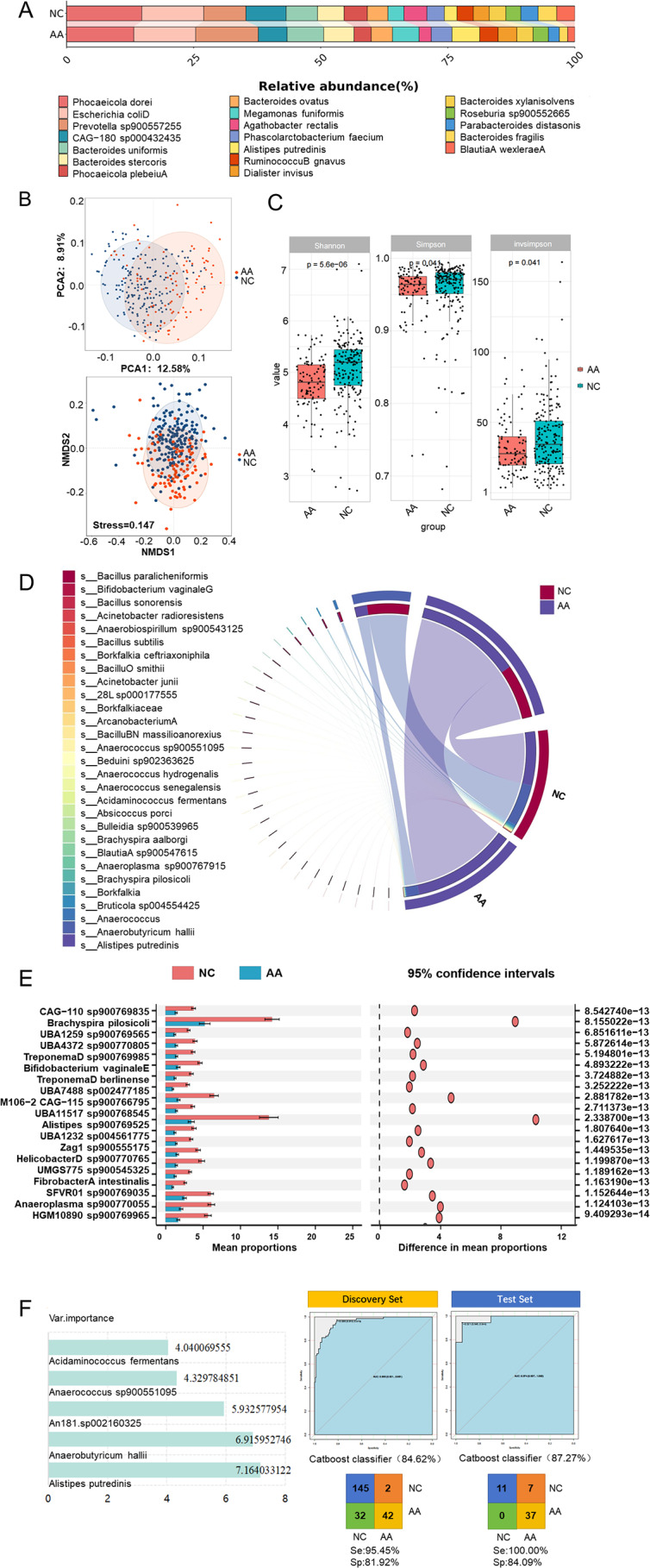
Fecal samples were collected from 92 AA and 184 negative control (NC). Illumina HiSeq X sequencing platform was used for high-throughput sequencing of microbial populations. The sequencing results were annotated and compared with NCBI RefSeq database to find the microbial characteristics of AA. R-vegan package was used to analyze α diversity and β diversity. α diversity included box diagram, and β diversity included Principal Component Analysis (PCA), principal co-ordinates analysis (PCoA), and non-metric multidimensional scaling (NMDS). The AA risk prediction models were constructed based on six kinds of machine learning algorithms. In addition, unsupervised clustering methods were used to classify bacteria and viruses. Finally, the characteristics of bacteria and viruses in different subtypes were analyzed.
The abundance of Prevotella sp900557255, Alistipes putredinis, and Megamonas funiformis were higher in AA, while the abundance of Lilyvirus, Felixounavirus, and Drulisvirus were also higher in AA. The Catboost based model for predicting the risk of AA has the highest accuracy (bacteria test set: 87.27%; virus test set: 83.33%). In addition, 4 subtypes (B1V1, B1V2, B2V1, and B2V2) were distinguished based on the abundance of gut bacteria and enteroviruses (EVs). Escherichia coli D, Prevotella sp900557255, CAG-180 sp000432435, Phocaeicola plebeiuA, Teseptimavirus, Svunavirus, Felixounavirus, and Jiaodavirus are the characteristic bacteria and viruses of 4 subtypes. The results of Catboost model indicated that the accuracy of prediction improved after incorporating subtypes. The accuracy of discovery sets was 100%, 96.34%, 100%, and 98.46% in 4 subtypes, respectively.
Prevotella sp900557255 and Felixounavirus have high value in early warning of AA. As promising non-invasive biomarkers, gut microbes can become potential diagnostic targets for AA, and the accuracy of predicting AA can be improved by typing.
超过 90%的结直肠癌(CRC)源于高级腺瘤(AA),肠道微生物与 AA 和 CRC 的发生和发展密切相关。
分析 AA 中的特征微生物。
收集了 92 个 AA 和 184 个阴性对照(NC)的粪便样本。使用 Illumina HiSeq X 测序平台对微生物种群进行高通量测序。将测序结果与 NCBI RefSeq 数据库进行注释比较,以找到 AA 的微生物特征。使用 R-vegan 包分析 α多样性和β多样性。α多样性包括箱线图,β多样性包括主成分分析(PCA)、主坐标分析(PCoA)和非度量多维尺度分析(NMDS)。基于 6 种机器学习算法构建 AA 风险预测模型。此外,使用无监督聚类方法对细菌和病毒进行分类。最后,分析不同亚型中细菌和病毒的特征。
在 AA 中,Prevotella sp900557255、Alistipes putredinis 和 Megamonas funiformis 的丰度较高,而在 AA 中,Lilyvirus、Felixounavirus 和 Drulisvirus 的丰度也较高。基于 Catboost 的 AA 风险预测模型的准确性最高(细菌测试集:87.27%;病毒测试集:83.33%)。此外,根据肠道细菌和肠病毒(EV)的丰度,区分出 4 种亚型(B1V1、B1V2、B2V1 和 B2V2)。Escherichia coli D、Prevotella sp900557255、CAG-180 sp000432435、Phocaeicola plebeiuA、Teseptimavirus、Svunavirus、Felixounavirus 和 Jiaodavirus 是 4 种亚型的特征细菌和病毒。Catboost 模型的结果表明,在纳入亚型后,预测的准确性有所提高。在 4 种亚型中,发现集的准确率分别为 100%、96.34%、100%和 98.46%。
Prevotella sp900557255 和 Felixounavirus 在 AA 的早期预警中有很高的价值。作为有前途的非侵入性生物标志物,肠道微生物可以成为 AA 的潜在诊断靶点,通过分型可以提高预测 AA 的准确性。