Department of Radiation Oncology, NewYork-Presbyterian Brooklyn Methodist Hospital, Brooklyn, NY, USA.
Division of Clinical Trials and Biostatistics, Department of Quantitative Health Sciences, Mayo Clinic, Rochester, MN, USA.
BMC Urol. 2024 Jul 25;24(1):151. doi: 10.1186/s12894-024-01506-8.
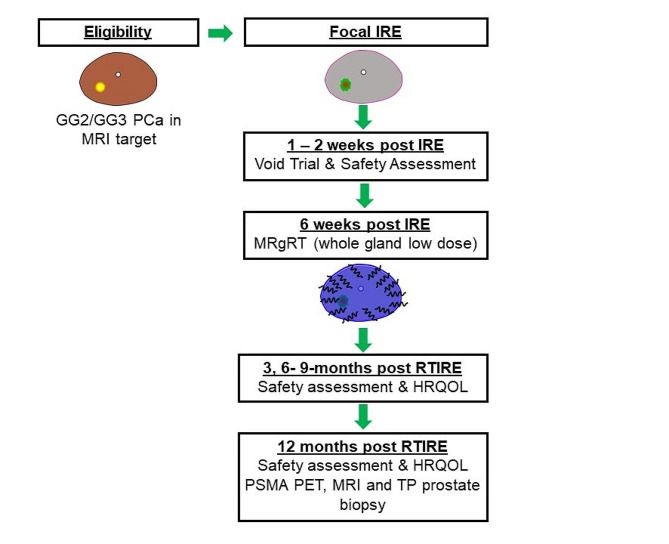
Radiation Therapy and IRreversible Electroporation for Intermediate Risk Prostate Cancer (RTIRE) is a phase II clinical trial testing combination of radiation therapy and irreversible electroporation for intermediate risk prostate cancer BACKGROUND: PCa is the most common non-cutaneous cancer in men and the second leading cause of cancer death in men. PCa treatment is associated with long term side effects including urinary, sexual, and bowel dysfunction. Management of PCa is based on risk stratification to prevent its overtreatment and associated treatment-related toxicity. There is increasing interest in novel treatment strategies, such as focal therapy, to minimize treatment associated morbidity. Focal therapy alone has yet to be included in mainstream guidelines, given ongoing concerns with potentially higher risk of recurrence. We hypothesize combining focal therapy with whole gland, reduced dose radiotherapy will provide acceptable oncologic efficacy with minimal treatment associated morbidity. RTIRE is a phase II single institution, investigator-initiated study combining a local ablative technique though local irreversible electroporation (IRE) with MR guided RT (MRgRT) to treat the entire prostate. The goal is to provide excellent oncologic outcomes and minimize treatment related side effects through leveraging benefits of locally ablative therapy with established radiation treatment techniques.
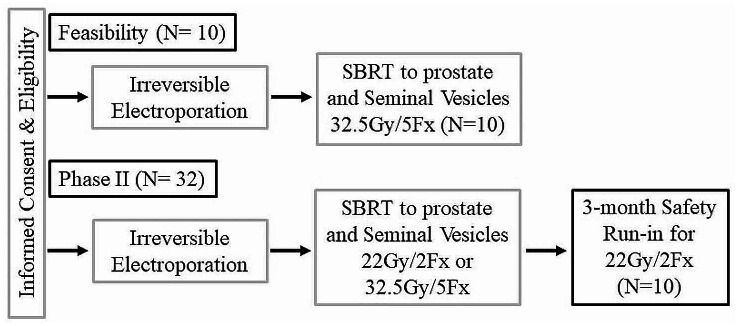
A total of 42 men with intermediate risk PCa per NCCN guidelines and focal grade group (GG) 2 or 3, Gleason Score (GS) 3 + 4 or GS 4 + 3, cancer in an MRI target will be enrolled. Patients with MRI visible foci of GG2/GG3 will undergo focal therapy with IRE of this lesion. Following successful focal therapy, patients will then undergo a course of reduced dose, whole gland MRgRT with either 32.5 Gy in 5 Fractions or 22 Gy in 2 fractions. The primary objective of the study is to determine safety. Secondary outcomes include evaluation of oncologic efficacy (as measured by the proportion of patients free of clinically significant cancer as defined as > Grade Group 1 at 1-year follow-up biopsy), imaging characteristics of patients pre and post RTIRE, impact on quality of life (QoL), and PSA kinetics.
Combining IRE with a reduced dose radiotherapy may offer a new treatment paradigm for PCa by both reducing treatment effects of full dose radiotherapy and minimizing the risk of recurrence observed with focal therapy.
Clinicaltrials.gov identifier: NCT05345444. Date of registration: April 25, 2022.
6.0, July 7, 2023.
《放疗与不可逆电穿孔治疗中危前列腺癌(RTIRE)》是一项 II 期临床试验,旨在测试放疗与不可逆电穿孔联合治疗中危前列腺癌。
前列腺癌是男性最常见的非皮肤癌,也是男性癌症死亡的第二大主要原因。前列腺癌的治疗会伴随长期的副作用,包括尿失禁、性功能障碍和肠道功能障碍。前列腺癌的治疗基于风险分层,以防止过度治疗和相关的治疗毒性。人们对新的治疗策略越来越感兴趣,例如聚焦治疗,以尽量减少与治疗相关的发病率。由于潜在复发风险较高,聚焦治疗尚未被纳入主流指南。我们假设,将局部消融技术(局部不可逆电穿孔(IRE))与磁共振引导放疗(MRgRT)相结合,对整个前列腺进行治疗,可结合局灶性治疗,减少全腺体放疗剂量,从而在最小化治疗相关发病率的同时,提供可接受的肿瘤学疗效。RTIRE 是一项由研究者发起的 II 期单机构研究,旨在通过 MRI 引导的放疗(MRgRT)联合局部消融技术(IRE)治疗整个前列腺,该技术是局部不可逆电穿孔(IRE)。其目的是通过利用局部消融治疗的益处与已确立的放射治疗技术相结合,提供卓越的肿瘤学结果并最小化治疗相关副作用。
根据 NCCN 指南,共招募 42 名中危前列腺癌患者,其局部分级组(GG)为 2 或 3,Gleason 评分(GS)为 3+4 或 4+3,且 MRI 靶区内有癌症。MRI 可见 GG2/GG3 病灶的患者将接受该病灶的IRE 局部治疗。在成功进行局部治疗后,患者将接受低剂量、全腺体 MRgRT 治疗,包括 32.5Gy 分 5 次或 22Gy 分 2 次。该研究的主要目的是确定安全性。次要结局包括评估肿瘤学疗效(通过 1 年随访活检定义为无临床显著癌症的患者比例来衡量,定义为 > 1 级 GG)、RTIRE 前后患者的影像学特征、对生活质量(QoL)的影响和 PSA 动力学。
IRE 联合低剂量放疗可能为前列腺癌提供一种新的治疗模式,既能降低全剂量放疗的治疗效果,又能降低聚焦治疗观察到的复发风险。
ClinicalTrials.gov 标识符:NCT05345444。注册日期:2022 年 4 月 25 日。
6.0,2023 年 7 月 7 日。