Universidad Nacional Mayor de San Marcos, Estación IVITA Pucallpa, Instituto Veterinario de Investigaciones Tropicales y de Altura, Pucallpa, Peru.
Universidad Nacional Mayor de San Marcos, Facultad de Medicina Veterinaria, Laboratorio de embriología, histología y patología animal, Lima, Peru.
Open Vet J. 2024 Jun;14(6):1384-1393. doi: 10.5455/OVJ.2024.v14.i6.6. Epub 2024 Jun 30.
There is no evidence of peptides-probiotics symbiosis as supplements in aquafeeds.
To evaluate the effect of peptides and probiotics supplementation via diet on blood parameters and growth performance of juvenile , an Amazonian fish, during the growth-out phase.
120 juvenile (242.77 g) were placed into twelve 200-l tanks (10 fish/tank), housed in an indoor open system with constant water renovation (flow rate:1.50 l/minute). The experiment used a completely randomized design with a 4 × 5 factorial arrangement [4 doses of supplementation (CD: commercial diet; PepD: CD+1.50% of peptides per CD weight; ProD: CD+40.00 ml of activated probiotics per kg of diet ( spp., spp., spp.); PepProD: CD+Pep+Pro); 5 sampling times (zero, second, fourth, sixth, and eighth week); = 3]. Fish were fed twice a day at a feeding rate of 1% of body weight. At each sampling time, blood was collected and fish were measured for growth performance analysis. Data were analyzed by using two-way ANOVA and Tukey's test ( < 0.05).
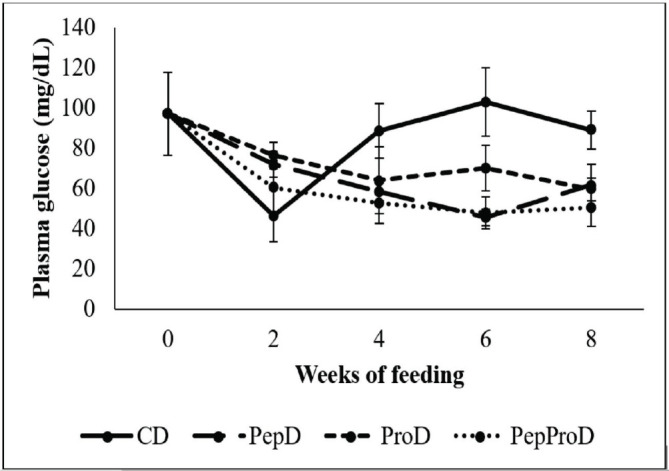
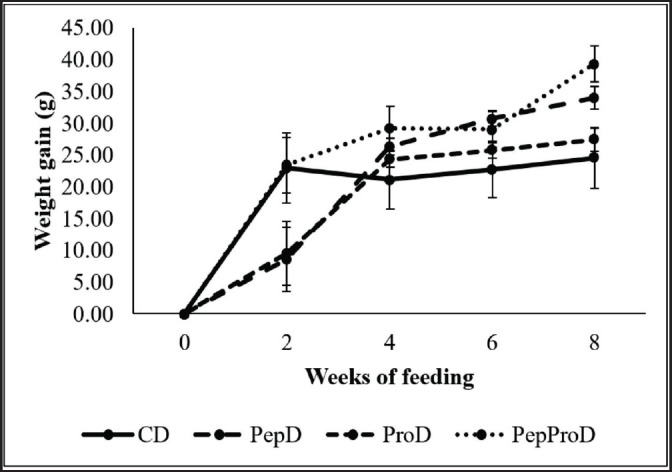
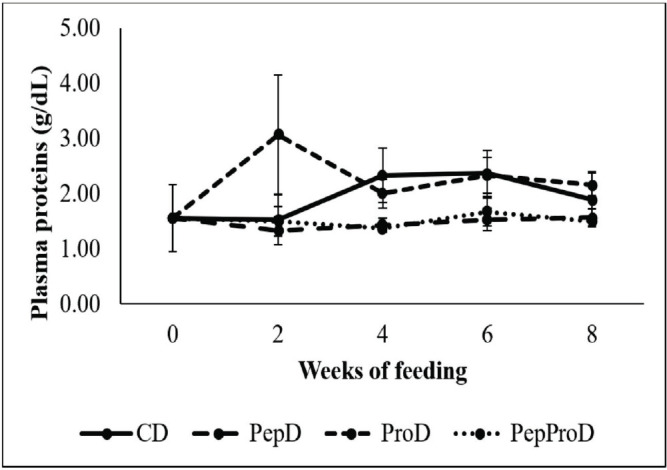
The values of hematocrit (18.31%), leukocytes (1,216.67 mm), neutrophils (81.27%), lymphocytes (18.73%), albumin (1.08 g/dl), relative growth rate (1.002%/day), and the Fulton allometric condition factor (2.03) remained constant throughout the experiment ( > 0.05). Plasma glucose decreased for all fish in the second week (59.56 mg/dl); then, that level increased in fish fed with the CD (89.00 mg/dl), while fish fed with PepD, ProD, and PepProD showed constant values (57.22 mg/dl). The plasma protein levels were constant in fish fed with the PepD and PepProD, ( > 0.05), while fish fed with the CD and ProD showed non-constant and higher values. At the end of the trial, fish fed with the PepProD showed the highest weight gain and the lowest feed conversion rate (39.66 g; 0.97).
It is possible to maintain the stability of plasma glucose and plasma protein by supplementing diets with peptides, but the peptides-probiotics symbiosis administrated via diet contributes to maintaining the stability of plasma glucose and plasma protein and to improve the growth performance of juvenile during the growth-out phase.
在水产饲料中,尚无肽-益生菌共生体作为补充物的证据。
评估通过饮食补充肽和益生菌对亚马逊鱼类幼鱼血液参数和生长性能的影响,在生长阶段。
将 120 条幼鱼(242.77 g)放入 12 个 200 升的水箱(10 条/箱)中,在室内开放式系统中饲养,水不断更新(流速:1.50 升/分钟)。该实验采用完全随机设计,具有 4×5 因子排列[4 种补充剂量(CD:商业饮食;PepD:CD 重量的 1.50%肽;ProD:CD 重量的 40.00 ml 活性益生菌/kg 饮食( spp., spp., spp.);PepProD:CD+Pep+Pro);5 个采样时间(零、第二、第四、第六和第八周);=3]。鱼每天喂食两次,喂食量为体重的 1%。在每个采样时间,采集血液并测量鱼的生长性能分析。使用双因素方差分析和 Tukey 检验分析数据( < 0.05)。
整个实验过程中,红细胞压积(18.31%)、白细胞(1,216.67 mm)、中性粒细胞(81.27%)、淋巴细胞(18.73%)、白蛋白(1.08 g/dl)、相对生长率(1.002%/天)和富尔顿等比生长系数(2.03)保持不变( > 0.05)。第二周所有鱼的血浆葡萄糖水平下降(59.56 mg/dl);然后,CD 喂养的鱼的血糖水平升高(89.00 mg/dl),而 PepD、ProD 和 PepProD 喂养的鱼的血糖水平保持不变(57.22 mg/dl)。PepD 和 PepProD 喂养的鱼的血浆蛋白水平保持不变( > 0.05),而 CD 和 ProD 喂养的鱼的血浆蛋白水平则保持不变且较高。试验结束时,PepProD 喂养的鱼体重增加最高,饲料转化率最低(39.66 g;0.97)。
通过饮食补充肽可以维持血浆葡萄糖和血浆蛋白的稳定性,但肽-益生菌共生体通过饮食给药有助于维持血浆葡萄糖和血浆蛋白的稳定性,并提高亚马逊鱼类幼鱼在生长阶段的生长性能。