Velez Maria João, Marujo Helena A, Charepe Zaida, Querido Ana, Laranjeira Carlos
Department of Human Resources and Organizational Behavior, ISCTE-Instituto Universitário de Lisboa, Avenida das Forças Armadas, 1649-026 Lisboa, Portugal.
Instituto Superior de Ciências Sociais e Políticas, Centro de Administração e Políticas Públicas (CAPP), Universidade de Lisboa, Rua Almerindo Lessa, 1300-663 Lisboa, Portugal.
Eur J Investig Health Psychol Educ. 2024 Jul 22;14(7):2101-2115. doi: 10.3390/ejihpe14070140.
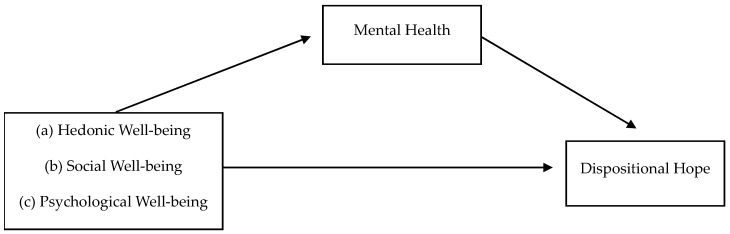
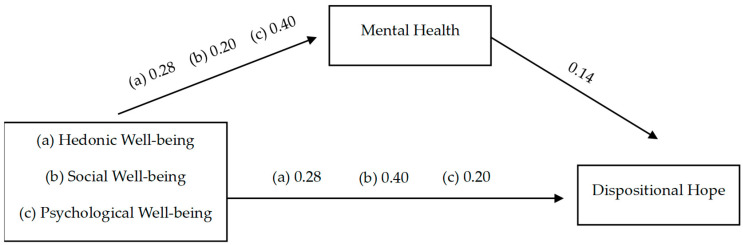
In our pursuit of a fulfilling and contented life, the study of well-being has emerged as a fundamental field of research. Higher levels of well-being are associated with better mental health outcomes. Individuals with better mental health might possess the personal resources necessary to set and pursue meaningful goals, maintain positive expectations, and overcome adversities. We aim to explore the positive relationship between well-being (hedonic, psychological, and social) and dispositional hope. We suggest that mental health acts as a mediator in this relationship, since improved mental health can create a conducive environment for the development and maintenance of dispositional hope. Data were collected using an e-survey through social media during the last quarter of 2022. The hypothesis of this study was tested using mediation analysis. The sample was composed of 471 participants (85.4% female) with a mean age of 47.72 ± 11.86 years. Participants were mainly workers (88.6%), followed by pensioners (6.8%), university students (2.5%), and unemployed (2.1%). Results revealed that well-being was positively and significantly associated with dispositional hope. Additionally, well-being presented a significant and positive relationship with mental health, which, in turn, also presented a significant and positive relationship with dispositional hope. Finally, using the Hayes process macro for SPSS, we found that mental health mediates the relationship between well-being and dispositional hope. Our findings reinforce the conceptual frameworks that consider well-being and mental health as key contributors to a resilient and optimistic mindset. Interventions that aim to cultivate positive affect, facilitate personal growth, and foster supportive social environments might help improve mental health outcomes.
在我们追求充实而满足的生活过程中,幸福感研究已成为一个基础研究领域。更高水平的幸福感与更好的心理健康结果相关联。心理健康状况较好的个体可能拥有设定和追求有意义目标、保持积极期望以及克服逆境所需的个人资源。我们旨在探讨幸福感(享乐、心理和社会层面)与特质性希望之间的正向关系。我们认为心理健康在这种关系中起中介作用,因为心理健康状况的改善可为特质性希望的发展和维持创造有利环境。数据于2022年最后一个季度通过社交媒体电子调查收集。本研究的假设通过中介分析进行检验。样本由471名参与者组成(85.4%为女性),平均年龄为47.72±11.86岁。参与者主要是工人(88.6%),其次是退休人员(6.8%)、大学生(2.5%)和失业者(2.1%)。结果显示,幸福感与特质性希望呈显著正相关。此外,幸福感与心理健康呈显著正相关,而心理健康又与特质性希望呈显著正相关。最后,使用SPSS的Hayes过程宏,我们发现心理健康在幸福感与特质性希望之间起中介作用。我们的研究结果强化了将幸福感和心理健康视为坚韧乐观心态关键因素的概念框架。旨在培养积极情感、促进个人成长以及营造支持性社会环境的干预措施可能有助于改善心理健康结果。