Morales Almeida Paula, Brás Marta, Nunes Cristina, Martins Cátia
Departament of Psychology, Sociology and Social Work, University of Las Palmas de Gran Canaria, 35001 Gran Canaria, Spain.
Psychology Research Centre (CIP), University of Algarve, Campus of Gambelas, 8005-139 Faro, Portugal.
Eur J Investig Health Psychol Educ. 2024 Oct 9;14(10):2772-2786. doi: 10.3390/ejihpe14100182.
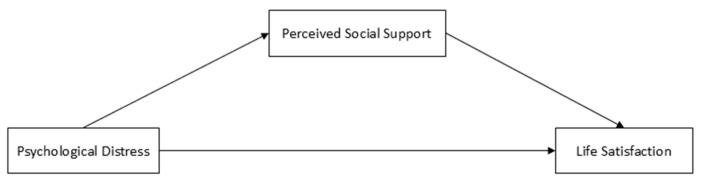
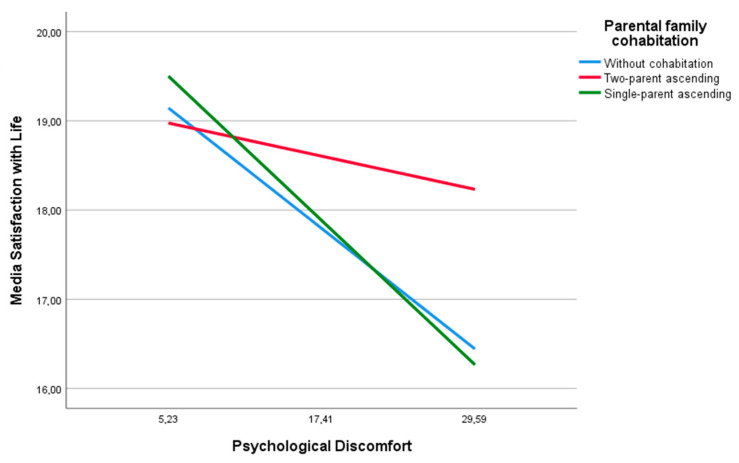
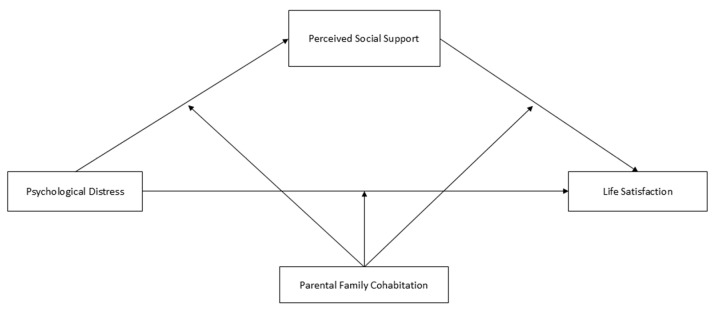
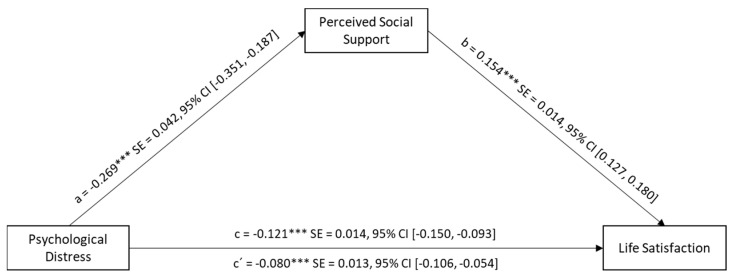
The support provided by parents plays a relevant role in the life satisfaction (LS) of young people, as well as in their level of psychological distress (PD), which are among the important mediators of their well-being. Family structure has also been identified as a protective or risk factor. Hence, the present study provides a more complex analysis of young people's LS, considering the type of family cohabitation (based on parental presence), the personal conditions of the young people (PS), and their perception of the context (social support; SP). A cross-sectional design was used, and 557 young people, with a mean age of 20.68 ( = 2.23), 50.8% women, 60.7% students, participated. Their levels of psychological distress, perceived social support, life satisfaction, and parental cohabitation were assessed. A mediation and a moderated-mediation model were used. Young people living in a biparental family reveal higher levels of LS and lower levels of PS. A partial mediation was found in the effect of SP on the relation between PS and LS. The moderated-mediation model tested showed that the indirect effects on the paths PS-SP and SP-LS were not significant by the type of parental family cohabitation. Several implications regarding family structure on young people's LS are discussed.
父母提供的支持在年轻人的生活满意度(LS)以及他们的心理困扰程度(PD)方面发挥着重要作用,而这两者是他们幸福感的重要中介因素。家庭结构也被认定为一个保护因素或风险因素。因此,本研究对年轻人的生活满意度进行了更复杂的分析,考虑了家庭同居类型(基于父母是否在身边)、年轻人的个人状况(PS)以及他们对环境的认知(社会支持;SP)。采用了横断面设计,共有557名年轻人参与,他们的平均年龄为20.68岁(标准差 = 2.23),其中女性占50.8%,学生占60.7%。评估了他们的心理困扰水平、感知到的社会支持、生活满意度以及父母同居情况。使用了中介模型和调节中介模型。生活在双亲家庭中的年轻人表现出更高的生活满意度水平和更低的心理困扰水平。在社会支持对心理困扰与生活满意度之间关系的影响中发现了部分中介效应。所测试的调节中介模型表明,按父母家庭同居类型划分,心理困扰 - 社会支持和社会支持 - 生活满意度路径上的间接效应并不显著。讨论了家庭结构对年轻人生活满意度的若干影响。