Kaźmierczak-Barańska Julia, Karwowski Bolesław T
DNA Damage Laboratory of Food Science Department, Faculty of Pharmacy, Medical University of Lodz, Ul. Muszynskiego 1, 90-151 Lodz, Poland.
Curr Issues Mol Biol. 2024 Jun 25;46(7):6366-6376. doi: 10.3390/cimb46070380.
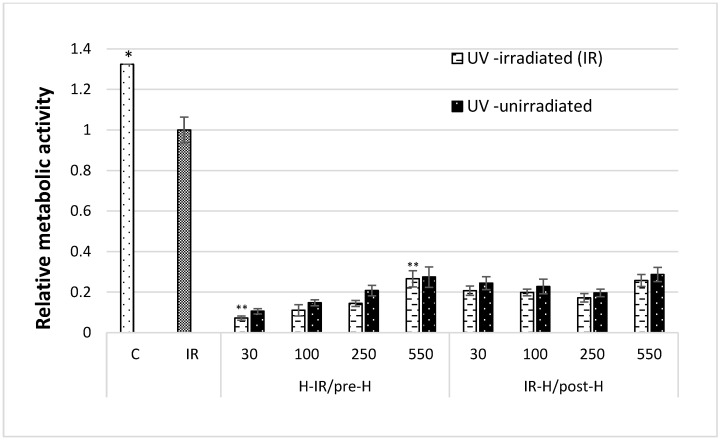
Manuka honey (MH) is considered a superfood mainly because of its various health-promoting properties, including its anti-cancer, anti-inflammatory, and clinically proven antibacterial properties. A unique feature of Manuka honey is the high content of methylglyoxal, which has antibacterial potential. Additionally, it contains bioactive and antioxidant substances such as polyphenols that contribute to its protective effects against oxidative stress. In this study, commercially available Manuka honey was tested for its total polyphenol content and DPPH radical scavenging ability. It was then tested in vitro on human fibroblast cells exposed to UV radiation to assess its potential to protect cells against oxidative stress. The results showed that the honey itself significantly interfered with cell metabolism, and its presence only slightly alleviated the effects of UV exposure. This study also suggested that the MGO content has a minor impact on reducing oxidative stress in UV-irradiated cells and efficiency in scavenging the DPPH radical.
麦卢卡蜂蜜(MH)被视为超级食物,主要是因为它具有多种促进健康的特性,包括抗癌、抗炎以及临床证实的抗菌特性。麦卢卡蜂蜜的一个独特之处在于其甲基乙二醛含量高,这种物质具有抗菌潜力。此外,它还含有生物活性和抗氧化物质,如多酚,这些物质有助于其对抗氧化应激的保护作用。在本研究中,对市售麦卢卡蜂蜜的总多酚含量和DPPH自由基清除能力进行了测试。然后在体外对暴露于紫外线辐射的人成纤维细胞进行测试,以评估其保护细胞免受氧化应激的潜力。结果表明,蜂蜜本身显著干扰细胞代谢,其存在仅略微减轻紫外线照射的影响。这项研究还表明,甲基乙二醛(MGO)含量对减少紫外线照射细胞中的氧化应激以及清除DPPH自由基的效率影响较小。