School of Health and Society, Centre for Human Movement and Rehabilitation, University of Salford, Salford, Greater Manchester, United Kingdom.
Section of Clinical Psychology, Department of Neurosciences, Biomedicine and Movement Sciences, University of Verona, Verona, Italy.
PLoS One. 2024 Jul 26;19(7):e0306095. doi: 10.1371/journal.pone.0306095. eCollection 2024.
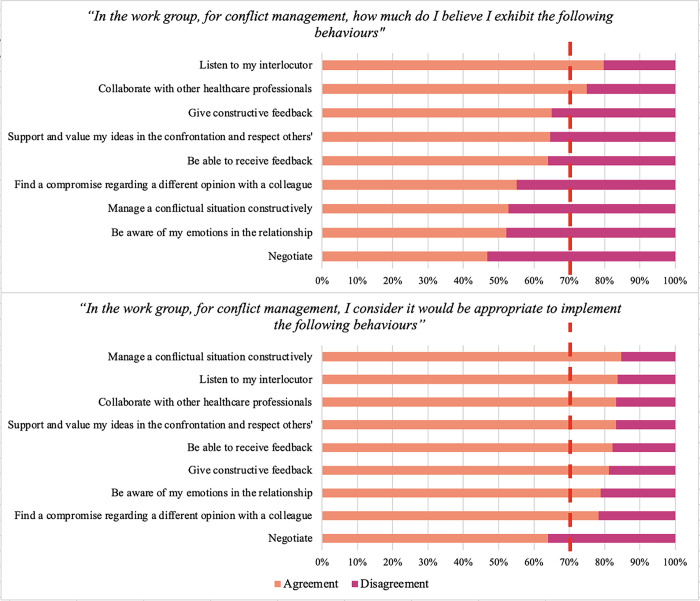
Conflict management is rarely explored among physiotherapists though they often work in teams. Hence, this study explored attitudes, perceived competencies, beliefs, training experiences, and needs in conflict management among Italian physiotherapists. We conducted a cross-sectional online survey study between June and September 2023 among Italian physiotherapists. The survey instrument comprised four sections. Section 1: Socio-Demographic and Professional Data: Explored participant profiles and conflict frequency. Section 2: Attitudes and Competences: assess conflict-related behaviours and management styles (Likert Scale). Section 3: Training Experiences and Needs: Evaluated training importance and conflict-related issues with other professionals (Likert Scale). Section 4: Beliefs About Factors: Participants rated (0-10) factors influencing conflict management and its impact on care and well-being. Descriptive analyses were performed, presenting continuous data as mean (SD) and categorical data as frequencies/percentages. Likert scale responses were dichotomised (agreement/disagreement), and consensus was defined as ≥70% agreement. Median, quartiles, and box-and-whisker plots depicted responses were used for 0-to-10 scales. Physiotherapists (n = 203; mean age: 39±10.40) generally leaned towards a constructive communication style, characterised by compromise and collaboration, viewing conflict management as an opportunity to grow. There was a disparity between their exhibited behaviours and self-assessment of appropriateness in conflict resolution. Only 27.6% considered their conflict resolution skills as satisfactory. However, 85.7% acknowledged the significance of being trained in conflict management. Challenges were evident in conflicts within interprofessional relationships and communication with superiors. Both personal and organisational factors were identified as influencing conflict management, with participants recognising the detrimental impact of conflicts on their well-being and patient care. This study highlighted educational gaps in conflict management among Italian physiotherapists, showing areas of improvement in their training. Our results suggested that physiotherapists might need additional training in conflict management to enhance workplace well-being and the quality of care provided.
冲突管理在物理治疗师中很少被探讨,尽管他们经常在团队中工作。因此,本研究探讨了意大利物理治疗师在冲突管理方面的态度、感知能力、信念、培训经验和需求。我们在 2023 年 6 月至 9 月期间进行了一项横断面在线调查研究,调查对象为意大利物理治疗师。调查工具包括四个部分:第一部分:社会人口统计学和专业数据:探讨参与者的个人资料和冲突频率。第二部分:态度和能力:评估与冲突相关的行为和管理风格(李克特量表)。第三部分:培训经验和需求:评估培训的重要性以及与其他专业人员的冲突相关问题(李克特量表)。第四部分:关于因素的信念:参与者对影响冲突管理及其对护理和福祉的影响的因素进行评分(0-10 分)。进行了描述性分析,以平均值(标准差)表示连续数据,以频率/百分比表示分类数据。李克特量表的回答被二分为(同意/不同意),共识定义为≥70%的同意。中位数、四分位数和箱线图描绘了 0 到 10 分的评分。物理治疗师(n=203;平均年龄:39±10.40)通常倾向于建设性的沟通风格,以妥协和合作为特征,将冲突管理视为成长的机会。他们表现出的行为与其在解决冲突方面的自我评估之间存在差距。只有 27.6%的人认为自己的冲突解决技能令人满意。然而,85.7%的人承认接受冲突管理培训的重要性。在跨专业关系和与上级沟通中存在冲突方面存在挑战。个人和组织因素都被确定为影响冲突管理的因素,参与者认识到冲突对他们的幸福感和患者护理的不利影响。本研究强调了意大利物理治疗师在冲突管理方面的教育差距,显示出他们在培训方面有待改进的地方。我们的结果表明,物理治疗师可能需要额外的冲突管理培训,以提高工作场所的幸福感和提供的护理质量。