White Larissa L, Sawyer Jennifer K, Zepp Jamilyn M, Prado Yolanda K, Reyes Ana A, Maiyani Mahesh, Shuster Elizabeth, Zucker Rachel, Henrikson Nora B, Rope Alan F, Weinmann Sheila, Feigelson Heather S, Ezzell Hunter Jessica
Institute for Health Research, Kaiser Permanente Colorado, 16601 East Centretech Parkway, Aurora, CO 80011, USA.
Center for Health Research, Department of Translational and Applied Genomics, Kaiser Permanente Northwest, 3800 North Interstate Avenue, Portland, OR 97227, USA.
Cancers (Basel). 2024 Jul 17;16(14):2563. doi: 10.3390/cancers16142563.
Recommendations state all people with ovarian cancers (OCs) receive genetic counseling, but testing uptake is only between 15 and 31%. Those with a prior diagnosis of OC who have not received genetic testing represent a missed opportunity for life-saving genetic risk information. The Genetic Risk Analysis in ovarian CancEr (GRACE) study aimed to evaluate the feasibility of the retrospective identification ("Traceback") of individuals diagnosed with OC.
This nonrandomized intervention study within two integrated health care systems identified participants with a history of OC between 1998 and 2020 who did not have genetic testing or testing limited to BRCA1/2. Participants received clinical genomic sequencing via a custom 60 gene panel. This study measured the feasibility of the Traceback methodology in OC survivors.
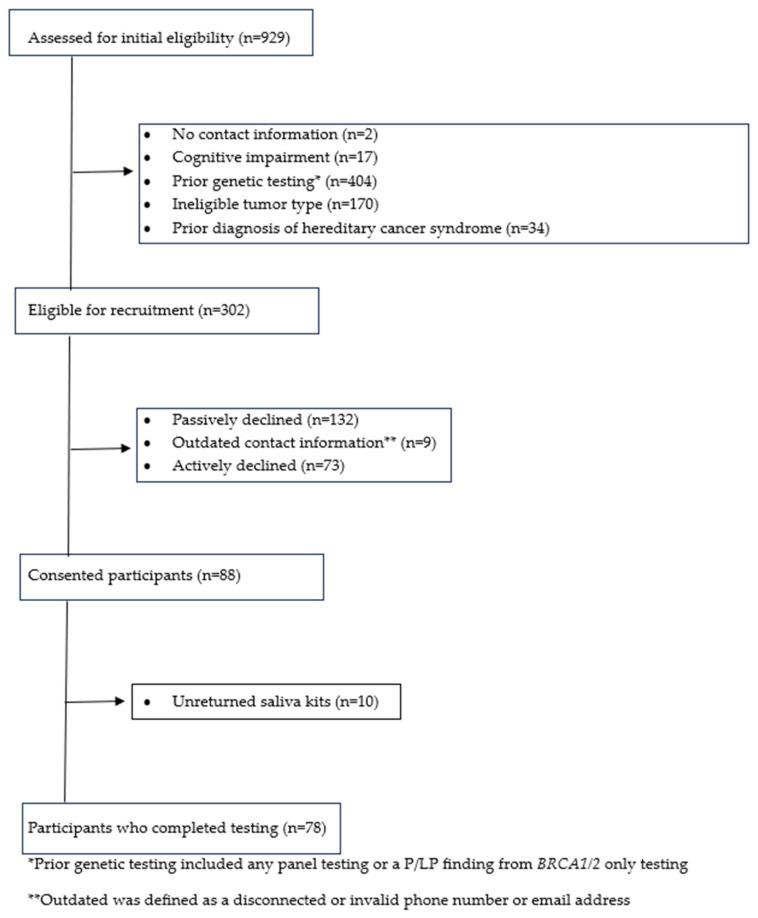
The initial cohort included 929 individuals, of which 57% had no prior genetic testing. Of the 302 eligible for recruitment, 88 consented to participate. We were able to outreach 97% of the eligible population using contact information from medical records. The stage at diagnosis was the only factor associated with consent. Of the 78 who returned their saliva sample, 21% had pathogenic/likely pathogenic variants, and 79% had negative results.
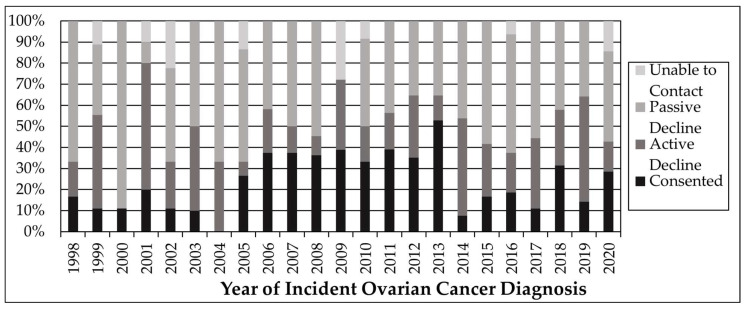
The GRACE study resulted in a 29% uptake of genetic testing in OC survivors. The time since diagnosis did not have an impact on consent or ability to contact. GRACE can inform the implementation of future Traceback programs, providing guidance on how to prevent and mitigate the burden of OC and other hereditary cancers.
指南建议所有卵巢癌(OC)患者接受遗传咨询,但检测接受率仅在15%至31%之间。那些先前被诊断为OC但未接受基因检测的患者错失了获得挽救生命的遗传风险信息的机会。卵巢癌遗传风险分析(GRACE)研究旨在评估对已诊断为OC的个体进行回顾性识别(“追溯”)的可行性。
在两个综合医疗系统内进行的这项非随机干预研究,确定了1998年至2020年间有OC病史但未进行基因检测或检测仅限于BRCA1/2的参与者。参与者通过定制的60基因面板接受临床基因组测序。本研究测量了追溯方法在OC幸存者中的可行性。
初始队列包括929人,其中57%此前未进行基因检测。在302名符合招募条件的人中,88人同意参与。我们能够利用病历中的联系信息联系到97%的符合条件人群。诊断时的分期是与同意参与相关的唯一因素。在78名返还唾液样本的人中,21%有致病/可能致病变异,79%结果为阴性。
GRACE研究使OC幸存者的基因检测接受率达到29%。诊断后的时间对同意参与或联系能力没有影响。GRACE可为未来追溯项目的实施提供信息,为如何预防和减轻OC及其他遗传性癌症的负担提供指导。