Al-Ghazzawi Karim, Neumann Inga, Knetsch Mareile, Chen Ying, Wilde Benjamin, Bechrakis Nikolaos E, Eckstein Anja, Oeverhaus Michael
Department of Ophthalmology, University Hospital Essen, 45147 Essen, Germany.
Department of Nephrology, University Hospital Essen, 45147 Essen, Germany.
J Clin Med. 2024 Jul 9;13(14):3998. doi: 10.3390/jcm13143998.
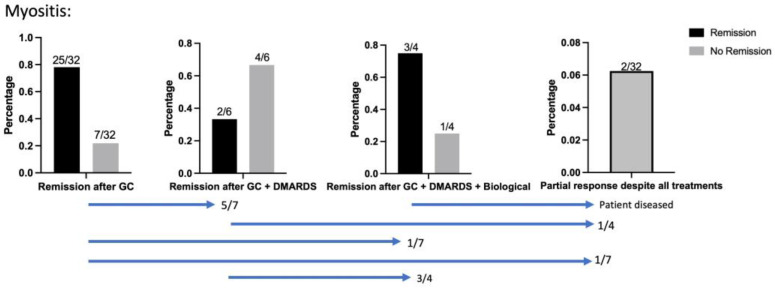
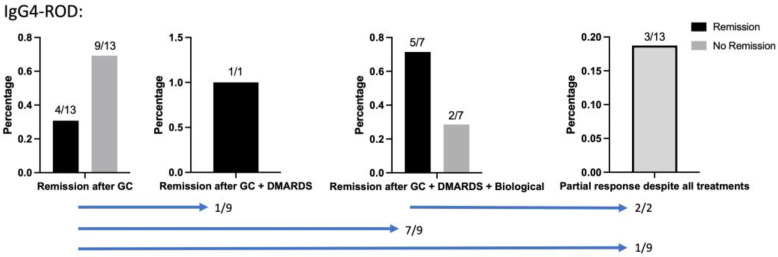
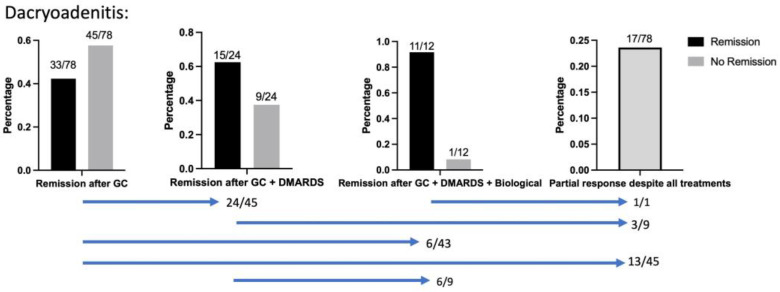
: To clarify the therapy response in orbital inflammatory diseases (OID), we analyzed the treatment effects of steroid therapy, the use of disease-modifying antirheumatic drugs (DMARDS), and biologicals in our tertiary referral center cohort. : We collected the clinical and demographic data of all patients treated for non-specific orbital inflammation (NSOI) ( = 111) and IgG4-ROD ( = 13), respectively at our center from 2008 to 2020 and analyzed them with descriptive statistics. NSOI were sub-grouped according to the location into either idiopathic dacryoadenitis (DAs) ( = 78) or typical idiopathic orbital myositis ( = 32). : Mean age at first clinical manifestation was significantly different between subgroups (IOI: 49.5 ± 18, IgG4-ROD: 63.2 ± 14, = 0.0171). Among all examined OID, 63 patients (50%) achieved full remission (FR) with corticosteroids (NSOI 53%/IgG4-ROD 31%). In contrast, classic myositis showed a significantly higher response (76%). Disease-modifying drugs (DMARDS) for myositis accomplished only 33% FR (NSOI 57%) and 66% did not respond sufficiently (NSOI 43%). The biologic agent (Rituximab) was significantly more efficient: 19 of 23 patients (82%) achieved full remission and only 4 (17%) did not respond fully and needed orbital irradiation or orbital decompressive surgery.
为明确眼眶炎性疾病(OID)的治疗反应,我们在三级转诊中心队列中分析了类固醇疗法、改善病情抗风湿药(DMARDs)及生物制剂的治疗效果。我们收集了2008年至2020年在本中心分别接受非特异性眼眶炎症(NSOI)(n = 111)和IgG4相关性眼眶病(IgG4-ROD)(n = 13)治疗的所有患者的临床和人口统计学数据,并采用描述性统计方法进行分析。NSOI根据病变部位分为特发性泪腺炎(DAs)(n = 78)或典型特发性眼眶肌炎(n = 32)。各亚组首次临床表现时的平均年龄存在显著差异(眼眶炎性肌病:49.5±18,IgG4-ROD:63.2±14,P = 0.0171)。在所有检查的OID中,63例患者(50%)使用皮质类固醇实现了完全缓解(FR)(NSOI为53%/IgG4-ROD为31%)。相比之下,典型肌炎的反应显著更高(76%)。用于肌炎的改善病情药物(DMARDs)仅实现了33%的完全缓解(NSOI为57%),66%的患者反应不佳(NSOI为43%)。生物制剂(利妥昔单抗)的疗效显著更高:23例患者中有19例(82%)实现了完全缓解,只有4例(17%)反应不完全,需要进行眼眶放疗或眼眶减压手术。