Division of Genetics, ICAR-Indian Agricultural Research Institute, New Delhi, Delhi, India.
Division of Seed Science and Technology, ICAR-Indian Agricultural Research Institute, New Delhi, Delhi, India.
PeerJ. 2024 Jul 23;12:e17609. doi: 10.7717/peerj.17609. eCollection 2024.
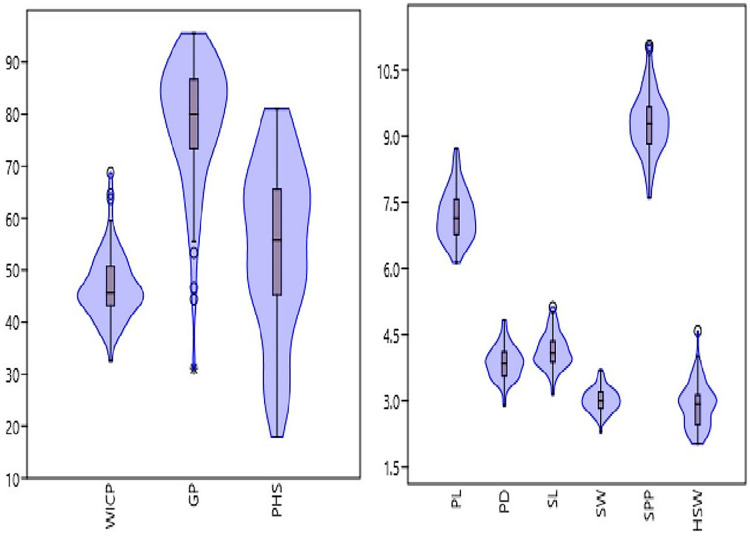
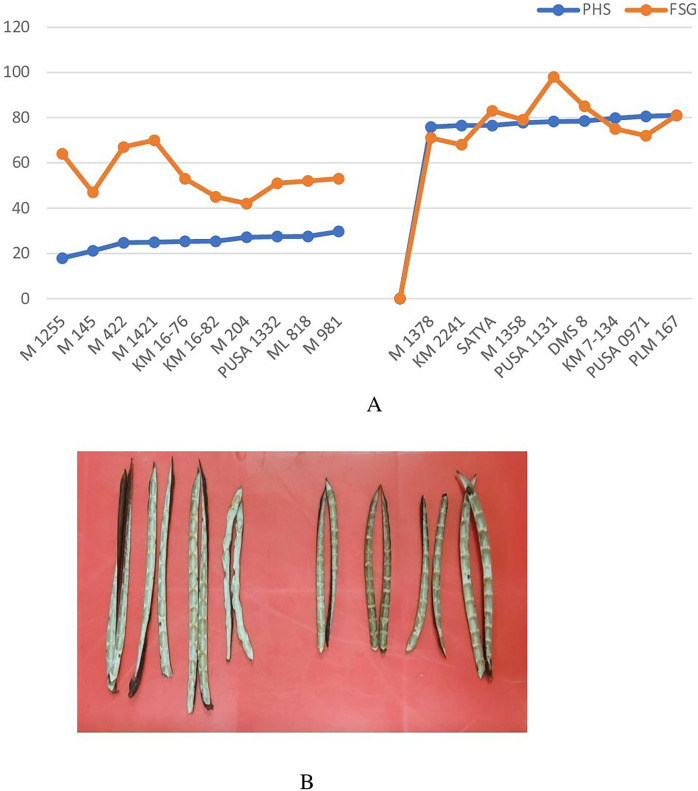
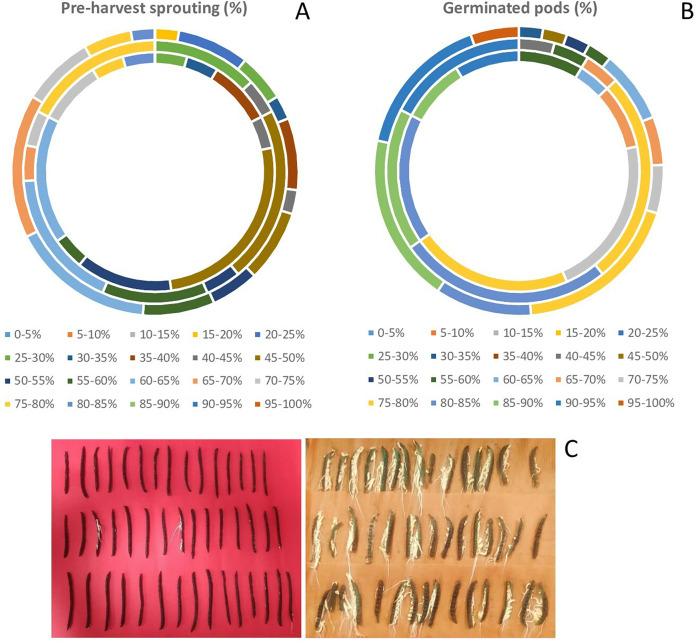
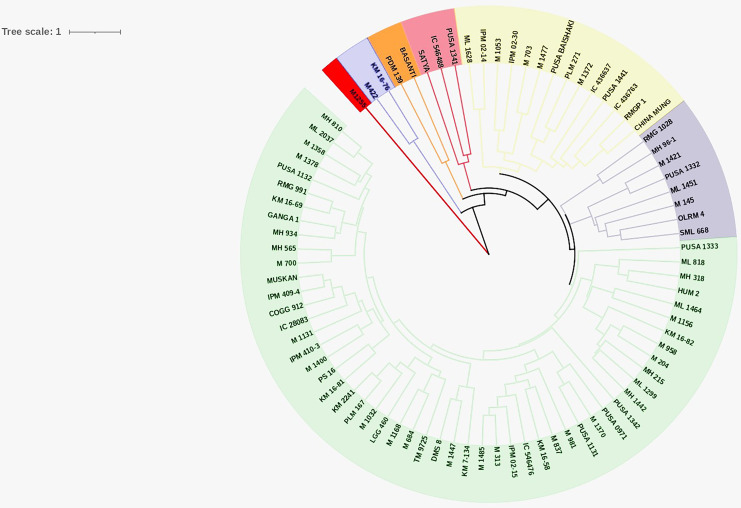
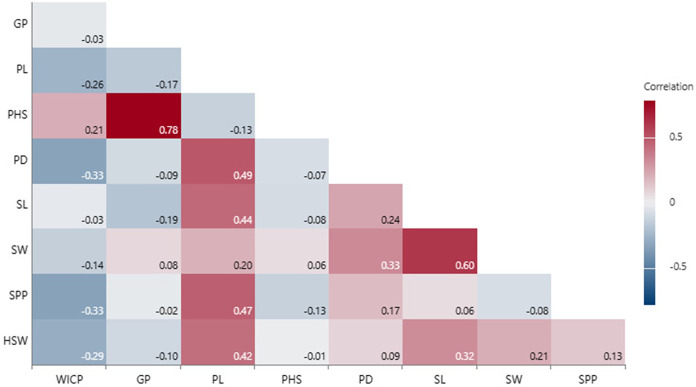
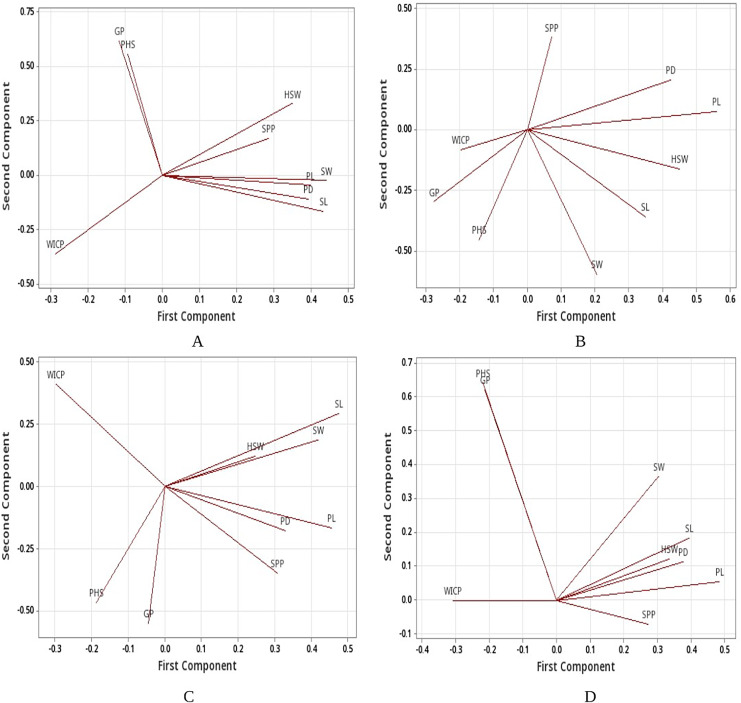
Pre-harvest sprouting (PHS) is one of the important abiotic stresses in mungbean which significantly reduces yield and quality of the produce. This study was conducted to evaluate the genetic variability for tolerance to pre-harvest sprouting in diverse mungbean genotypes while simultaneously deciphering the association of yield contributing traits with PHS. Eighty-three diverse mungbean genotypes (23 released varieties, 23 advanced breeding lines and 37 exotic germplasm lines) were investigated for tolerance to PHS, water imbibition capacities by pods, pod and seed physical traits. Wide variation in PHS was recorded which ranged between 17.8% to 81% (mean value 54.34%). Germplasm lines exhibited higher tolerance to PHS than the high-yielding released varieties. Correlation analysis revealed PHS to be positively associated with water imbibition capacity by pods (r = 0.21) and germinated pod % (r = 0.78). Pod length (r = -0.13) and seeds per pod (r = -0.13) were negatively influencing PHS. Positive associations between PHS and water imbibition capacity by pods, germinated pod % and 100-seed weight was further confirmed by multivariate analysis. Small-seeded genotypes having 100-seed weight <3 g exhibited higher tolerance to PHS compared to bold-seeded genotypes having 100-seed weight more than 3.5 g. Fresh seed germination among the selected PHS tolerant and susceptible genotypes ranged from 42% (M 204) to 98% (Pusa 1131). A positive association (r = 0.79) was recorded between fresh seed germination and PHS. Genotypes M 1255, M 145, M 422, M 1421 identified as potential genetic donors against PHS could be utilized in mungbean breeding programs.
采前发芽(PHS)是绿豆的重要非生物胁迫之一,会显著降低产量和产品质量。本研究旨在评估不同绿豆基因型对采前发芽的耐受性的遗传变异性,同时解析与 PHS 相关的产量性状的关联。对 83 个不同的绿豆基因型(23 个已发布品种、23 个先进的育种系和 37 个外来种质系)进行了采前发芽、荚果吸水能力、荚果和种子物理特性的耐受力评估。记录到 PHS 广泛变化,范围为 17.8%至 81%(平均值为 54.34%)。种质系比高产的已发布品种表现出更高的 PHS 耐受性。相关分析表明,PHS 与荚果吸水能力(r = 0.21)和发芽荚果%(r = 0.78)呈正相关。荚果长度(r = -0.13)和每荚种子数(r = -0.13)对 PHS 有负面影响。通过多元分析进一步证实了 PHS 与荚果吸水能力、发芽荚果%和 100 粒种子重量之间的正相关关系。与种皮较厚的基因型(100 粒种子重量超过 3.5 克)相比,种皮较薄的基因型(100 粒种子重量<3 克)表现出更高的 PHS 耐受性。从所选的 PHS 耐受和敏感基因型中,新鲜种子发芽率从 42%(M 204)到 98%(Pusa 1131)不等。记录到新鲜种子发芽率与 PHS 之间存在正相关(r = 0.79)。M 1255、M 145、M 422、M 1421 等基因型被认为是对抗 PHS 的潜在遗传供体,可以在绿豆育种计划中利用。