Palermi Stefano, Cavarretta Elena, D'Ascenzi Flavio, Castelletti Silvia, Ricci Fabrizio, Vecchiato Marco, Serio Alessandro, Cavigli Luna, Bossone Eduardo, Limongelli Giuseppe, Biffi Alessandro, Monda Emanuele, La Gerche Andre, Baggish Aaron, D'Andrea Antonello
Public Health Department, University of Naples Federico II, 80131 Naples, Italy.
Department of Medical-Surgical Sciences and Biotechnologies, Sapienza University of Rome, 04100 Latina, Italy.
Rev Cardiovasc Med. 2023 May 19;24(5):151. doi: 10.31083/j.rcm2405151. eCollection 2023 May.
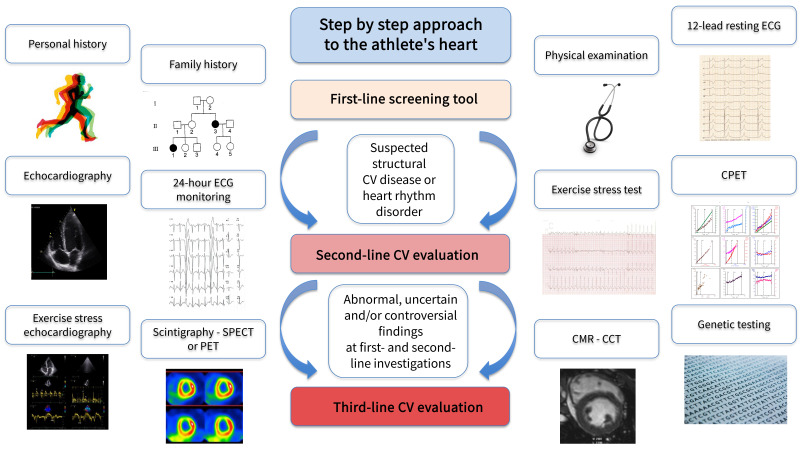
"Athlete's heart" is a spectrum of morphological, functional, and regulatory changes that occur in people who practice regular and long-term intense physical activity. The morphological characteristics of the athlete's heart may overlap with some structural and electrical cardiac diseases that may predispose to sudden cardiac death, including inherited and acquired cardiomyopathies, aortopathies and channelopathies. Overdiagnosis should be avoided, while an early identification of underlying cardiac life-threatening disorders is essential to reduce the potential for sudden cardiac death. A step-by-step multimodality approach, including a first-line evaluation with personal and family history, clinical evaluation, 12-lead resting electrocardiography (ECG), followed by second and third-line investigations, as appropriate, including exercise testing, resting and exercise echocardiography, 24-hour ECG Holter monitoring, cardiac magnetic resonance, computed tomography, nuclear scintigraphy, or genetic testing, can be determinant to differentiate between extreme physiology adaptations and cardiac pathology. In this context, cardiovascular imaging plays a key role in detecting structural abnormalities in athletes who fall into the grey zone between physiological adaptations and a covert or early phenotype of cardiovascular disease.
“运动员心脏”是指经常进行长期高强度体育活动的人群所出现的一系列形态、功能和调节方面的变化。运动员心脏的形态特征可能与某些结构性和电性心脏疾病重叠,这些疾病可能易引发心源性猝死,包括遗传性和后天性心肌病、主动脉病变和离子通道病。应避免过度诊断,而早期识别潜在的危及生命的心脏疾病对于降低心源性猝死风险至关重要。一种逐步的多模态方法,包括通过个人和家族病史进行一线评估、临床评估、12导联静息心电图(ECG),然后根据情况进行二线和三线检查,包括运动试验、静息和运动超声心动图、24小时动态心电图监测、心脏磁共振成像、计算机断层扫描、核素显像或基因检测,对于区分极端生理适应和心脏病理情况可能具有决定性作用。在这种情况下,心血管成像在检测处于生理适应与心血管疾病隐匿或早期表型之间灰色地带的运动员的结构异常方面起着关键作用。