Department of Cardiology, Angiology, and Intensive Care Medicine, University Hospital, Philipps University of Marburg, Baldinger Str., 35043, Marburg, Germany.
Sci Rep. 2024 Jul 30;14(1):17484. doi: 10.1038/s41598-024-68376-w.
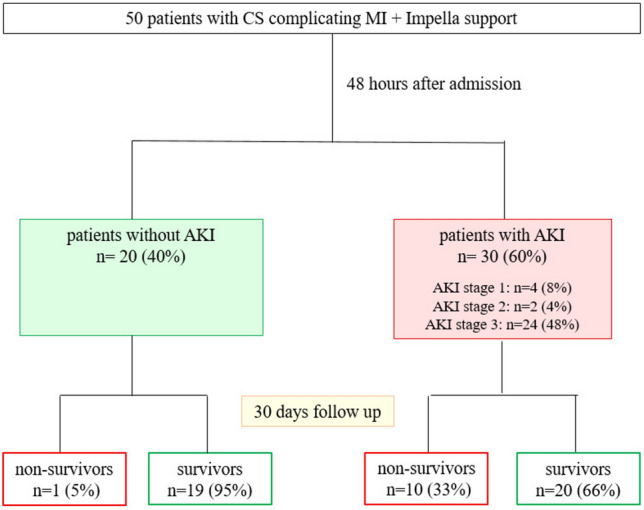
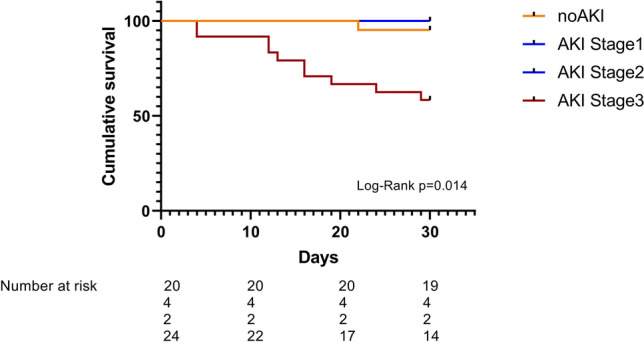
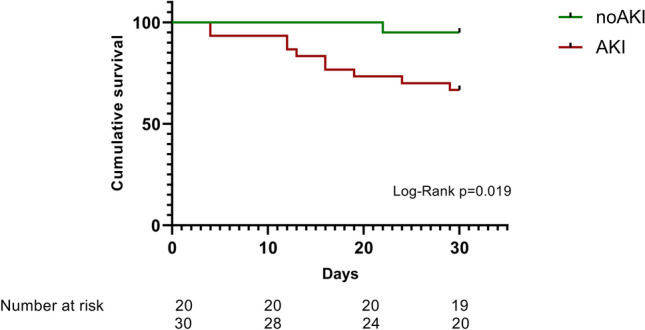
Acute kidney injury (AKI) is one of the most frequent and prognostic-relevant complications of cardiogenic shock (CS) complicating myocardial infarction (MI). Mechanical circulatory assist devices (MCS) like left ventricular Impella microaxial pump have increasingly been used in the last decade for stabilization of hemodynamics in those patients. Moreover, a protective effect of Impella on renal organ perfusion could recently be demonstrated. However, data identifying early risk predictors for developing AKI during Impella support in CS are rare. Data of hemodynamics and renal function from 50 Impella patients (January 2020 and February 2022) with MI-related CS (SCAI stage C), were retrospectively analyzed using e.g. multivariate logistic regression analysis as well as Kaplan-Meier curves and Cox regression analysis. 30 patients (60%) developed AKI. Central venous pressure as an indicator for venous congestion (OR 1.216, p = 0.02), GFR at admission indicating existing renal damage (OR 0.928, p = 0.002), and reduced central venous oxygen saturation (SvO) as a marker for decreased tissue perfusion (OR 0.930, p = 0.029) were independently associated with developing an AKI. The 30-day mortality rate was significantly higher in patients with AKI stage 3 (Stage 1: 0%, Stage 2: 0%, Stage 3; 41.6%, p = 0.014) while AKI stage 3 (HR 0.095, p = 0.026) and norepinephrine dosage (HR 1.027, p = 0.008) were independent predictors for 30-day mortality. AKI as a complication of MI-related CS occurs frequently with a major impact on prognosis. Venous congestion, reduced tissue perfusion, and an already impaired renal function are independent predictors of AKI. Thus, timely diagnostics and a focused treatment of the identified factors could improve prognosis and outcome.
急性肾损伤(AKI)是心肌梗死后并发心源性休克(CS)最常见和预后相关的并发症之一。过去十年中,左心室Impella 微轴流泵等机械循环辅助装置(MCS)越来越多地用于稳定这些患者的血液动力学。此外,最近已经证明 Impella 对肾脏器官灌注有保护作用。然而,在 CS 中使用 Impella 支持时,确定发生 AKI 的早期风险预测因子的数据很少。回顾性分析了 2020 年 1 月至 2022 年 2 月期间 50 例因心肌梗死后 CS(SCAI 阶段 C)而接受 Impella 治疗的患者的血流动力学和肾功能数据,例如使用多变量逻辑回归分析以及 Kaplan-Meier 曲线和 Cox 回归分析。30 名患者(60%)发生 AKI。静脉充血的指标中心静脉压(OR 1.216,p=0.02)、入院时的肾小球滤过率(GFR)表明存在肾损伤(OR 0.928,p=0.002)和中心静脉血氧饱和度(SvO)降低表明组织灌注减少(OR 0.930,p=0.029)与发生 AKI 独立相关。AKI 第 3 期(第 1 期:0%,第 2 期:0%,第 3 期:41.6%,p=0.014)的 30 天死亡率显著更高,而 AKI 第 3 期(HR 0.095,p=0.026)和去甲肾上腺素剂量(HR 1.027,p=0.008)是 30 天死亡率的独立预测因子。AKI 是 MI 相关 CS 的并发症,常伴有严重的预后影响。静脉充血、组织灌注减少和已受损的肾功能是 AKI 的独立预测因子。因此,及时诊断和针对性治疗这些确定的因素可能会改善预后和结果。