Centers for Disease Control and Prevention, National Institute for Occupational Safety and Health, 1150 Tusculum Ave., Cincinnati, OH 45226, USA.
Centers for Disease Control and Prevention, National Institute for Occupational Safety and Health, 395 E St. SW, Washington, DC 20201, USA.
Int J Environ Res Public Health. 2021 Sep 24;18(19):10032. doi: 10.3390/ijerph181910032.
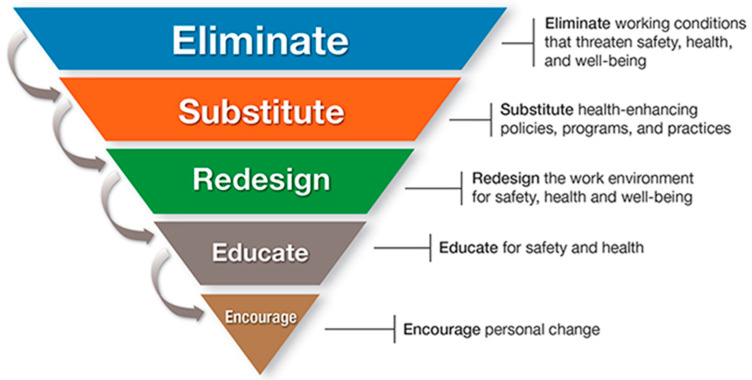
Understanding of how (TWH) guidelines are implemented in employment organizations in the USA is not well understood. The purpose of this study is to explore how the principles of the Hierarchy of Controls Applied to NIOSH Total Worker Health (TWH HoC), have been implemented among organizations featured as Promising Practices for TWH between 2012-2019, with special focus on the work-related issues of fatigue, stress, sedentary work, and tobacco control. We also sought to identify benefits, obstacles, and lessons learned in the implementation of the TWH HoC. Eighteen organizations were identified to be included in the study. Using a qualitative cross-sectional design and purposive sampling, seven in-depth interviews were conducted with thirteen key informants. The Consolidated Framework for Implementation Research was used to guide the thematic analysis and interpretation of qualitative data. Four themes identified include recognition of the TWH approach and TWH HoC, implementation of the TWH HoC, barriers and facilitators in addressing specific work-related issues, and implementation climate primes benefits, obstacles, and lessons learned. The inner setting (i.e., culture, implementation climate, readiness for implementation) of organizations was a prominent determinant of the implementation of integrated worker safety, health, and well-being interventions.
美国就业组织对(TWH)指南实施情况的理解并不清楚。本研究的目的是探讨 2012-2019 年期间被确定为 TWH 的有前途的实践的组织中,应用于 NIOSH 全面工人健康(TWH HoC)的控制层次原则是如何实施的,特别关注与疲劳、压力、久坐工作和烟草控制等与工作相关的问题。我们还试图确定 TWH HoC 实施中的收益、障碍和经验教训。确定了 18 个组织纳入研究。采用定性的横断面设计和目的抽样法,对 13 名关键信息提供者进行了 7 次深入访谈。采用实施研究综合框架指导定性数据的主题分析和解释。确定了四个主题,包括对 TWH 方法和 TWH HoC 的认识、TWH HoC 的实施、解决特定与工作相关问题的障碍和促进因素,以及实施气候促进了收益、障碍和经验教训的产生。组织的内部环境(即文化、实施气候、实施准备)是综合工人安全、健康和幸福感干预措施实施的重要决定因素。