Department of Rehabilitation Medicine, West China Second University Hospital, Sichuan University, Chengdu, Sichuan, China.
Key Laboratory of Birth Defects and Related Diseases of Women and Children (Sichuan University), Ministry of Education, Chengdu, Sichuan, China.
Front Public Health. 2024 Jul 16;12:1386137. doi: 10.3389/fpubh.2024.1386137. eCollection 2024.
Studies have found maternal smoking during pregnancy was linked to attention-deficit/hyperactivity disorder (ADHD) risk. It is unclear if maternal smoking cessation during pregnancy lowers ADHD and learning disability (LD) risk in offspring. This study aimed to explore the associations between maternal smoking cessation during pregnancy and ADHD and LD risk in offspring.
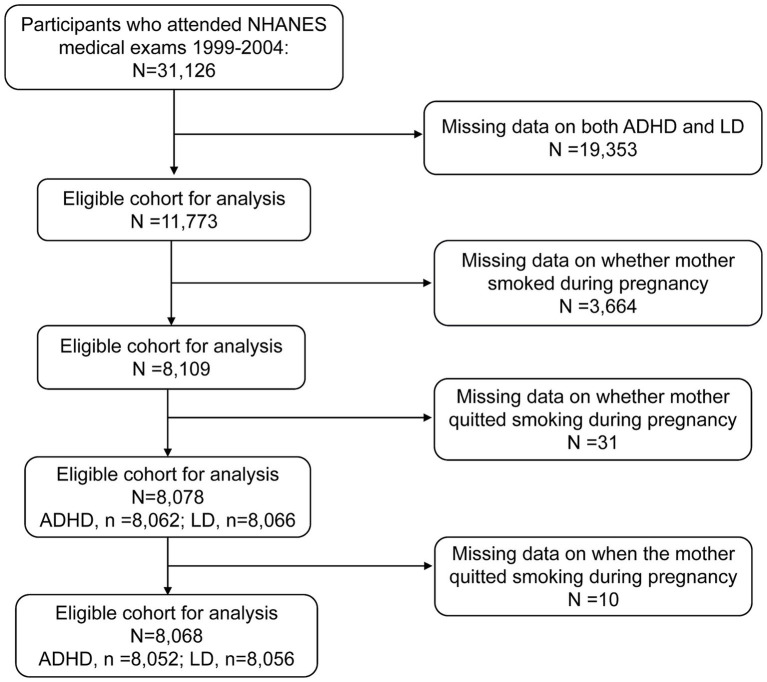
Data from the National Health and Nutrition Examination Survey 1999-2004 (8,068 participants) were used. Logistic regression was used to analyze the associations between maternal smoking and smoking cessation during pregnancy and ADHD and LD risk in offspring.
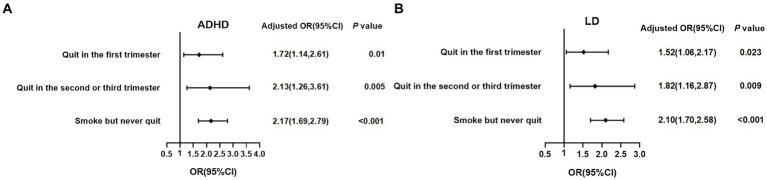
Compared to non-smokers' offspring, maternal smoking during pregnancy increased the risk of ADHD (odds ratios [OR] = 2.07, 95% confidence interval [CI]: 1.67-2.56) and LD (OR = 1.93, 95% CI: 1.61-2.31) in offspring, even if mothers quit smoking later (OR = 1.91, 95%CI: 1.38-2.65, OR = 1.65, 95%CI: 1.24-2.19). Further analysis of the timing of initiation of smoking cessation during pregnancy revealed that, compared to non-smokers' offspring, maternal quitting smoking in the first trimester still posed an increased risk of ADHD (OR = 1.72, 95% CI: 1.41-2.61) and LD (OR = 1.52, 95% CI: 1.06-2.17) in offspring. Maternal quitting smoking in the second or third trimester also had a significantly increased risk of ADHD (OR = 2.13, 95% CI: 1.26-3.61) and LD (OR = 1.82, 95% CI: 1.16-2.87) in offspring. Furthermore, maternal smoking but never quitting during pregnancy had the highest risk of ADHD (OR = 2.17, 95% CI: 1.69-2.79) and LD (OR = 2.10, 95% CI: 1.70-2.58) in offspring. Interestingly, a trend toward a gradual increase in the risk-adjusted OR for ADHD and LD risk was observed among the three groups: maternal quitting smoking in the first trimester, maternal quitting smoking in the second or third trimester, and maternal smoking but never quitting.
Maternal smoking cessation in the first trimester still poses an increased risk of ADHD and LD in offspring. Furthermore, it seems that the later the mothers quit smoking during pregnancy, the higher the risk of ADHD and LD in their offspring. Therefore, early intervention of maternal smoking in preconception and prenatal care is vital for offspring neurodevelopment.
研究发现,孕妇吸烟与注意力缺陷多动障碍(ADHD)风险有关。但目前尚不清楚孕妇在怀孕期间戒烟是否会降低后代患 ADHD 和学习障碍(LD)的风险。本研究旨在探讨孕妇在怀孕期间戒烟与后代患 ADHD 和 LD 的风险之间的关联。
本研究使用了 1999-2004 年全国健康和营养调查(National Health and Nutrition Examination Survey,NHANES 1999-2004)的数据。采用逻辑回归分析孕妇吸烟和怀孕期间戒烟与后代患 ADHD 和 LD 风险之间的关系。
与不吸烟者的后代相比,孕妇在怀孕期间吸烟会增加后代患 ADHD(比值比[OR] = 2.07,95%置信区间[CI]:1.67-2.56)和 LD(OR = 1.93,95%CI:1.61-2.31)的风险,即使母亲后来戒烟(OR = 1.91,95%CI:1.38-2.65,OR = 1.65,95%CI:1.24-2.19)也是如此。进一步分析怀孕期间开始戒烟的时间发现,与不吸烟者的后代相比,母亲在孕早期戒烟仍会增加后代患 ADHD(OR = 1.72,95%CI:1.41-2.61)和 LD(OR = 1.52,95%CI:1.06-2.17)的风险。母亲在孕中期或孕晚期戒烟也会显著增加后代患 ADHD(OR = 2.13,95%CI:1.26-3.61)和 LD(OR = 1.82,95%CI:1.16-2.87)的风险。此外,母亲在怀孕期间吸烟但从未戒烟的后代患 ADHD(OR = 2.17,95%CI:1.69-2.79)和 LD(OR = 2.10,95%CI:1.70-2.58)的风险最高。有趣的是,在这三组人群中,ADHD 和 LD 风险的调整后比值比(OR)都呈现出逐渐升高的趋势:母亲在孕早期戒烟、母亲在孕中期或孕晚期戒烟、母亲在怀孕期间吸烟但从未戒烟。
母亲在孕早期戒烟仍会增加后代患 ADHD 和 LD 的风险。此外,母亲在怀孕期间戒烟的时间越晚,后代患 ADHD 和 LD 的风险越高。因此,在孕前和产前保健中早期干预母亲吸烟对于后代的神经发育至关重要。