Research Centre in Communication Psychology, Università Cattolica del Sacro Cuore, Largo Gemelli 1, Milan, 20123, Italy.
Department of Psychology, Università Cattolica del Sacro Cuore, Largo Gemelli 1, Milan, 20123, Italy.
Curr Psychiatry Rep. 2024 Sep;26(9):470-486. doi: 10.1007/s11920-024-01523-2. Epub 2024 Jul 31.
Immersive Virtual Reality (IVR) has shown promise in the assessment, understanding, and treatment of eating disorders (EDs), providing a dynamic platform for clinical innovation. This scoping review aims to synthesize the recent advancements and applications of IVR in addressing these complex psychological disorders.
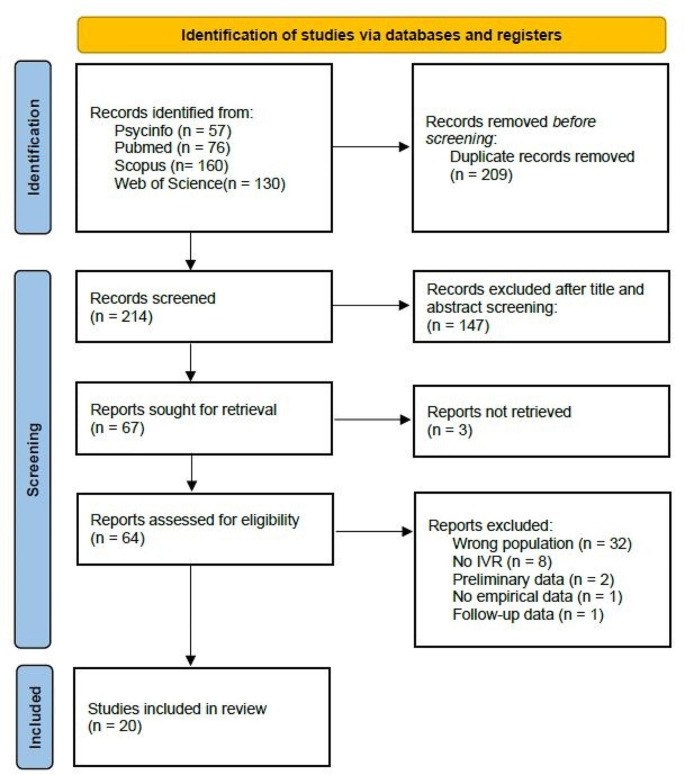
This review followed the Preferred Reporting Items for Systematic Reviews and Meta-analysis Protocols, focusing on studies published in the past five years. It included peer-reviewed papers that used IVR for ED assessment, examination, or treatment. A comprehensive database search provided a selection of relevant articles, which were then methodically screened and analyzed.
Twenty studies met the inclusion criteria, with a primary focus on Anorexia Nervosa (AN), Bulimia Nervosa (BN), and Binge Eating Disorder (BED). The application of IVR was categorized into three areas: assessment, understanding, and treatment. IVR was found to be an effective tool in assessing body image distortions and emotional responses to food, providing insights that are less accessible through traditional methods. Furthermore, IVR offers innovative treatment approaches by facilitating exposure therapy, modifying body-related biases, and enabling emotional regulation through embodied experiences. The studies demonstrate IVR's potential to improve body image accuracy, reduce food-related anxieties, and support behavioral changes in ED patients.
IVR stands out as a transformative technology in the field of EDs, offering comprehensive benefits across diagnostic, therapeutic, and experiential domains. The IVR's ability to simulate the brain's predictive coding mechanisms provides a powerful avenue for delivering embodied, experiential interventions that can help recalibrate distorted body representations and dysfunctional affective predictive models implicated in EDs. Future research should continue to refine these applications, ensuring consistent methodologies and wider clinical trials to fully harness IVR's potential in clinical settings.
沉浸式虚拟现实(IVR)在评估、理解和治疗饮食失调症(ED)方面显示出了前景,为临床创新提供了一个充满活力的平台。本综述旨在综合 IVR 在解决这些复杂心理障碍方面的最新进展和应用。
本综述遵循系统评价和荟萃分析协议的首选报告项目,重点关注过去五年内发表的研究。它包括使用 IVR 进行 ED 评估、检查或治疗的同行评审论文。全面的数据库搜索提供了相关文章的选择,然后对这些文章进行了系统筛选和分析。
有 20 项研究符合纳入标准,主要关注神经性厌食症(AN)、贪食症(BN)和暴食障碍(BED)。IVR 的应用分为三个领域:评估、理解和治疗。IVR 被发现是评估身体意象扭曲和对食物的情绪反应的有效工具,提供了通过传统方法难以获得的见解。此外,IVR 通过促进暴露疗法、修改与身体相关的偏见以及通过体现经验实现情绪调节,提供了创新的治疗方法。这些研究表明 IVR 有可能提高 ED 患者的身体意象准确性、降低与食物相关的焦虑,并支持行为改变。
IVR 是 ED 领域的一项变革性技术,在诊断、治疗和体验领域提供了全面的益处。IVR 模拟大脑预测编码机制的能力为提供体现经验的干预提供了强大的途径,可以帮助重新校准扭曲的身体表现和与 ED 相关的功能失调的情感预测模型。未来的研究应继续完善这些应用,确保采用一致的方法和更广泛的临床试验,以充分利用 IVR 在临床环境中的潜力。