Vassilopoulos Thanos, Tsitsipanis Christos, Stavrakakis Anastasios, Ntotsikas Konstantinos, Moustakis Nikolaos, Theofanopoulos Athanasios K, Lazarioti Sofia, Bartsokas Christos, Raouzaiou Konstantina M, Trikkos Andronikos, Kritikou Georgia, Konidis Efstratios, Tsilimbaris Miltiadis K, Yannopoulos Andreas
School of Medicine, University of Crete, Heraklion, Crete, Greece.
Department of Neurosurgery, General University Hospital of Heraklion, Heraklion, Crete, Greece.
Am J Case Rep. 2024 Aug 1;25:e943567. doi: 10.12659/AJCR.943567.
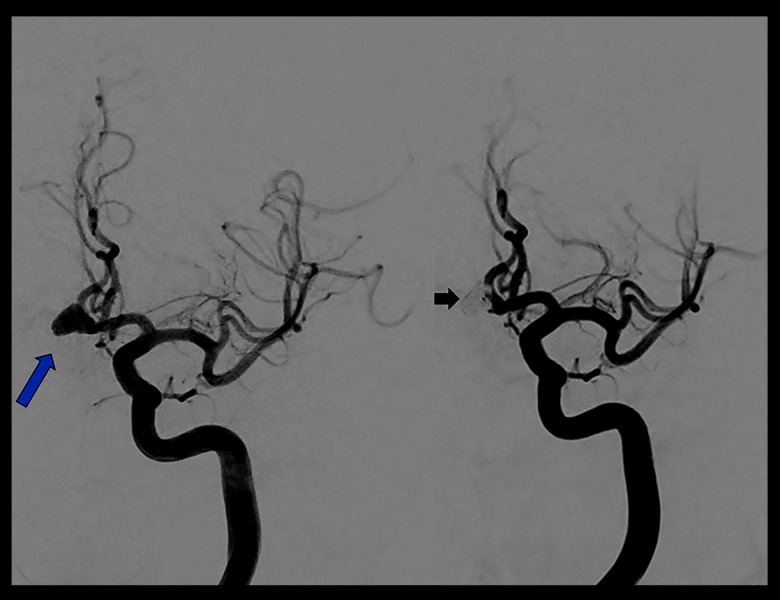
BACKGROUND Terson's syndrome (TS) is a medical condition characterized by intraocular bleeding that can lead to visual impairment and is associated to subarachnoid hemorrhage (SAH). The pathophysiology and natural history are not well established in the current literature. This report describes successful treatment of a 52-year-old man with aneurysmal SAH who developed late-onset TS using balloon-assisted coiling and vitrectomy to raise awareness of this important complication of aneurysmal SAH. CASE REPORT A 52-year-old smoker with no known past medical history presented to the emergency department with a sudden, severe headache that worsened with photophobia and phonophobia. The patient had a diffuse SAH and underwent an embolization procedure. After 48 hours of close Intensive Care Unit monitoring, the patient's vital signs were stable, and the GCS score was consistently 15/15. However, after 3 weeks in the hospital, the patient experienced blurred vision and a right upper quadrantanopia. Further examination revealed TS and the patient underwent a vitrectomy in 1 eye. The surgery was successful and the eye recovered to 20/20 with no complications. However, the other eye showed slow absorption of the hemorrhage, and a vitrectomy was scheduled for that eye as well. CONCLUSIONS TS is a complication of aneurysmal SAH that can lead to vision loss and increased morbidity. It often goes undiagnosed, and ophthalmologists are not regularly consulted. Late manifestation of the condition is exemplified by the present case. Early detection and intervention are crucial for better patient outcomes.
泰森综合征(TS)是一种以眼内出血为特征的病症,可导致视力损害,并与蛛网膜下腔出血(SAH)相关。目前文献中对其病理生理学和自然病史尚未明确。本报告描述了一名52岁动脉瘤性SAH男性患者的成功治疗过程,该患者发生了迟发性TS,采用球囊辅助弹簧圈栓塞术和玻璃体切除术进行治疗,以提高对动脉瘤性SAH这一重要并发症的认识。病例报告:一名52岁吸烟者,既往无已知病史,因突发剧烈头痛就诊于急诊科,畏光和声ophobia使头痛加重。患者发生弥漫性SAH并接受了栓塞手术。在重症监护病房密切监测48小时后,患者生命体征稳定,格拉斯哥昏迷评分(GCS)始终为15/15。然而,住院3周后,患者出现视力模糊和右上象限偏盲。进一步检查发现为TS,患者一只眼睛接受了玻璃体切除术。手术成功,该眼恢复至20/20视力且无并发症。然而,另一只眼睛的出血吸收缓慢,也计划为该眼进行玻璃体切除术。结论:TS是动脉瘤性SAH的一种并发症,可导致视力丧失和发病率增加。它常常未被诊断出来,且眼科医生也未被常规咨询。本例体现了该病症的晚期表现。早期发现和干预对于改善患者预后至关重要。