Jamil Saba, Afzal Rabia, Khan Shanza Rauf, Shabbir Mehwish, Alhokbany Norah, Li Songnan, Saeed Ashraf Janjua Muhammad Ramzan
Super Light Materials and Nanotechnology Laboratory, Department of Chemistry, University of Agriculture Faisalabad 38000 Pakistan.
Department of Chemistry, College of Science, King Saud University Riyadh 11451 Saudi Arabia.
RSC Adv. 2024 Jul 31;14(33):23973-23986. doi: 10.1039/d4ra02476a. eCollection 2024 Jul 26.
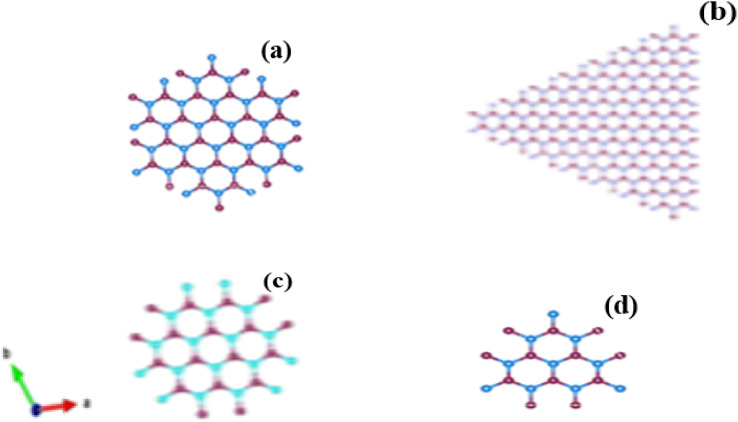
Graphene nano dots (GNDs) are an intriguing emerging class of materials at the nano scale with distinctive characteristics and exciting potential applications. Graphene oxide was synthesized in a lab setting using a modified version of Hummers' approach and used as a precursor for synthesis of graphene nano dots. Graphene oxide is then treated through hydrothermal treatment to produce GNDs with exact control over their size and form. Synthesized graphene nano dots were subjected to various instruments to study morphology, crystallinity, size and other properties. UV-visible spectroscopy was used to detect the maximum absorbance of light. For functional group identification, FTIR analysis was conducted. X-ray diffraction analysis explained structural composition and various other parameters , crystal size and diameter, which was further verified by Vesta software. Surface morphology of GNDs was analyzed by scanning electron microscopy. AFM analysis of GNDs demonstrates the topography of the surface. The photo degradation of the indigo carmine dye by the GNDs also demonstrates their superiority as UV-visible light driven photo catalysts. To evaluate the results, the thermodynamics and kinetics of the degradation reactions are examined. The effects of several factors, such as temperature, initial concentration, time, pH and catalyst concentration, are also investigated. The data will be analyzed statistically by regression and correlation analysis using dependent and independent variables, regression coefficient and other statistical techniques.
石墨烯纳米点(GNDs)是一类在纳米尺度上颇具吸引力的新兴材料,具有独特的特性和令人兴奋的潜在应用。在实验室环境中,采用改良的Hummers法合成了氧化石墨烯,并将其用作合成石墨烯纳米点的前驱体。然后通过水热处理氧化石墨烯,以精确控制所制备的石墨烯纳米点的尺寸和形态。对合成的石墨烯纳米点使用各种仪器来研究其形态、结晶度、尺寸和其他性质。利用紫外可见光谱检测光的最大吸光度。通过傅里叶变换红外光谱(FTIR)分析进行官能团鉴定。X射线衍射分析解释了结构组成以及各种其他参数,如晶体尺寸和直径,这通过Vesta软件进一步得到验证。通过扫描电子显微镜分析石墨烯纳米点的表面形态。原子力显微镜(AFM)对石墨烯纳米点的分析展示了其表面形貌。石墨烯纳米点对靛蓝胭脂红染料的光降解也证明了它们作为紫外可见光驱动光催化剂的优越性。为了评估结果,研究了降解反应的热力学和动力学。还研究了温度、初始浓度、时间、pH值和催化剂浓度等几个因素的影响。将使用因变量和自变量、回归系数及其他统计技术,通过回归和相关性分析对数据进行统计分析。