Whitmer Shannon L M, Whitesell Amy, Mobley Melissa, Talundzic Emir, Shedroff Elizabeth, Cossaboom Caitlin M, Messenger Sharon, Deldari Mojgan, Bhatnagar Julu, Estetter Lindsey, Zufan Sara, Cannon Debi, Chiang Cheng-Feng, Gibbons Ardith, Krapiunaya Inna, Morales-Betoulle Maria, Choi Mary, Knust Barbara, Amman Brian, Montgomery Joel M, Shoemaker Trevor, Klena John D
Viral Special Pathogens Branch, U.S. Centers for Disease Control and Prevention (CDC), 1600 Clifton Rd., NE Atlanta, GA, 30333, USA.
Zoonotic and Vector-borne Diseases Section, Viral and Rickettsial Disease Laboratory, California Department of Public Health, Richmond, CA, 94804, USA.
Lancet Reg Health Am. 2024 Jul 11;37:100836. doi: 10.1016/j.lana.2024.100836. eCollection 2024 Sep.
In the United States (U.S.), hantavirus pulmonary syndrome (HPS) and non-HPS hantavirus infection are nationally notifiable diseases. Criteria for identifying human cases are based on clinical symptoms (HPS or non-HPS) and acute diagnostic results (IgM+, rising IgG+ titers, RT-PCR+, or immunohistochemistry (IHC)+). Here we provide an overview of diagnostic testing and summarize human Hantavirus disease occurrence and genotype distribution in the U.S. from 2008 to 2020.
Epidemiological data from the national hantavirus registry was merged with laboratory diagnostic testing results performed at the CDC. Residual hantavirus-positive specimens were sequenced, and the available epidemiological and genetic data sets were linked to conduct a genomic epidemiological study of hantavirus disease in the U.S.
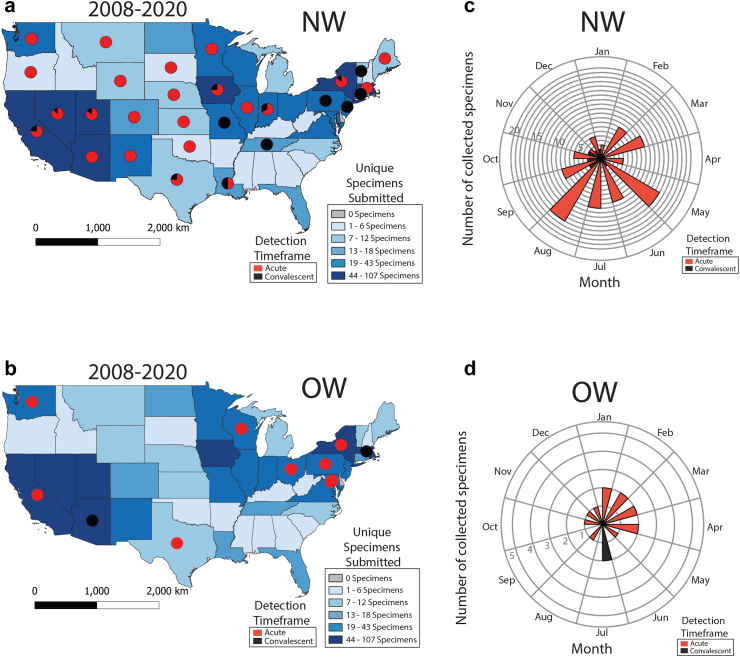
From 1993 to 2020, 833 human hantavirus cases have been identified, and from 2008 to 2020, 335 human cases have occurred. Among New World (NW) hantavirus cases detected at the CDC diagnostic laboratory (representing 29.2% of total cases), most (85.0%) were detected during acute disease, however, some convalescent cases were detected in states not traditionally associated with hantavirus infections (Connecticut, Missouri, New Jersey, Pennsylvania, Tennessee, and Vermont). From 1993 to 2020, 94.9% (745/785) of U.S. hantaviruses cases were detected west of the Mississippi with 45.7% (359/785) in the Four Corners region of the U.S. From 2008 to 2020, 67.7% of NW hantavirus cases were detected between the months of March and August. Sequencing of RT-PCR-positive cases demonstrates a geographic separation of species [Sin Nombre virus (SNV), New York virus, and Monongahela virus]; however, there is a large gap in viral sequence data from the Northwestern and Central U.S. Finally, these data indicate that commercial IgM assays are not concordant with CDC-developed assays, and that "concordant positive" (i.e., commercial IgM+ and CDC IgM+ results) specimens exhibit clinical characteristics of hantavirus disease.
Hantaviral disease is broadly distributed in the contiguous U.S, viral variants are localised to specific geographic regions, and hantaviral disease infrequently detected in most Southeastern states. Discordant results between two diagnostic detection methods highlight the need for an improved standardised testing plan in the U.S. Hantavirus surveillance and detection will continue to improve with clearly defined, systematic reporting methods, as well as explicit guidelines for clinical characterization and diagnostic criteria.
This work was funded by core funds provided to the Viral Special Pathogens Branch at CDC.
在美国,汉坦病毒肺综合征(HPS)和非HPS汉坦病毒感染均为国家法定报告疾病。人类病例的识别标准基于临床症状(HPS或非HPS)以及急性诊断结果(IgM阳性、IgG滴度升高、逆转录聚合酶链反应(RT-PCR)阳性或免疫组织化学(IHC)阳性)。在此,我们概述了诊断检测情况,并总结了2008年至2020年美国人类汉坦病毒病的发病情况及基因型分布。
将国家汉坦病毒登记处的流行病学数据与美国疾病控制与预防中心(CDC)进行的实验室诊断检测结果相结合。对剩余的汉坦病毒阳性标本进行测序,并将可用的流行病学和基因数据集关联起来,以开展美国汉坦病毒病的基因组流行病学研究。
1993年至2020年期间,共确诊833例人类汉坦病毒病例,2008年至2020年期间,共出现335例人类病例。在CDC诊断实验室检测到的新大陆(NW)汉坦病毒病例中(占总病例数的29.2%),大多数(85.0%)是在急性疾病期间检测到的,不过,在一些传统上与汉坦病毒感染无关的州(康涅狄格州、密苏里州、新泽西州、宾夕法尼亚州、田纳西州和佛蒙特州)也检测到了一些恢复期病例。1993年至2020年,美国94.9%(745/785)的汉坦病毒病例在密西西比河以西被检测到,其中45.7%(359/785)在美国四角地区。2008年至2020年,67.7%的NW汉坦病毒病例在3月至8月期间被检测到。对RT-PCR阳性病例的测序显示了不同物种[辛诺柏病毒(SNV)、纽约病毒和莫农加希拉病毒]的地理分隔;然而,美国西北部和中部的病毒序列数据存在很大差距。最后,这些数据表明,商业IgM检测与CDC开发的检测方法不一致,且“一致阳性”(即商业IgM阳性和CDC IgM阳性结果)标本呈现出汉坦病毒病的临床特征。
汉坦病毒病在美国本土广泛分布,病毒变种局限于特定地理区域,且在大多数东南部州很少检测到汉坦病毒病。两种诊断检测方法之间的不一致结果凸显了美国需要改进标准化检测方案。随着明确、系统的报告方法以及临床特征和诊断标准的明确指南的出现,汉坦病毒监测和检测将不断改善。
这项工作由提供给CDC病毒特殊病原体分支的核心资金资助。