Alan Dikmen Hacer, Gönenç İlknur Münevver, Ataş Ayşe Nur
Faculty of Health Sciences, Department of Midwifery, Selcuk University, Selcuklu, 42250, Konya, Turkey.
Faculty of Nursing, Department of Midwifery, Ankara University, Ankara, Turkey.
Arch Gynecol Obstet. 2025 Jun;311(6):1579-1589. doi: 10.1007/s00404-024-07656-2. Epub 2024 Aug 5.
The aim of this study was to evaluate the effects of using peanut balls on labor pain, fatigue, and the mother's perception of labor.
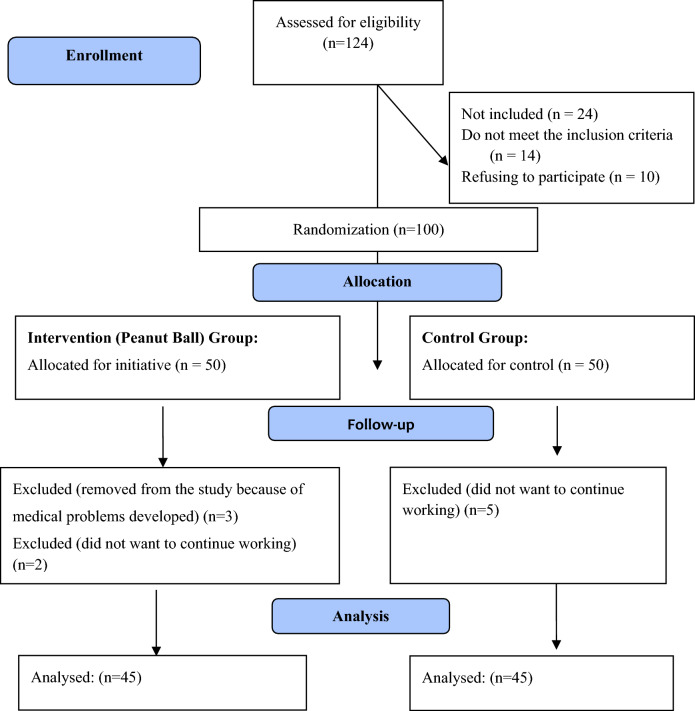
This is a randomized controlled intervention trial. Data were collected from the Intervention (peanut ball) and Control groups between July 2022 and June 2023, with 45 pregnant women in each group. Data were collected using a personal information form, the Visual Analog Scale-Pain (VAS-P), the Visual Analog Scale for Fatigue (VAS-F), and the Maternal Perception of Childbirth Scale (MPCS).
The VAS-P scores of the intervention group were statistically significantly lower than those of the control group 15 min after peanut ball application (p = .000). Immediately after and 15 min after peanut ball application, the mean fatigue score of the Intervention group was statistically significantly lower than that of the Control group (p = .000). There was no statistically significant difference between the mean duration of labor minutes in the two groups (p = .177). The mean MPCS scores of the intervention group and control groups were 62.73 + 7.30 and 47.17 + 9.12, respectively, and the difference was statistically significant (p = .000).
The findings of this study indicate that the use of peanut balls during labor can effectively reduce labor pain and fatigue in pregnant women, without affecting the duration of labor. Additionally, the use of peanut balls has been shown to positively influence the perception of labor among pregnant women. Therefore, it is recommended that midwives educate pregnant women about the use of peanut balls during labor and provide support in their use.
本研究旨在评估使用花生球对分娩疼痛、疲劳以及母亲对分娩的感知的影响。
这是一项随机对照干预试验。在2022年7月至2023年6月期间从干预组(花生球组)和对照组收集数据,每组45名孕妇。使用个人信息表、视觉模拟疼痛量表(VAS-P)、疲劳视觉模拟量表(VAS-F)和分娩母亲感知量表(MPCS)收集数据。
在使用花生球15分钟后,干预组的VAS-P评分在统计学上显著低于对照组(p = .000)。在使用花生球后即刻和15分钟后,干预组的平均疲劳评分在统计学上显著低于对照组(p = .000)。两组之间的平均分娩分钟时长没有统计学上的显著差异(p = .177)。干预组和对照组的平均MPCS评分分别为62.73 + 7.30和47.17 + 9.12,差异具有统计学意义(p = .000)。
本研究结果表明,分娩期间使用花生球可有效减轻孕妇的分娩疼痛和疲劳,且不影响分娩时长。此外,使用花生球已被证明对孕妇的分娩感知有积极影响。因此,建议助产士对孕妇进行关于分娩期间使用花生球的教育,并在其使用过程中提供支持。