State Key Laboratory for Conservation and Utilization of Bio-Resources & Key Laboratory for Microbial Resources of the Ministry of Education, School of Life Sciences, Yunnan University, Kunming, 650091, P. R. China.
Kunming Key Laboratory of Respiratory Disease, Kunming University, Kunming, 650214, P. R. China.
Microb Cell Fact. 2024 Aug 6;23(1):219. doi: 10.1186/s12934-024-02494-y.
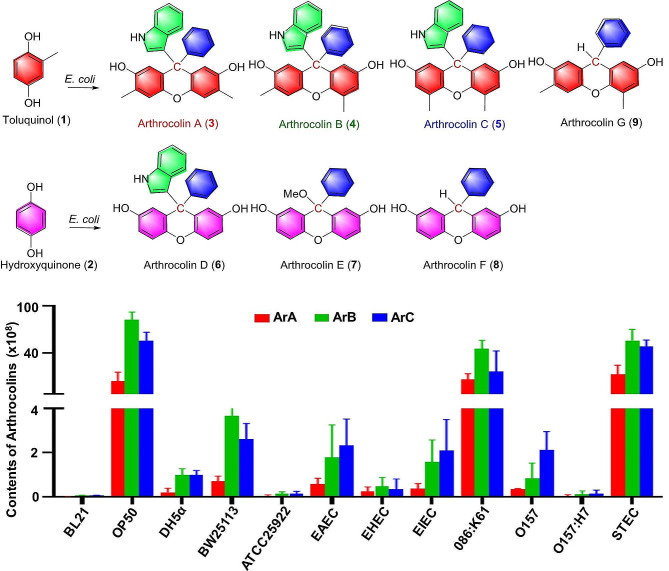
Xanthenes and multi-aryl carbon core containing compounds represent different types of complex and condensed architectures that have impressive wide range of pharmacological, industrial and synthetic applications. Moreover, indoles as building blocks were only found in naturally occurring metabolites with di-aryl carbon cores and in chemically synthesized tri-aryl carbon core containing compounds. Up to date, rare xanthenes with indole bearing multicaryl carbon core have been reported in natural or synthetic products. The underlying mechanism of fluorescein-like arthrocolins with tetra-arylmethyl core were synthesized in an engineered Escherichia coli fed with toluquinol remained unclear.
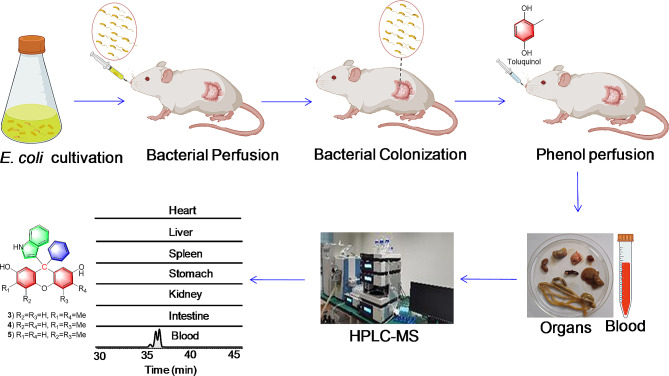
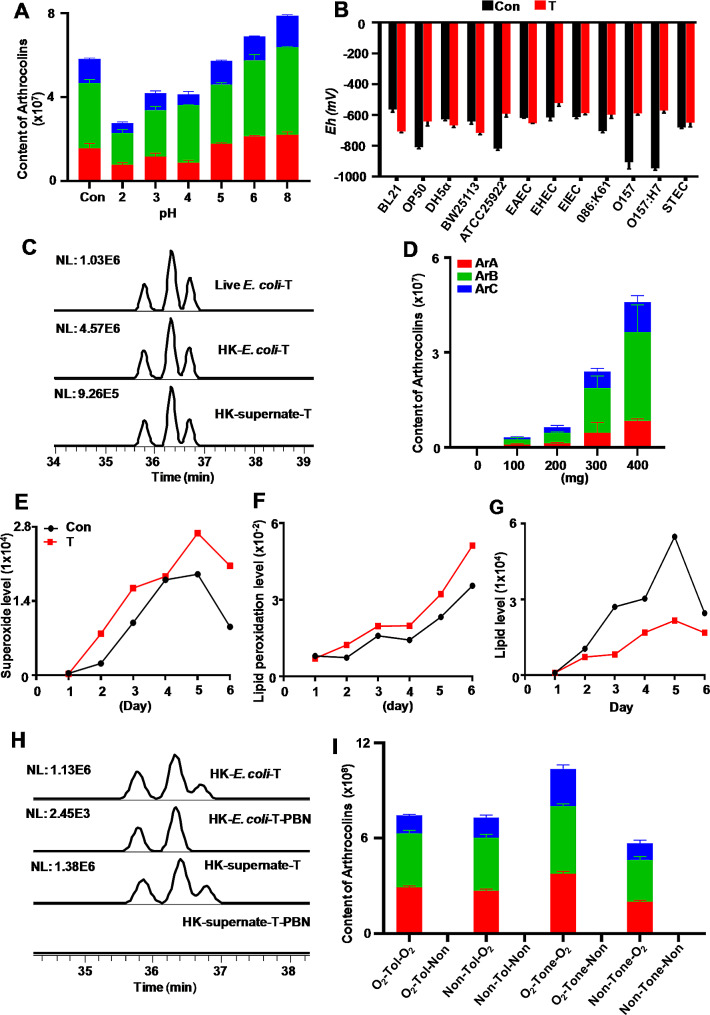
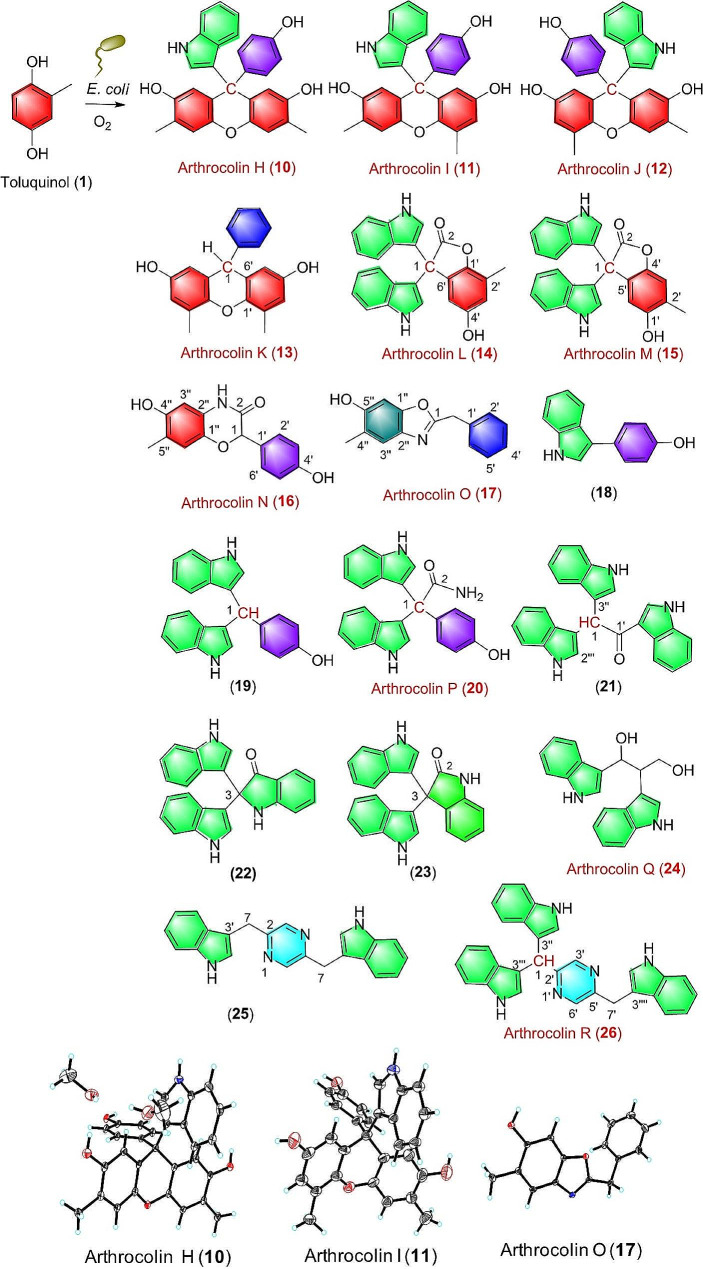
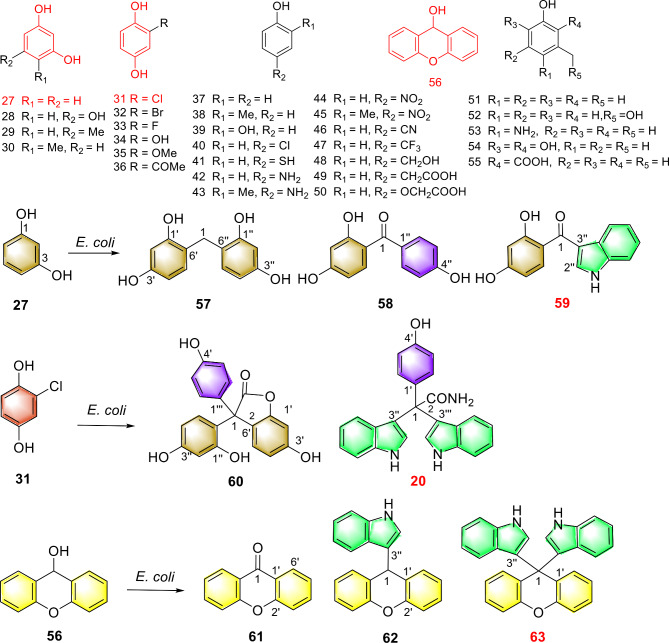
In this study, the Keio collection of single gene knockout strains of 3901 mutants of E. coli BW25113, together with 14 distinct E. coli strains, was applied to explore the origins of endogenous building blocks and the biogenesis for arthrocolin assemblage. Deficiency in bacterial respiratory and aromatic compound degradation genes ubiX, cydB, sucA and ssuE inhibited the mutant growth fed with toluquinol. Metabolomics of the cultures of 3897 mutants revealed that only disruption of tnaA involving in transforming tryptophan to indole, resulted in absence of arthrocolins. Further media optimization, thermal cell killing and cell free analysis indicated that a non-enzyme reaction was involved in the arthrocolin biosynthesis in E. coli. Evaluation of redox potentials and free radicals suggested that an oxygen-mediated free radical reaction was responsible for arthrocolins formation in E. coli. Regulation of oxygen combined with distinct phenol derivatives as inducer, 31 arylmethyl core containing metabolites including 13 new and 8 biological active, were isolated and characterized. Among them, novel arthrocolins with p-hydroxylbenzene ring from tyrosine were achieved through large scale of aerobic fermentation and elucidated x-ray diffraction analysis. Moreover, most of the known compounds in this study were for the first time synthesized in a microbe instead of chemical synthesis. Through feeding the rat with toluquinol after colonizing the intestines of rat with E. coli, arthrocolins also appeared in the rat blood.
Our findings provide a mechanistic insight into in vivo synthesis of complex and condensed arthrocolins induced by simple phenols and exploits a quinol based method to generate endogenous aromatic building blocks, as well as a methylidene unit, for the bacteria-facilitated synthesis of multiarylmethanes.
氧杂蒽和多芳基碳核心化合物代表了不同类型的复杂和浓缩结构,具有广泛的药理学、工业和合成应用。此外,吲哚作为构建块仅存在于具有二芳基碳核心的天然存在代谢物和化学合成的三芳基碳核心化合物中。迄今为止,在天然或合成产物中已报道了带有吲哚的罕见氧杂蒽和多芳基碳核心。在以甲苯醌醇为食的工程大肠杆菌中合成具有四芳基甲基核心的类荧光素arthrocolins 的潜在机制尚不清楚。
在这项研究中,应用了京瓷公司的大肠杆菌 BW25113 的 3901 个突变体的单基因敲除菌株的集合,以及 14 种不同的大肠杆菌菌株,来探索内源性构建块的起源和 arthrocolin 组装的生物发生。细菌呼吸和芳香化合物降解基因 ubiX、cydB、sucA 和 ssuE 的缺陷抑制了以甲苯醌醇为食的突变体的生长。对 3897 个突变体的培养物进行代谢组学分析表明,只有涉及将色氨酸转化为吲哚的 tnaA 的缺失会导致 arthrocolins 缺失。进一步的培养基优化、热细胞杀伤和无细胞分析表明,非酶反应参与了大肠杆菌中的 arthrocolin 生物合成。氧化还原电势和自由基的评估表明,氧介导的自由基反应负责大肠杆菌中 arthrocolins 的形成。氧气的调节与不同的酚衍生物作为诱导剂相结合,分离并鉴定了 31 种芳基甲基核心代谢物,包括 13 种新的和 8 种具有生物活性的代谢物。其中,通过大规模有氧发酵从酪氨酸中获得了带有对羟基苯环的新型 arthrocolins,并通过 X 射线衍射分析进行了阐明。此外,本研究中的大多数已知化合物均首次在微生物中而不是通过化学合成合成。通过用大肠杆菌定植大鼠肠道后给大鼠喂食甲苯醌醇,也在大鼠血液中出现了 arthrocolins。
我们的发现提供了对简单酚诱导的复杂和浓缩 arthrocolins 的体内合成的机制见解,并利用基于喹啉的方法产生内源性芳香族构建块,以及亚甲基单元,用于细菌促进的多芳基甲烷合成。