Telethon Kids Institute, The University of Western Australia, 35 Stirling Highway, Perth, WA, 6009, Australia.
School of Population and Global Health, The University of Western Australia, 35 Stirling Highway, Perth, WA, 6009, Australia.
Int J Behav Nutr Phys Act. 2024 Sep 2;21(1):97. doi: 10.1186/s12966-024-01645-z.
Knowledge of developmental trends in meeting age-specific 24-hour movement behaviour guidelines is lacking. This study describes developmental trends in device-measured physical activity and sedentary time over a three-year period among Western Australian children aged two to seven years, including differences between boys and girls. The proportion of children meeting age-specific physical activity guidelines before and after they transition to full-time school was also examined.
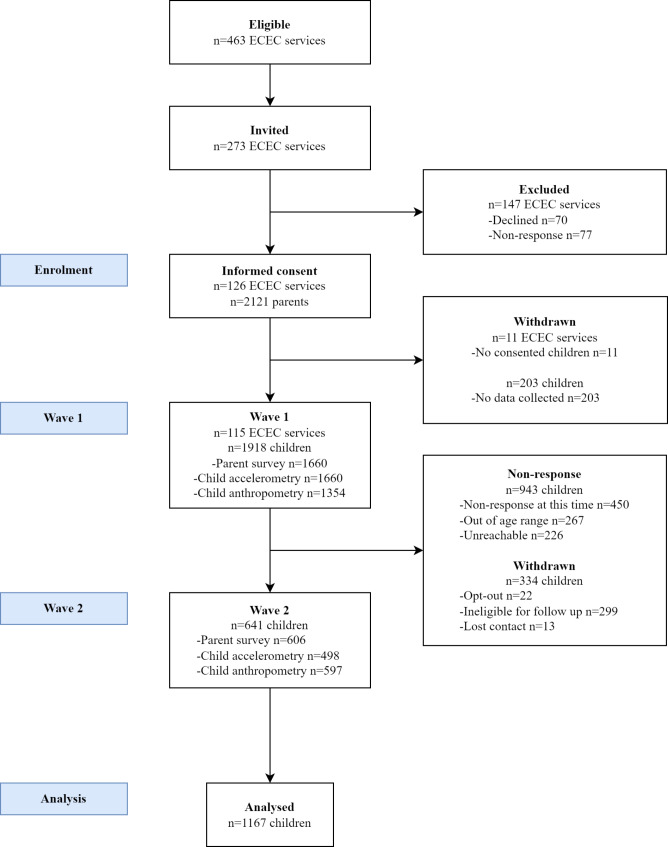
Data from waves 1 and 2 of the Play Spaces and Environments for Children's Physical Activity (PLAYCE) cohort study were used (analysis n = 1217). Physical activity and sedentary time were measured by accelerometry at ages two to five (preschool, wave 1) and ages five to seven (commenced full-time school, wave 2). Accelerometer data were processed using a validated machine-learning physical activity classification model. Daily time spent in sedentary behaviour, energetic play (moderate-to-vigorous physical activity (MVPA)), total physical activity, and meeting physical activity guidelines were analysed using linear and generalised linear mixed-effects models with age by sex interaction terms.
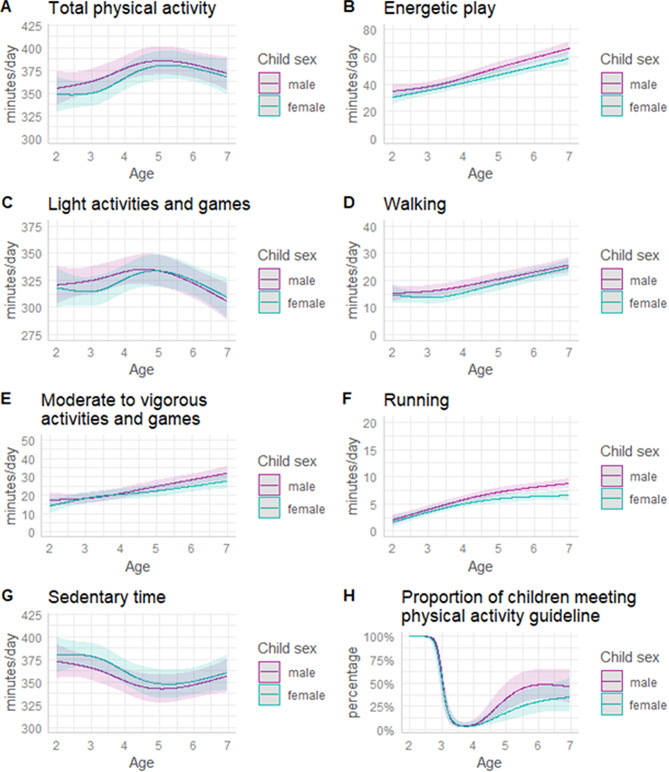
All movement behaviours changed significantly with increasing age, and trends were similar in boys and girls. Total daily physical activity increased from age two to five then declined to age seven. Mean daily total physical activity exceeded 180 min/day from ages two to five. Daily energetic play increased significantly from age two to seven, however, was below 60 min/day at all ages except for seven-year-old boys. Daily sedentary time decreased to age five then increased to age seven but remained lower than at age two. All two-year-olds met their age-specific physical activity guideline, decreasing to 5% of girls and 6% of boys at age four. At age seven, 46% of boys and 35% of girls met their age-specific physical activity guideline.
Young children's energetic play and total physical activity increased with age, but few children aged three to seven met the energetic play (MVPA) guideline. Interventions should focus on increasing children's energetic play in early childhood. Clearer guidance and strategies are needed to support young children as they change developmentally and as they transition from one age-specific movement guideline to the next.
缺乏关于满足特定年龄 24 小时运动行为指南的发展趋势的知识。本研究描述了西澳大利亚 2 至 7 岁儿童在三年内通过设备测量的身体活动和久坐时间的发展趋势,包括男孩和女孩之间的差异。还检查了这些儿童在过渡到全日制学校前后达到特定年龄的身体活动指南的比例。
使用 Play Spaces and Environments for Children's Physical Activity (PLAYCE) 队列研究的第 1 波和第 2 波的数据(分析 n=1217)。在 2 至 5 岁(学前,第 1 波)和 5 至 7 岁(开始全日制学校,第 2 波)期间,通过加速度计测量身体活动和久坐时间。使用经过验证的机器学习身体活动分类模型处理加速度计数据。使用线性和广义线性混合效应模型以及年龄与性别交互项分析每天久坐时间、活跃玩耍(中等到剧烈体力活动(MVPA))、总身体活动和满足身体活动指南的情况。
所有运动行为都随着年龄的增长而显著变化,男孩和女孩的趋势相似。总日身体活动量从 2 岁增加到 5 岁,然后在 7 岁时下降。从 2 岁到 5 岁,每天的总身体活动量超过 180 分钟。从 2 岁到 7 岁,每天的活跃玩耍显著增加,但除了 7 岁的男孩外,所有年龄的活动量都低于 60 分钟。每天的久坐时间在 5 岁时下降,然后在 7 岁时增加,但仍低于 2 岁时的水平。所有 2 岁的儿童都达到了他们特定年龄的身体活动指南,到 4 岁时,女孩下降到 5%,男孩下降到 6%。在 7 岁时,46%的男孩和 35%的女孩达到了他们特定年龄的身体活动指南。
幼儿的活跃玩耍和总身体活动量随着年龄的增长而增加,但只有少数 3 至 7 岁的儿童达到了能量活跃(MVPA)指南。干预措施应侧重于增加幼儿的活跃玩耍。需要更明确的指导和策略,以支持幼儿在发展过程中的变化,以及从一个特定年龄的运动指南过渡到下一个指南。