Ying Xiaoqian, Gao Yi, Liao Limin
Beijing Tsinghua Changgung Hospital, School of Clinical Medicine, Tsinghua University, Beijing 102218, China.
Rehabilitation School, Capital Medical University, Beijing Boai Hospital, China Rehabilitation Research Center, Beijing 100068, China.
J Clin Med. 2024 Jul 23;13(15):4284. doi: 10.3390/jcm13154284.
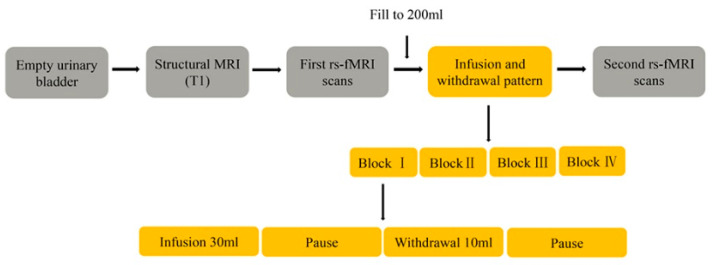
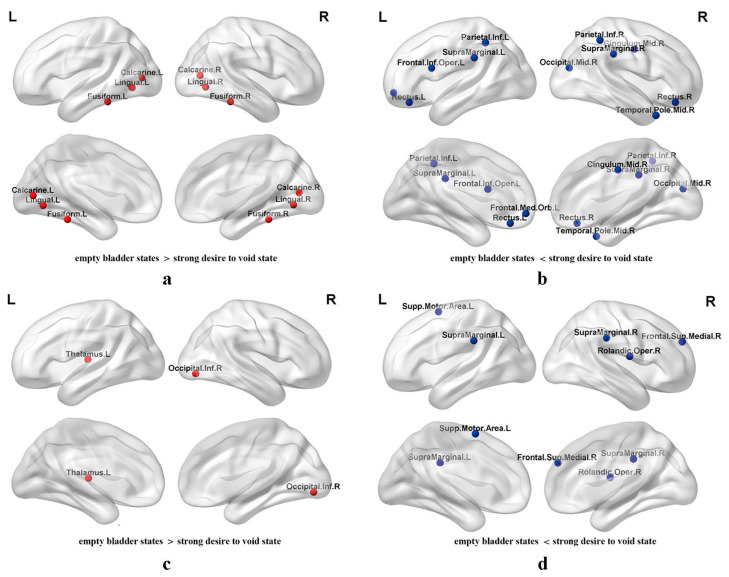
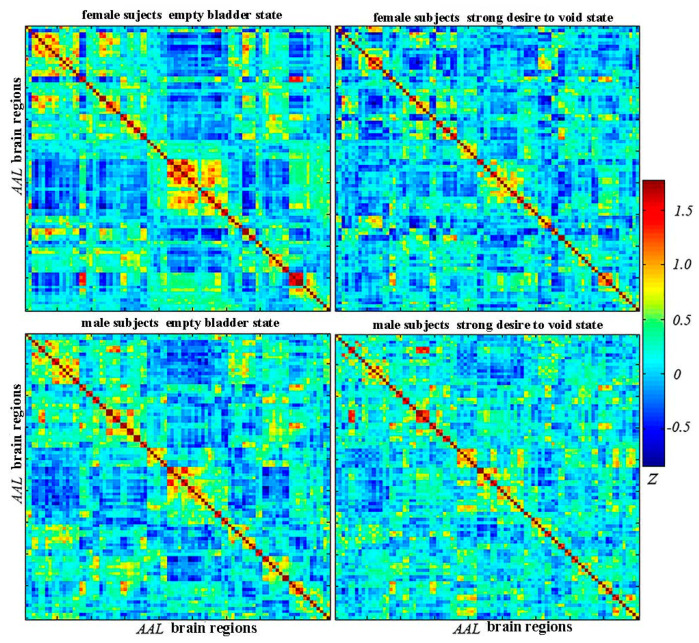
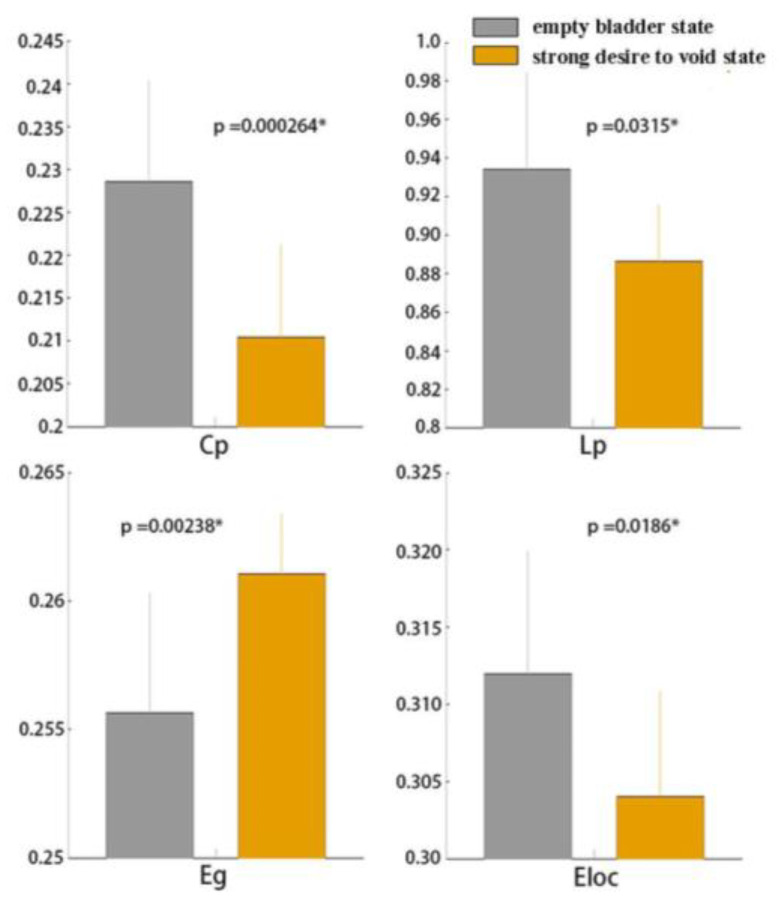
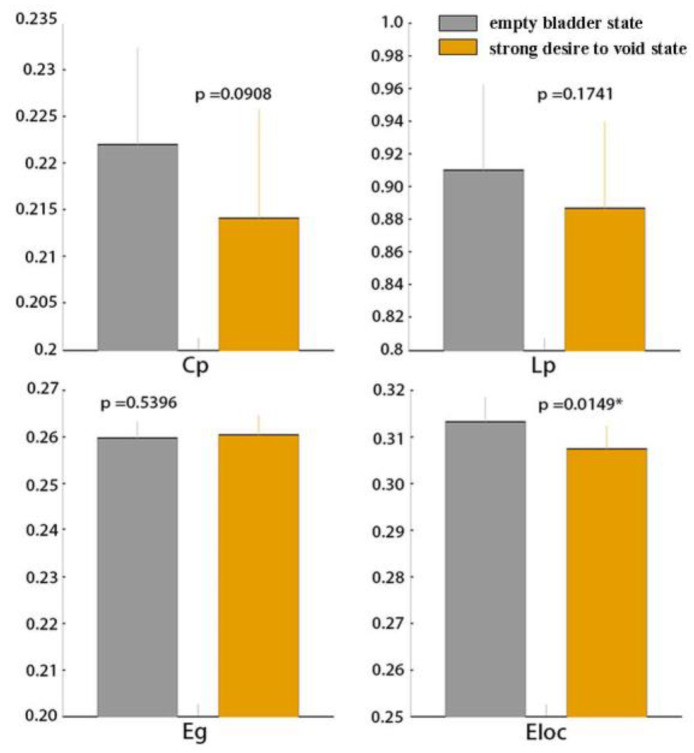
The alternations of brain responses to a strong desire to void were unclear, and the gender differences under the strong desire to void remain controversial. The present study aims to identify the functional brain network's topologic property changes evoked by a strong desire to void in healthy male and female adults with synchronous urodynamics using a graph theory analysis. The bladders of eleven healthy males and eleven females were filled via a catheter using a specific infusion and withdrawal pattern. A resting-state functional magnetic resonance imaging (fMRI) was performed on the enrolled subjects, scanning under both the empty bladder and strong desire to void states. An automated anatomical labeling (AAL) atlas was used to identify the ninety cortical and subcortical regions. Pearson's correlation calculations were performed to establish a brain connection matrix. A paired -test ( < 0.05) and Bonferroni correction were applied to identify the significant statistical differences in topological properties between the two states, including small-world network property parameters [gamma (γ) and lambda (λ)], characteristic path length (L), clustering coefficient (C), global efficiency (E), local efficiency (E), and regional nodal efficiency (E). The final data suggested that females and males had different brain response patterns to a strong desire to void, compared with an empty bladder state. More brain regions involving emotion, cognition, and social work were active in females, and males might obtain a better urinary continence via a compensatory mechanism.
大脑对强烈排尿欲望的反应变化尚不清楚,并且在强烈排尿欲望下的性别差异仍存在争议。本研究旨在通过图论分析,确定在同步尿动力学检查中,健康成年男性和女性因强烈排尿欲望而诱发的功能性脑网络拓扑特性变化。通过导管使用特定的灌注和抽回模式对11名健康男性和11名女性的膀胱进行充盈。对纳入的受试者进行静息态功能磁共振成像(fMRI),在膀胱空虚和强烈排尿欲望状态下进行扫描。使用自动解剖标记(AAL)图谱来识别90个皮质和皮质下区域。进行Pearson相关性计算以建立脑连接矩阵。应用配对检验(<0.05)和Bonferroni校正来识别两种状态之间拓扑特性的显著统计学差异,包括小世界网络特性参数[γ(γ)和λ(λ)]、特征路径长度(L)、聚类系数(C)、全局效率(E)、局部效率(E)和区域节点效率(E)。最终数据表明,与膀胱空虚状态相比,女性和男性对强烈排尿欲望有不同的脑反应模式。女性中更多涉及情绪、认知和社会工作的脑区活跃,而男性可能通过代偿机制获得更好的尿失禁控制。