Division of Computer Science and Engineering, University of Michigan, 2260 Hayward St, Ann Arbor, 48109, MI, USA.
Division of Pediatric Endocrinology, University of Michigan, 1540 E Hospital Dr, Ann Arbor, 48109, MI, USA.
Comput Biol Med. 2024 Sep;180:108995. doi: 10.1016/j.compbiomed.2024.108995. Epub 2024 Aug 9.
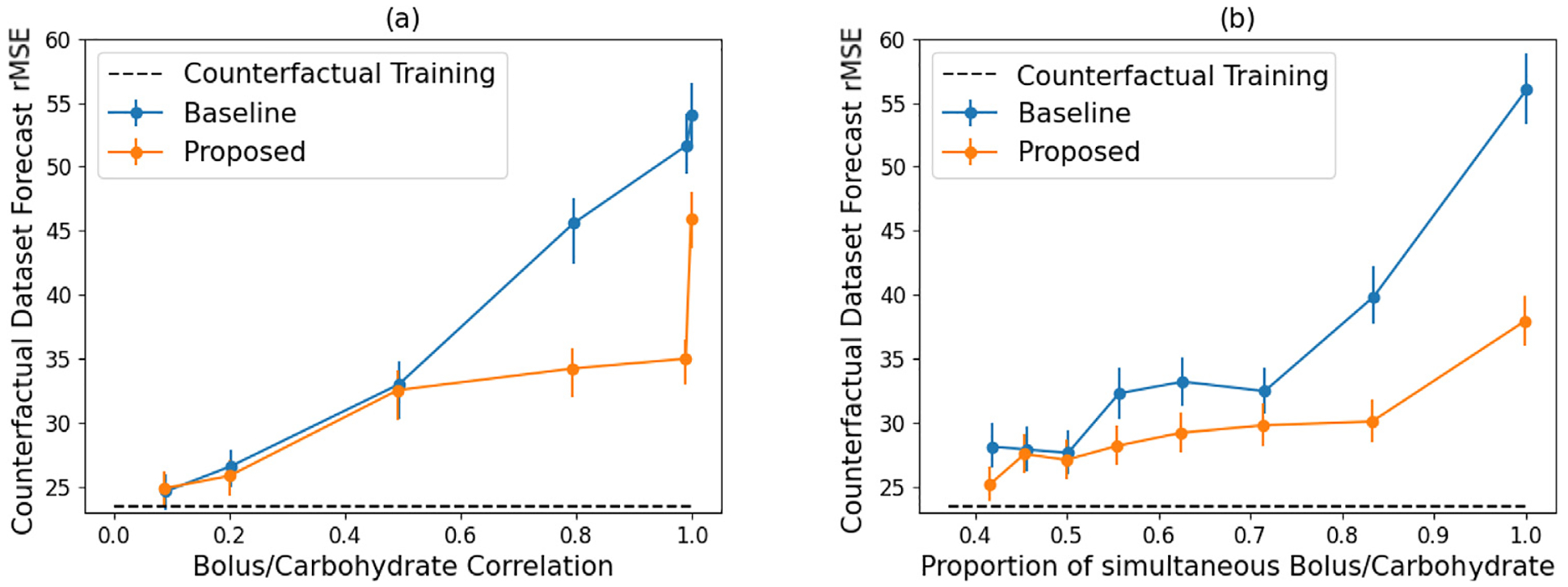
Type 1 diabetes (T1D) presents a significant health challenge, requiring patients to actively manage their blood glucose (BG) levels through regular bolus insulin administration. Automated control solutions based on machine learning (ML) models could reduce the need for manual patient intervention. However, the accuracy of current models falls short of what is needed. This is due in part to the fact that these models are often trained on data collected using a basal bolus (BB) strategy, which results in substantial entanglement between bolus insulin and carbohydrate intake. Under standard training approaches, this entanglement can lead to inaccurate forecasts in a control setting, ultimately resulting in poor BG management. To address this, we propose a novel algorithm for training BG forecasters that disentangles the effects of insulin and carbohydrates. By exploiting correction bolus values and leveraging the monotonic effect of insulin on BG, our method accurately captures the independent effects of insulin and carbohydrates on BG. Using an FDA-approved simulator, we evaluated our approach on 10 individuals across 30 days of data. Our approach achieved on average higher time in range compared to standard approaches (81.1% [95% confidence interval (CI) 80.3,81.9] vs 53.6% [95%CI 52.7,54.6], p<0.001), indicating that our approach is able to reliably maintain healthy BG levels in simulated individuals, while baseline approaches are not. Utilizing proxy metrics, our approach also demonstrates potential for improved control on three real world datasets, paving the way for advancements in ML-based BG management.
1 型糖尿病(T1D)是一个重大的健康挑战,需要患者通过定期给予胰岛素推注来积极管理血糖(BG)水平。基于机器学习(ML)模型的自动控制解决方案可以减少患者的手动干预需求。然而,当前模型的准确性仍不尽如人意。部分原因是这些模型通常是在使用基础-推注(BB)策略收集的数据上进行训练的,这导致推注胰岛素和碳水化合物摄入之间存在实质性的纠缠。在标准训练方法下,这种纠缠可能会导致控制环境下的预测不准确,最终导致 BG 管理不善。为了解决这个问题,我们提出了一种新的训练 BG 预测器的算法,该算法可以分离胰岛素和碳水化合物的影响。通过利用校正推注值和利用胰岛素对 BG 的单调效应,我们的方法准确地捕捉到了胰岛素和碳水化合物对 BG 的独立影响。使用 FDA 批准的模拟器,我们在 10 名个体的 30 天数据上评估了我们的方法。与标准方法相比,我们的方法平均在范围内的时间更高(81.1%[95%置信区间(CI)80.3,81.9]比 53.6%[95%CI 52.7,54.6],p<0.001),这表明我们的方法能够可靠地维持模拟个体的健康 BG 水平,而基线方法则不能。利用代理指标,我们的方法还表明在三个真实世界数据集上具有改善控制的潜力,为基于 ML 的 BG 管理的进展铺平了道路。