
一种新型益生菌配方BLLL,通过减轻神经炎症和增加神经营养因子来改善慢性应激诱导的小鼠抑郁样行为。
A novel probiotic formula, BLLL, ameliorates chronic stress-induced depression-like behaviors in mice by reducing neuroinflammation and increasing neurotrophic factors.
作者信息
Ye Minxiu, Ji Feng, Huang Chao, Li Fu, Zhang Changliang, Zhang Yu, Wang Runxin, Ma Kai, Lu Xu, Wang Hui
机构信息
Department of Pharmacy, Kunshan Hospital of Traditional Chinese Medicine, Kunshan, China.
Jiangsu Biodep Biotechnology, Jiangyin, China.
出版信息
Front Pharmacol. 2024 Jul 26;15:1398292. doi: 10.3389/fphar.2024.1398292. eCollection 2024.
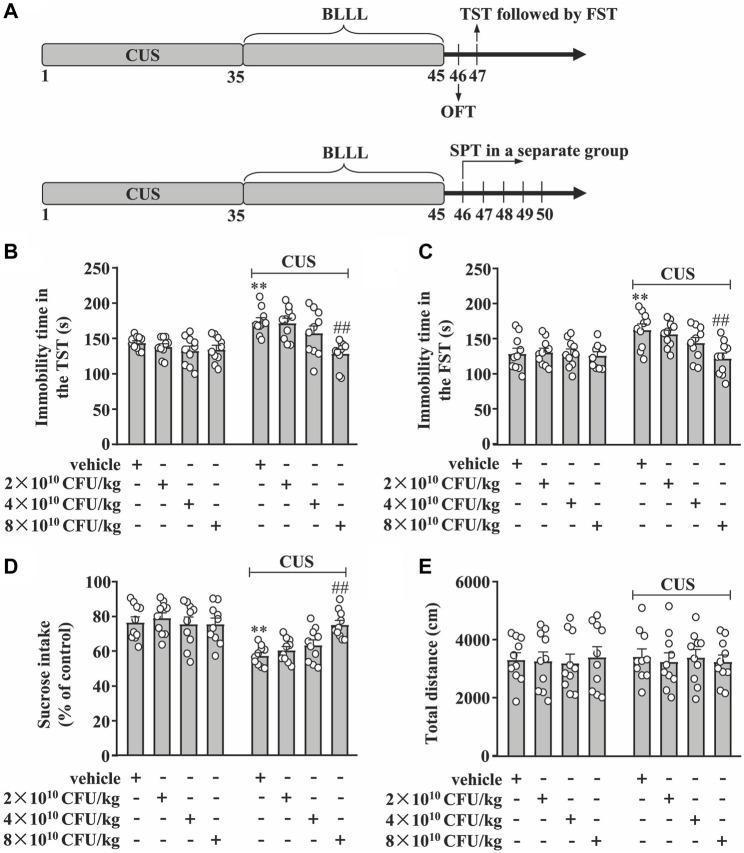
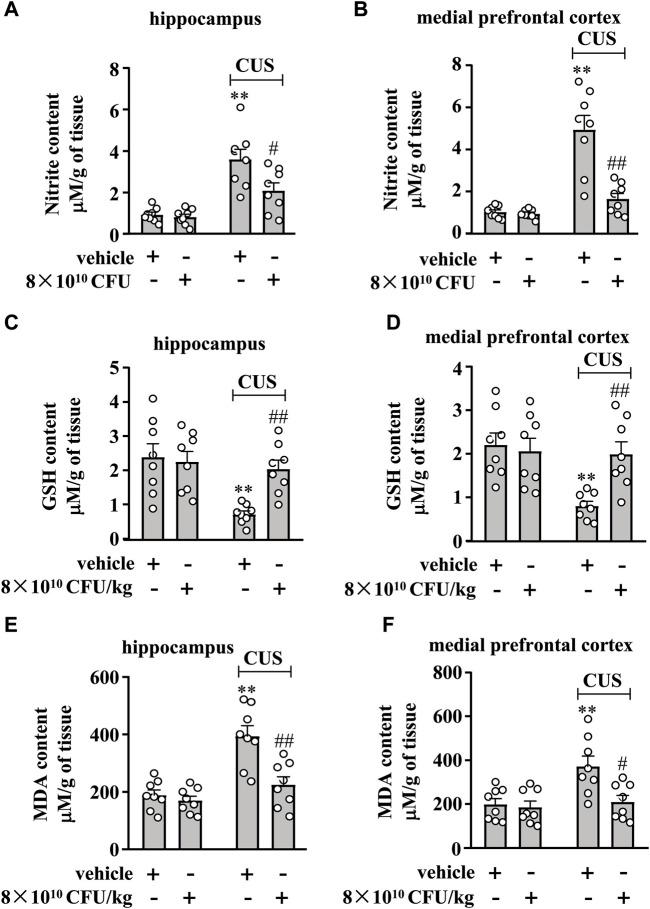
Probiotics have been recognized for their various biological activities, including antioxidant and anti-inflammatory properties. This study investigates the therapeutic effect of a novel probiotic formula, BLLL, consisting of , , , and , on chronic stress-induced depression-like behaviors in mice. The BLLL formula or phosphate-buffered saline (PBS) was given orally at a dose of 2, 4, or 8 × 10 CFU/kg once daily for 10 days in mice treated with chronic unpredictable stress (CUS) treated or vehicle. Depression-like behaviors were assessed using the sucrose preference test (SPT), the forced swimming test (FST), and the tail suspension test (TST). The mRNA and/or protein expression of interleukin-1β (IL-1β), IL-6, tumor necrosis factor-α (TNF-α), IL-4, IL-10, and chitinase-3-like protein 3 (CHI3L1, also known as Ym-1), as well as the concentration of nitrite, malondialdehyde (MDA), glutathione (GSH), and brain-derived neurotrophic factor (BDNF) in the hippocampus and medial prefrontal cortex were examined. The BLLL formula treatment at a dose of 8 × 10 CFU/kg, but not at a dose of 2 or 4 × 10 CFU/kg, improved CUS-induced depression-like behaviors in mice, as shown by the decrease in immobility time in the TST and FST and the increase in sucrose intake in the SPT. Further analysis revealed that BLLL treatment suppressed the CUS-induced increase in IL-1β, IL-6, and TNF-α mRNA and protein levels, as well as the CUS-induced decrease in IL-4, IL-10, and Ym-1 mRNA and/or protein levels in the hippocampus and medial prefrontal cortex. In addition, treatment with the BLLL formula countered the CUS-induced increase in nitrite and MDA levels and the CUS-induced decrease in GSH content and BDNF concentration in the hippocampus and medial prefrontal cortex. These results demonstrate that the novel probiotic formula BLLL ameliorates chronic stress-induced depression-like behavior in mice by suppressing neuroinflammation and oxido-nitrosative stress in the brain.
益生菌因其多种生物活性而受到认可,包括抗氧化和抗炎特性。本研究调查了一种新型益生菌配方BLLL(由[具体成分]组成)对慢性应激诱导的小鼠抑郁样行为的治疗效果。在接受慢性不可预测应激(CUS)处理的小鼠或对照小鼠中,以2×10⁸、4×10⁸或8×10⁸CFU/kg的剂量每天口服一次BLLL配方或磷酸盐缓冲盐水(PBS),持续10天。使用蔗糖偏好试验(SPT)、强迫游泳试验(FST)和悬尾试验(TST)评估抑郁样行为。检测海马体和内侧前额叶皮质中白细胞介素-1β(IL-1β)、IL-6、肿瘤坏死因子-α(TNF-α)、IL-4、IL-10和几丁质酶-3样蛋白3(CHI3L1,也称为Ym-1)的mRNA和/或蛋白表达,以及亚硝酸盐、丙二醛(MDA)、谷胱甘肽(GSH)和脑源性神经营养因子(BDNF)的浓度。8×10⁸CFU/kg剂量的BLLL配方治疗可改善CUS诱导的小鼠抑郁样行为,而2×10⁸或4×10⁸CFU/kg剂量则无此效果,表现为TST和FST中不动时间减少以及SPT中蔗糖摄入量增加。进一步分析表明,BLLL治疗可抑制CUS诱导的海马体和内侧前额叶皮质中IL-1β、IL-6和TNF-α mRNA及蛋白水平的升高,以及CUS诱导的IL-4、IL-10和Ym-1 mRNA和/或蛋白水平的降低。此外,BLLL配方治疗可对抗CUS诱导的海马体和内侧前额叶皮质中亚硝酸盐和MDA水平的升高以及GSH含量和BDNF浓度的降低。这些结果表明,新型益生菌配方BLLL通过抑制大脑中的神经炎症和氧化亚硝化应激来改善慢性应激诱导的小鼠抑郁样行为。




 Zotero 插件