School of Public Health, Hebei Medical University, No.361, Zhongshan East Road, Shijiazhuang, Hebei Province, 050017, China.
Hebei Provincial Center for Disease Control and Prevention, No.97, Huai'an East Road, Shijiazhuang, Hebei Province, 050021, China.
BMC Public Health. 2024 Aug 12;24(1):2171. doi: 10.1186/s12889-024-19590-8.
Influenza, an acute infectious respiratory disease, presents a significant global health challenge. Accurate prediction of influenza activity is crucial for reducing its impact. Therefore, this study seeks to develop a hybrid Convolution Neural Network-Long Short Term Memory neural network (CNN-LSTM) model to forecast the percentage of influenza-like-illness (ILI) rate in Hebei Province, China. The aim is to provide more precise guidance for influenza prevention and control measures.
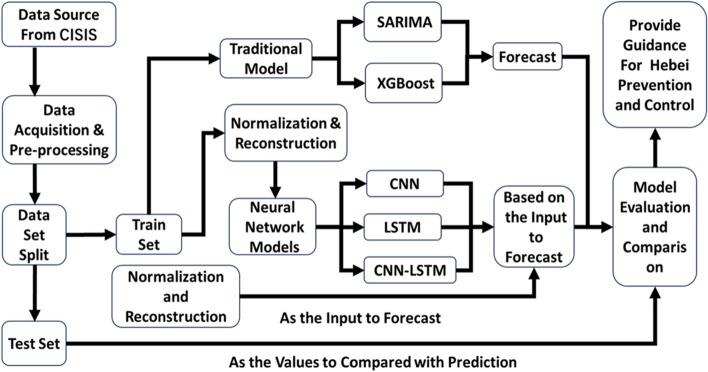
Using ILI% data from 28 national sentinel hospitals in the Hebei Province, spanning from 2010 to 2022, we employed the Python deep learning framework PyTorch to develop the CNN-LSTM model. Additionally, we utilized R and Python to develop four other models commonly used for predicting infectious diseases. After constructing the models, we employed these models to make retrospective predictions, and compared each model's prediction performance using mean absolute error (MAE), root mean square error (RMSE), mean absolute percentage error (MAPE), and other evaluation metrics.
Based on historical ILI% data from 28 national sentinel hospitals in Hebei Province, the Seasonal Auto-Regressive Indagate Moving Average (SARIMA), Extreme Gradient Boosting (XGBoost), Convolution Neural Network (CNN), Long Short Term Memory neural network (LSTM) models were constructed. On the testing set, all models effectively predicted the ILI% trends. Subsequently, these models were used to forecast over different time spans. Across various forecasting periods, the CNN-LSTM model demonstrated the best predictive performance, followed by the XGBoost model, LSTM model, CNN model, and SARIMA model, which exhibited the least favorable performance.
The hybrid CNN-LSTM model had better prediction performances than the SARIMA model, CNN model, LSTM model, and XGBoost model. This hybrid model could provide more accurate influenza activity projections in the Hebei Province.
流感是一种急性传染病,对全球健康构成重大挑战。准确预测流感活动对于减轻其影响至关重要。因此,本研究旨在开发一种卷积神经网络-长短期记忆神经网络(CNN-LSTM)混合模型,以预测中国河北省流感样疾病(ILI)发病率的百分比。目的是为流感防控措施提供更精确的指导。
利用河北省 28 家国家级哨点医院 2010 年至 2022 年的 ILI%数据,我们使用 Python 深度学习框架 PyTorch 开发了 CNN-LSTM 模型。此外,我们还利用 R 和 Python 开发了常用于预测传染病的另外四种模型。在构建模型后,我们使用这些模型进行回顾性预测,并使用平均绝对误差(MAE)、均方根误差(RMSE)、平均绝对百分比误差(MAPE)等评价指标比较了每个模型的预测性能。
基于河北省 28 家国家级哨点医院的历史 ILI%数据,构建了季节性自回归求和移动平均(SARIMA)、极端梯度提升(XGBoost)、卷积神经网络(CNN)、长短期记忆神经网络(LSTM)模型。在测试集上,所有模型都能有效预测 ILI%趋势。随后,这些模型被用于不同时间段的预测。在不同的预测期内,CNN-LSTM 模型表现出最佳的预测性能,其次是 XGBoost 模型、LSTM 模型、CNN 模型和 SARIMA 模型,后者表现出最差的性能。
与 SARIMA 模型、CNN 模型、LSTM 模型和 XGBoost 模型相比,混合 CNN-LSTM 模型具有更好的预测性能。该混合模型可以提供更准确的河北省流感活动预测。