
临床算法中的种族调整可以帮助纠正数据质量方面的种族差异。
Race adjustments in clinical algorithms can help correct for racial disparities in data quality.
机构信息
Booth School of Business, University of Chicago, Chicago, IL 60637.
School of Public Health, University of California, Berkeley, CA 94704.
出版信息
Proc Natl Acad Sci U S A. 2024 Aug 20;121(34):e2402267121. doi: 10.1073/pnas.2402267121. Epub 2024 Aug 13.
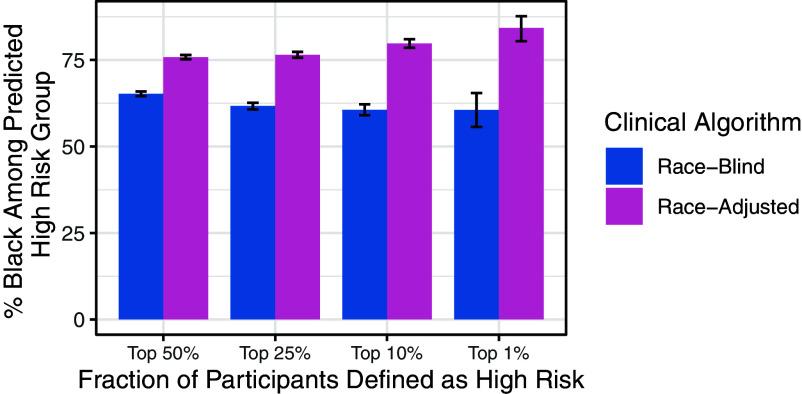
Despite ethical and historical arguments for removing race from clinical algorithms, the consequences of removal remain unclear. Here, we highlight a largely undiscussed consideration in this debate: varying data quality of input features across race groups. For example, family history of cancer is an essential predictor in cancer risk prediction algorithms but is less reliably documented for Black participants and may therefore be less predictive of cancer outcomes. Using data from the Southern Community Cohort Study, we assessed whether race adjustments could allow risk prediction models to capture varying data quality by race, focusing on colorectal cancer risk prediction. We analyzed 77,836 adults with no history of colorectal cancer at baseline. The predictive value of self-reported family history was greater for White participants than for Black participants. We compared two cancer risk prediction algorithms-a race-blind algorithm which included standard colorectal cancer risk factors but not race, and a race-adjusted algorithm which additionally included race. Relative to the race-blind algorithm, the race-adjusted algorithm improved predictive performance, as measured by goodness of fit in a likelihood ratio test (-value: <0.001) and area under the receiving operating characteristic curve among Black participants (-value: 0.006). Because the race-blind algorithm underpredicted risk for Black participants, the race-adjusted algorithm increased the fraction of Black participants among the predicted high-risk group, potentially increasing access to screening. More broadly, this study shows that race adjustments may be beneficial when the data quality of key predictors in clinical algorithms differs by race group.
尽管从伦理和历史角度来看,将种族因素从临床算法中去除具有合理性,但去除种族因素的后果仍不明确。在这里,我们强调了这一辩论中一个很大程度上未被讨论的考虑因素:不同种族群体的输入特征数据质量存在差异。例如,癌症家族史是癌症风险预测算法中的一个重要预测因素,但对于黑人参与者来说,其记录往往不太可靠,因此对癌症结果的预测性可能较低。我们使用南方社区队列研究的数据,评估了种族调整是否可以使风险预测模型通过种族来捕捉不同的数据质量,重点关注结直肠癌风险预测。我们分析了 77836 名基线时没有结直肠癌病史的成年人。与黑人参与者相比,白人参与者的自我报告家族史对预测价值的影响更大。我们比较了两种癌症风险预测算法:一种是不考虑种族的盲目种族算法,它包括标准的结直肠癌风险因素,但不包括种族;另一种是种族调整算法,它额外包括了种族因素。与盲目种族算法相比,种族调整算法提高了预测性能,表现在似然比检验中的拟合优度(-值:<0.001)和黑人参与者的接收者操作特征曲线下面积(-值:0.006)方面有所提高。由于盲目种族算法低估了黑人参与者的风险,因此种族调整算法增加了预测高危组中黑人参与者的比例,可能会增加筛查的机会。更广泛地说,这项研究表明,当临床算法中关键预测因素的数据质量因种族群体而异时,种族调整可能是有益的。

 Zotero 插件