Universidade de São Paulo, Faculdade de Odontologia de Bauru, Departamento de Odontopediatria, Ortodontia e Saúde Coletiva, Bauru, Brasil.
University of Michigan, Department of Pediatric Dentistry, EUA.
J Appl Oral Sci. 2024 Aug 9;32:e20230462. doi: 10.1590/1678-7757-2023-0462. eCollection 2024.
Several materials have been developed to preserve pulp vitality. They should have ideal cytocompatibility characteristics to promote the activity of stem cells of human exfoliated deciduous teeth (SHED) and thus heal pulp tissue.
To evaluate the cytotoxicity of different dilutions of bioceramic material extracts in SHED.
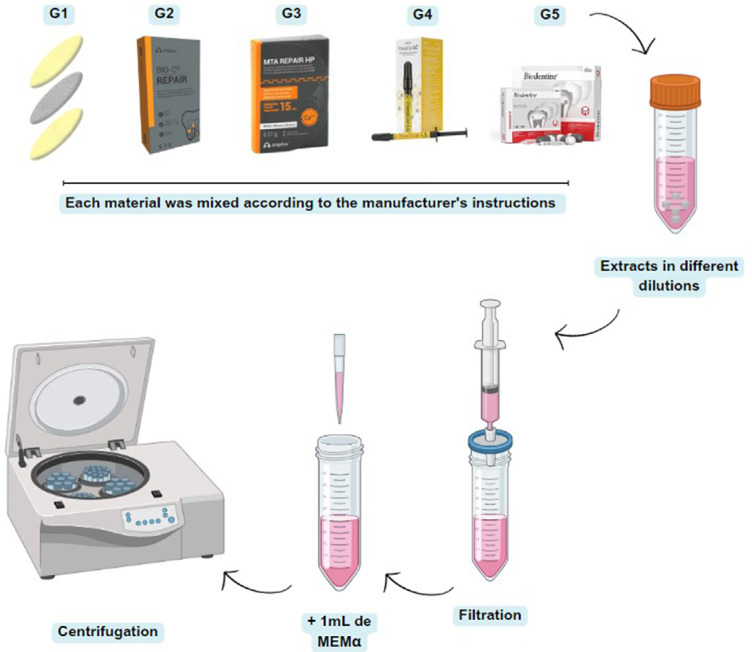
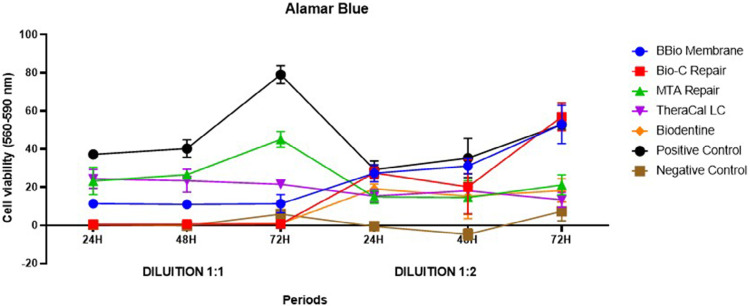
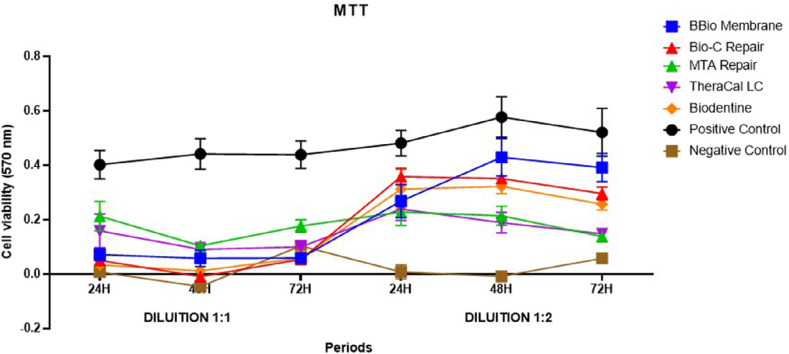
SHED were immersed in αMEM + the material extract according to the following experimental groups: Group 1 (G1) -BBio membrane, Group 2 (G2) - Bio-C Repair, Group 3 (G3) - MTA Repair HP, Group 4 (G4) - TheraCal LC, and Group 5 (G5) - Biodentine. Positive and negative control groups were maintained respectively in αMEM + 10% FBS and Milli-Q Water. The methods to analyze cell viability and proliferation involved MTT and Alamar Blue assays at 24, 48, and 72H after the contact of the SHED with bioceramic extracts at 1:1 and 1:2 dilutions. Data were analyzed by the three-way ANOVA, followed by Tukey's test (p<0.05).
At 1:1 dilution, SHED in contact with the MTA HP Repair extract showed statistically higher cell viability than the other experimental groups and the negative control (p<0.05), except for TheraCal LC (p> 0.05). At 1:2 dilution, BBio Membrane and Bio-C showed statistically higher values in intra- and intergroup comparisons (p<0.05). BBio Membrane, Bio-C Repair, and Biodentine extracts at 1:1 dilution showed greater cytotoxicity than 1:2 dilution in all periods (p<0.05).
MTA HP Repair showed the lowest cytotoxicity even at a 1:1 dilution. At a 1:2 dilution, the SHED in contact with the BBio membrane extract showed high cell viability. Thus, the BBio membrane would be a new non-cytotoxic biomaterial for SHED. Results offer possibilities of biomaterials that can be indicated for use in clinical regenerative procedures of the dentin-pulp complex.
已经开发出多种材料来保存牙髓活力。它们应该具有理想的细胞相容性特征,以促进人脱落乳牙(SHED)干细胞的活性,从而治愈牙髓组织。
评估不同稀释度生物陶瓷材料提取物在 SHED 中的细胞毒性。
SHED 分别浸泡在 αMEM+材料提取物中,分为以下实验组:第 1 组(G1)-BBio 膜,第 2 组(G2)-Bio-C 修复剂,第 3 组(G3)-MTA 修复 HP,第 4 组(G4)-TheraCal LC,第 5 组(G5)-Biodentine。阳性和阴性对照组分别保存在含 10%FBS 的αMEM 和 Milli-Q 水中。分析细胞活力和增殖的方法包括 MTT 和 Alamar Blue 测定法,在 SHED 与生物陶瓷提取物接触 24、48 和 72 小时后,提取物以 1:1 和 1:2 的稀释度进行。采用三因素方差分析,然后进行 Tukey 检验(p<0.05)。
在 1:1 稀释度下,与其他实验组和阴性对照组相比,接触 MTA HP 修复提取物的 SHED 细胞活力更高(p<0.05),除了 TheraCal LC(p>0.05)。在 1:2 稀释度下,BBio 膜和 Bio-C 在组内和组间比较中显示出统计学上更高的值(p<0.05)。在所有时期,1:1 稀释度下的 BBio 膜、Bio-C 修复剂和 Biodentine 提取物的细胞毒性均高于 1:2 稀释度(p<0.05)。
即使在 1:1 稀释度下,MTA HP 修复剂的细胞毒性也最低。在 1:2 稀释度下,接触 BBio 膜提取物的 SHED 具有较高的细胞活力。因此,BBio 膜可能是一种用于 SHED 的新型非细胞毒性生物材料。研究结果为牙髓-牙本质复合体的临床再生治疗提供了可能的生物材料选择。