Hernandez Diana M, Soliman Amr S, Lewis Almira G C, Garcés-Palacio Isabel C
Department of Sociomedical Sciences, Mailman School of Public Health, Columbia University, New York, NY, USA.
Department of Community Health and Social Medicine, City University of New York School of Medicine, New York, NY, USA.
J Migr Health. 2024 Jul 26;10:100257. doi: 10.1016/j.jmh.2024.100257. eCollection 2024.
We aimed to compare cancer mortality among foreign- and Colombian populations in Colombia during the period of 2006-2020.
This retrospective study utilized vital statistics from the Colombian National Department of Statistics (DANE). The dataset included variables such as age group, sex, country of permanent residency, insurance, education level, marital status, ethnicity, and cause of death. The population data to calculate rates was obtained from the Colombian census and the United Nations. Crude and adjusted rates as well as proportional mortality rates were calculated.
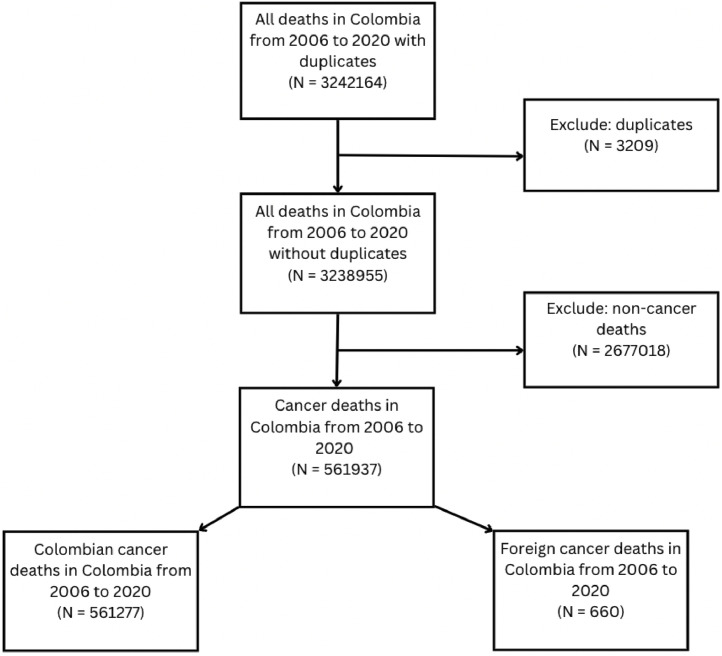
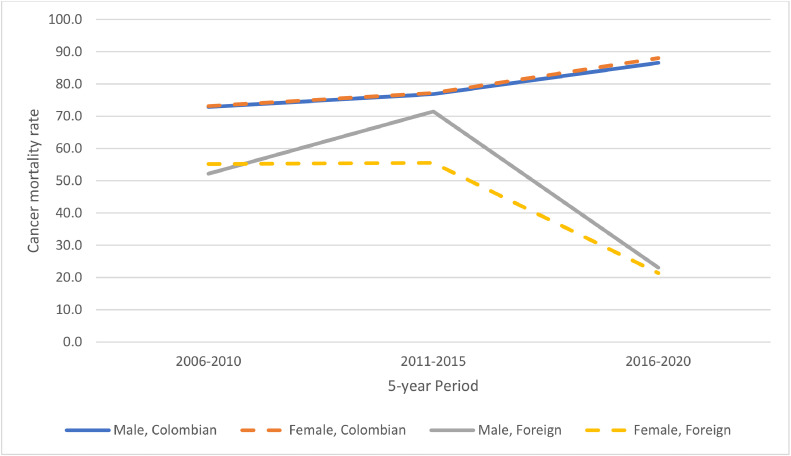
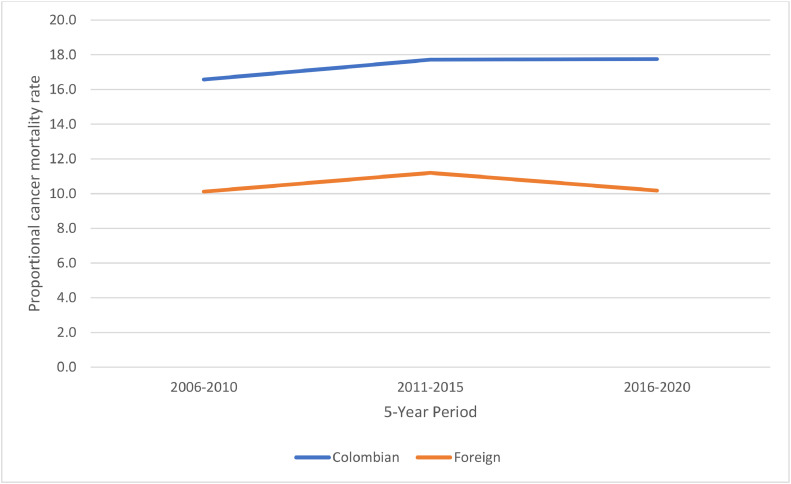
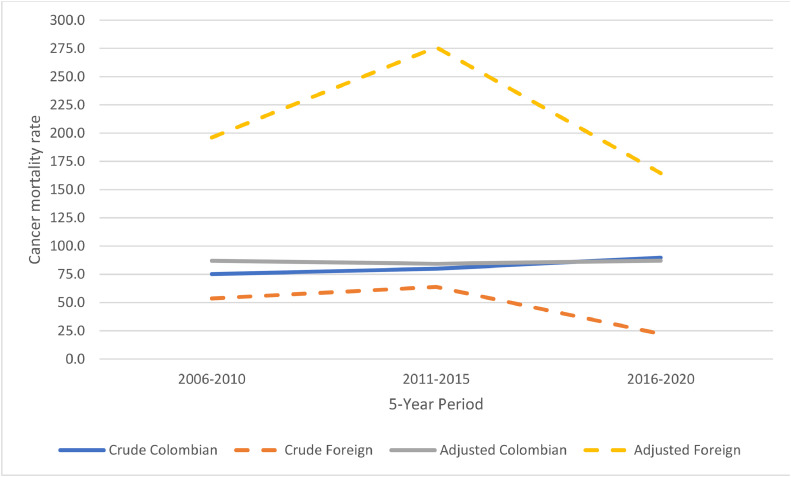
A total of 561,932 cancer deaths occurred in Colombia from 2006 to 2020. The foreign population (country of permanent residency different to Colombia) had a lower crude cancer mortality rate (31.1 per 100,000 inhabitants) than the Colombian population (81.9 per 100,000 inhabitants). However, the age-adjusted cancer mortality rate among the foreign population was 253.6 per 100,000, compared to 86.1 per 100,000 among the Colombian population. The proportional cancer mortality was 10.4 % among foreign population compared to 17.4 % among Colombian population.
The proportional cancer mortality shows that the proportion of cancer-related deaths is greater among the Colombian population compared to the immigrant population. However, immigrants in Colombia have a higher age-adjusted cancer mortality rate than Colombians, indicating that immigrants have worse cancer outcomes than the Colombians even though the immigrant population is younger. This is likely due to the frequent barriers that immigrants encounter in accessing health care in Colombia. Future research needs to focus on access to care for the immigrant population by investigating cancer-related risk factors among immigrants and addressing their barriers to cancer prevention and treatment.
我们旨在比较2006年至2020年期间哥伦比亚外国人口和哥伦比亚人口的癌症死亡率。
这项回顾性研究利用了哥伦比亚国家统计局(DANE)的人口动态统计数据。数据集包括年龄组、性别、永久居住国、保险、教育水平、婚姻状况、种族和死亡原因等变量。用于计算比率的人口数据来自哥伦比亚人口普查和联合国。计算了粗死亡率和调整后死亡率以及比例死亡率。
2006年至2020年期间,哥伦比亚共有561,932例癌症死亡病例。外国人口(永久居住国与哥伦比亚不同)的粗癌症死亡率(每10万居民31.1例)低于哥伦比亚人口(每10万居民81.9例)。然而,外国人口的年龄调整后癌症死亡率为每10万253.6例,而哥伦比亚人口为每10万86.1例。外国人口的癌症比例死亡率为10.4%,而哥伦比亚人口为17.4%。
癌症比例死亡率表明,与移民人口相比,哥伦比亚人口中与癌症相关的死亡比例更高。然而,哥伦比亚的移民年龄调整后癌症死亡率高于哥伦比亚人,这表明即使移民人口更年轻,他们的癌症结局也比哥伦比亚人更差。这可能是由于移民在哥伦比亚获得医疗保健时经常遇到障碍。未来的研究需要通过调查移民中与癌症相关的风险因素并解决他们在癌症预防和治疗方面的障碍,来关注移民人口获得医疗保健的情况。