Department of Infection Biology, Institute of Medicine, University of Tsukuba, Tsukuba, Japan.
Laboratory of Biochemistry, School of Pharmacy, Kitasato University, Tokyo, Japan.
Microbiol Spectr. 2024 Oct 3;12(10):e0041624. doi: 10.1128/spectrum.00416-24. Epub 2024 Aug 20.
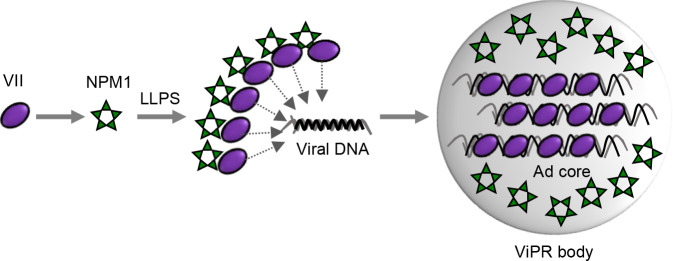
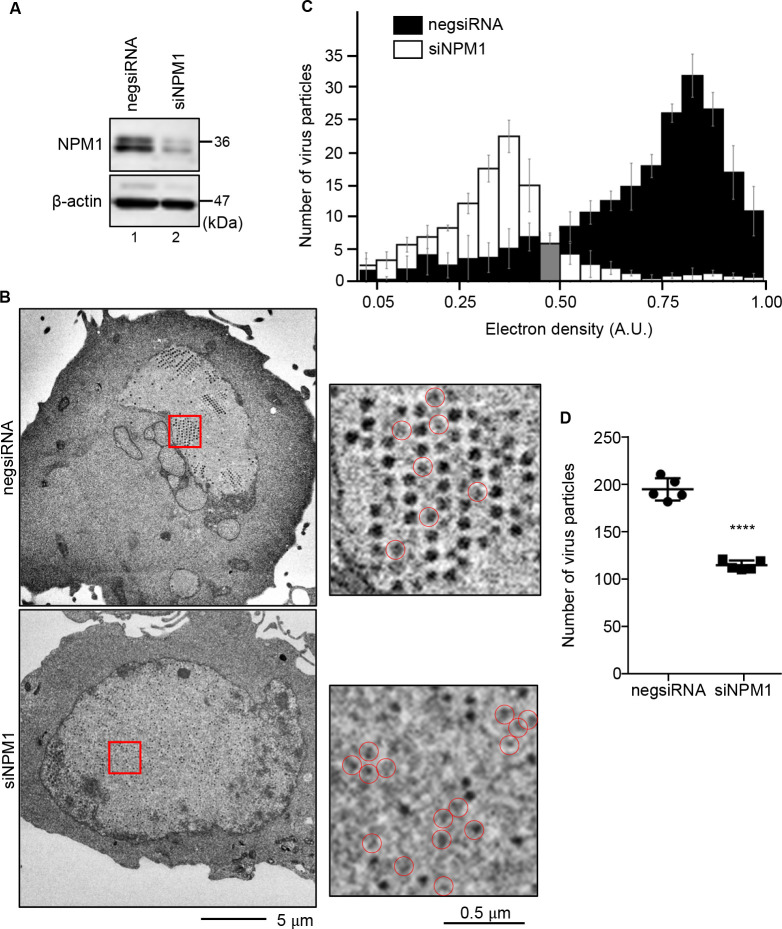
Recent evidence has revealed that the reorganization of nuclear domains is largely mediated by liquid-liquid phase separation (LLPS). During viral infection, numerous nuclear domains undergo significant changes through LLPS for and against the replication of the virus. However, the regulatory mechanism of LLPS in response to viral infection and its detailed functions in viral replication remain unclear. In this study, we found that the activity of the nucleolar protein NPM1, a remodeling factor for the chromatin-like structure of adenovirus DNA, to induce LLPS is required for deposition of adenovirus core protein VII in a subnuclear domain, the virus-induced post-replication (ViPR) body, in the late phases of infection. The interaction between NPM1 and protein VII was responsible for initiating LLPS. The inhibition of LLPS by 1,6-hexanediol treatment resulted in the dispersion of protein VII from the ViPR bodies. These findings suggest that protein VII accumulates in the ViPR bodies in concert with the LLPS formation of NPM1 triggered by protein VII. After photobleaching of EGFP-NPM1 in the ViPR bodies, EGFP-NPM1 showed a relatively fast recovery half-time, indicating the fluid-like properties of NPM1 in this compartment. Importantly, NPM1 depletion decreased the genome packaging in the viral capsids, possibly owing to the formation of a defective adenovirus core. This study highlights the dynamic interplay between viral pathogens and the host nucleus for the reorganization of membrane-less compartments that facilitate their replication.
In this study, we explored how adenoviruses utilize a process known as liquid-liquid phase separation (LLPS) to enhance their replication. We focused on a cellular chromatin remodeling protein, NPM1, which plays a crucial role in nucleolar formation through LLPS. NPM1 facilitates LLPS by interacting with adenovirus protein VII, effectively accumulating protein VII into membrane-less compartments called virus-induced post-replication bodies. NPM1 functions as a molecular chaperone of protein VII to assemble viral chromatin by transferring protein VII to viral DNA. Remarkably, when NPM1 was depleted, this process was disrupted, decreasing viral genome packaging. These findings shed light on a critical aspect of virus-host interactions, illustrating how adenovirus utilizes NPM1-mediated LLPS activity. Our findings provide valuable insights into the dynamic interplay between viruses and the host nucleus.
最近的证据表明,核域的重排主要是通过液-液相分离(LLPS)介导的。在病毒感染过程中,许多核域通过 LLPS 发生显著变化,有利于或不利于病毒的复制。然而,LLPS 对病毒感染的调节机制及其在病毒复制中的详细功能尚不清楚。在这项研究中,我们发现,核仁蛋白 NPM1 的活性,即腺病毒 DNA 染色质样结构重塑因子,诱导 LLPS 对于腺病毒核心蛋白 VII 在感染后期的亚核域,即病毒诱导的复制后(ViPR)体中的沉积是必需的。NPM1 和蛋白 VII 之间的相互作用负责引发 LLPS。用 1,6-己二醇处理抑制 LLPS 会导致蛋白 VII 从 ViPR 体中分散。这些发现表明,蛋白 VII 与蛋白 VII 触发的 NPM1 的 LLPS 形成一起在 ViPR 体中积累。在 ViPR 体中的 EGFP-NPM1 被光漂白后,EGFP-NPM1 显示出相对较快的恢复半衰期,表明该隔室中 NPM1 的流体性质。重要的是,NPM1 耗竭减少了病毒衣壳中的基因组包装,可能是由于形成了有缺陷的腺病毒核心。这项研究强调了病毒病原体与宿主核之间的动态相互作用,这种相互作用促进了无膜隔室的重组,从而促进了它们的复制。
在这项研究中,我们探讨了腺病毒如何利用一种称为液-液相分离(LLPS)的过程来增强其复制。我们专注于一种细胞染色质重塑蛋白 NPM1,它通过 LLPS 发挥关键作用形成核仁。NPM1 通过与腺病毒蛋白 VII 相互作用促进 LLPS,有效地将蛋白 VII 积累到称为病毒诱导的复制后体的无膜隔室中。NPM1 作为蛋白 VII 的分子伴侣,通过将蛋白 VII 转移到病毒 DNA 上来组装病毒染色质。值得注意的是,当 NPM1 被耗尽时,这个过程被打乱,导致病毒基因组包装减少。这些发现揭示了病毒-宿主相互作用的一个关键方面,说明了腺病毒如何利用 NPM1 介导的 LLPS 活性。我们的研究结果为病毒与宿主核之间的动态相互作用提供了有价值的见解。