Dhouioui Sabrine, Baroudi Sana, Zemni Ines, Mahdhi Fadia, Najjari Afef, Chelbi Hanen, Khiari Houyem, Boujelbene Nadia, Zidi Ines
Laboratory Microorganisms and Active Biomolecules, Sciences Faculty of Tunis, University of Tunis El Manar, Tunis, Tunisia.
Department of Surgical Oncology, Salah Azaiez Institute, Faculty of Medicine of Tunis, University of Tunis El Manar, Tunis, Tunisia.
Heliyon. 2024 Jul 23;10(15):e34852. doi: 10.1016/j.heliyon.2024.e34852. eCollection 2024 Aug 15.
As the presence of single nucleotide polymorphisms (SNPs) in the interleukin gene continues to be a major challenge in the development of effective therapies for digestive cancers, this case-control study was conducted to assess the possible influence of genotype, haplotype and diplotype for two SNPs (-1082A/G (rs1800896) and -592A/C (rs1800872)) located in the promoter region of gene on the incidence, severity and prognosis of colorectal cancer (CRC) in Tunisians.
gene SNPs were analyzed in 130 CRC cases and 165 healthy subjects (HS) using PCR-SSP.
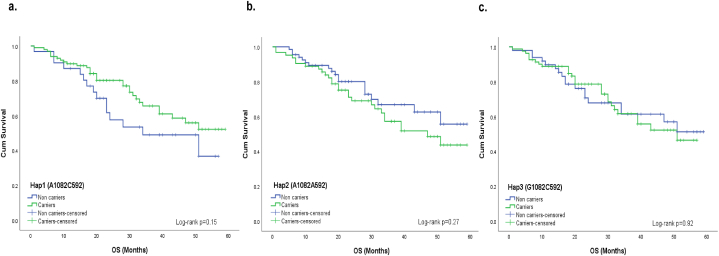
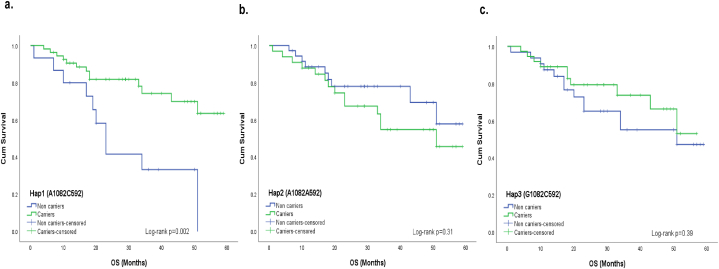
For the -1082A/G SNP, the comparison of genotype frequencies between cases and HS groups showed that the G allele significantly reduced CRC risk under the recessive model (GG vs. AA + AG: OR [95%CI] = 0.44 [0.21-0.93], p = 0.03). Conversely, a positive association was observed between the codominant model (AG vs. AA + GG) and high susceptibility (OR [95%CI] = 1.65 [1.02-2.63], p = 0.04). After stratification by disease site, the recessive model was also found to reduce susceptibility to colon cancer (OR [95%CI] = 0.18 [0.04-0.72], p = 0 0.01), while the homozygote model (AA vs. GG) was suggested as a risk factor (OR [95%CI] = 5.16 [1.31-23.26], p = 0.02). Furthermore, the codominant model (AG vs. AA + GG) doubled the risk of rectum cancer (OR [95%CI] = 1.98 [1.07-3.70], p = 0.03). For the -592A/C SNP, the codominant model (AC vs. AA + CC) has a protective effect against the development of CRC (OR [95%CI] = 0.59 [0.36-0.94], p = 0.03). The gene haplotype was not associated with CRC risk. A stratified analysis by disease site demonstrated that the presence of Hap3 (-1082G and -592C alleles) specifically reduced the risk of developing colon cancer (OR [95%CI] = 0.51 [0.32-0.80], p = 0.003). Moreover, homozygous Hap3/Hap3 diplotype significantly reduced susceptibility to CRC (OR [95%CI] = 0.35 [0.14-0.85], p = 0.02). Interestingly, this diplotype has not been identified in colon cancer patients. Kaplan-Meier analysis showed that the homozygous Hap2/Hap2 diplotype was significantly associated with decreased overall survival (Log-rank: p = 0.01). This association was also observed in the colon cancer subgroup (Log-rank: p = 0.001).
Our findings provide preliminary indications that the -1082A/G and -592/AC SNPs within the gene may exhibit significant associations with the pathogenesis and prognostic outcomes of CRC. However, further investigations are still warranted to validate and establish the veracity of our findings.
由于白细胞介素基因中存在单核苷酸多态性(SNP)仍是消化癌有效治疗方法开发中的一项重大挑战,因此开展了本病例对照研究,以评估位于白细胞介素基因启动子区域的两个SNP(-1082A/G(rs1800896)和-592A/C(rs1800872))的基因型、单倍型和双倍型对突尼斯人大肠癌(CRC)的发病率、严重程度和预后的可能影响。
采用聚合酶链反应-序列特异性引物(PCR-SSP)对130例CRC病例和165名健康受试者(HS)的白细胞介素基因SNP进行分析。
对于-1082A/G SNP,病例组与HS组之间基因型频率的比较显示,在隐性模型下,G等位基因显著降低了CRC风险(GG与AA + AG相比:比值比[95%置信区间]=0.44[0.21 - 0.93],p = 0.03)。相反,在共显性模型(AG与AA + GG相比)与高易感性之间观察到正相关(比值比[95%置信区间]=1.65[1.02 - 2.63],p = 0.04)。按疾病部位分层后,还发现隐性模型降低了患结肠癌的易感性(比值比[95%置信区间]=0.18[0.04 - 0.72],p = 0.01),而纯合子模型(AA与GG相比)被认为是一个风险因素(比值比[95%置信区间]=5.16[1.31 - 23.26],p = 0.02)。此外,共显性模型(AG与AA + GG相比)使直肠癌风险增加一倍(比值比[95%置信区间]=1.98[1.07 - 3.70],p = 0.03)。对于-592A/C SNP,共显性模型(AC与AA + CC相比)对CRC的发生具有保护作用(比值比[95%置信区间]=0.59[0.36 - 0.94],p = 0.03)。白细胞介素基因单倍型与CRC风险无关。按疾病部位进行的分层分析表明,单倍型3(-1082G和-592C等位基因)的存在特别降低了患结肠癌的风险(比值比[95%置信区间]=0.51[0.32 - 0.80],p = 0.003)。此外,纯合子单倍型3/单倍型3双倍型显著降低了对CRC的易感性(比值比[95%置信区间]=0.35[0.14 - 0.85],p = 0.02)。有趣的是,在结肠癌患者中未发现这种双倍型。Kaplan-Meier分析表明,纯合子单倍型2/单倍型2双倍型与总生存期降低显著相关(对数秩检验:p = 0.01)。在结肠癌亚组中也观察到了这种关联(对数秩检验:p = 0.001)。
我们的研究结果提供了初步迹象,表明白细胞介素基因内的-1082A/G和-592A/C SNP可能与CRC的发病机制和预后结果存在显著关联。然而,仍需要进一步研究来验证和确定我们研究结果的准确性。