Department of Parasitology, Key Laboratory of Tropical Disease Control (Ministry of Education), Zhongshan School of Medicine, Sun Yat-Sen University, Guangzhou, 510080, China.
Guangdong Provincial Center for Disease Control and Prevention, WHO Collaborating Centre for Surveillance, Research and Training of Emerging Infectious Diseases, Guangzhou, 511430, China.
Parasit Vectors. 2024 Aug 21;17(1):353. doi: 10.1186/s13071-024-06425-z.
Clonorchiasis has significant socioeconomic importance in endemic areas; however, studies investigating the disease burden in specific sub-regions are lacking. This study aims to address the gap by quantifying the current disease burden caused by clonorchiasis in Guangdong province and assessing its distribution characteristics.
Comprehensive measures, including prevalence rates, disability-adjusted life years (DALYs), and direct medical costs, were used to assess the disease burden of clonorchiasis. To estimate the prevalence rate, the number of infections was divided by the examined population, based on the annual surveillance data on clonorchiasis cases during 2016-2021. The calculation of DALYs was based on the epidemiological parameters according to the definition issued by the World Health Organization. Cost data of clonorchiasis were utilized to quantify the direct medical costs. The distribution characteristics of disease burden were assessed through comparisons of groups of population defined by geographic area, time, and characteristics of people.
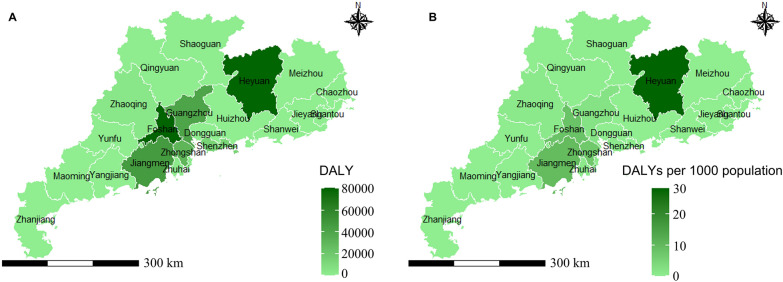
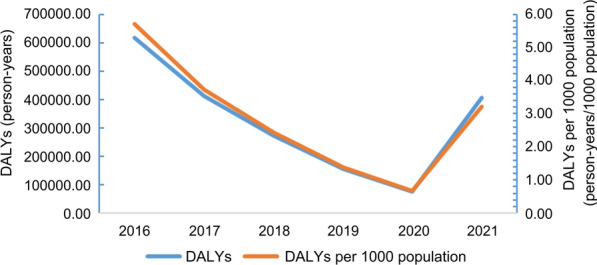
In 2021, clonorchiasis posed a significant disease burden in Guangdong Province. The prevalence rate was found to be 4.25% [95% CI (4.02%, 4.49%)], with an associated burden of DALYs of 406,802.29 [95% CI (329,275.33, 49,215,163.78)] person-years. The per-case direct medical costs of patients with clonorchiasis were estimated to be CNY 7907.2 (SD = 5154.4). Notably, while the prevalence rate and DALYs showed a steady decrease from 2016 to 2020, there was a rising trend in 2021. Spatial clustering of clonorchiasis cases and DALYs was also observed, particularly along the Pearl River and Han River. This suggests a concentration of the disease in these regions. Furthermore, significant differences in prevalence rates were found among various demographic groups, including sex, age, occupation, and education level. Additionally, patients with longer hospital stays were more likely to incur higher direct medical costs.
The burden of clonorchiasis in Guangdong Province remains high, despite significant progress achieved through the implementation of the prevention and control programs. It is suggested that measures should be taken based on the distribution characteristics to maximize the effectiveness of prevention and control, with a primary focus on key populations and areas.
在流行地区,华支睾吸虫病具有重要的社会经济意义;然而,缺乏针对特定亚地区疾病负担的研究。本研究旨在通过量化广东省华支睾吸虫病的当前疾病负担并评估其分布特征来填补这一空白。
采用患病率、伤残调整生命年(DALYs)和直接医疗费用等综合措施来评估华支睾吸虫病的疾病负担。为了估计患病率,根据 2016-2021 年华支睾吸虫病病例年度监测数据,将感染人数除以受检人群数。DALYs 的计算基于世界卫生组织发布的流行病学参数。利用华支睾吸虫病的成本数据来量化直接医疗费用。通过比较按地理区域、时间和人群特征定义的人群组来评估疾病负担的分布特征。
2021 年华支睾吸虫病在广东省造成了重大疾病负担。患病率为 4.25%[95%CI(4.02%,4.49%)],相关 DALYs 负担为 406,802.29[95%CI(329,275.33,49,215,163.78)]人年。华支睾吸虫病患者的每例直接医疗费用估计为 7907.2 元人民币(SD=5154.4)。值得注意的是,尽管患病率和 DALYs 从 2016 年到 2020 年呈稳步下降趋势,但 2021 年呈上升趋势。华支睾吸虫病病例和 DALYs 的空间聚类也很明显,特别是在珠江和汉江沿线。这表明该疾病在这些地区集中。此外,不同人口统计学群体(包括性别、年龄、职业和教育水平)之间的患病率存在显著差异。此外,住院时间较长的患者更有可能产生较高的直接医疗费用。
尽管通过实施防控计划取得了显著进展,但广东省的华支睾吸虫病负担仍然很高。建议根据分布特征采取措施,以最大限度地提高防控效果,重点关注重点人群和地区。