United States Department of Agriculture-Agricultural Research Service, Conservation and Production Research Laboratory, Bushland, Texas, United States of America.
Department of Animal Science, Auburn University, Auburn, Alabama, United States of America.
PLoS One. 2024 Aug 22;19(8):e0308914. doi: 10.1371/journal.pone.0308914. eCollection 2024.
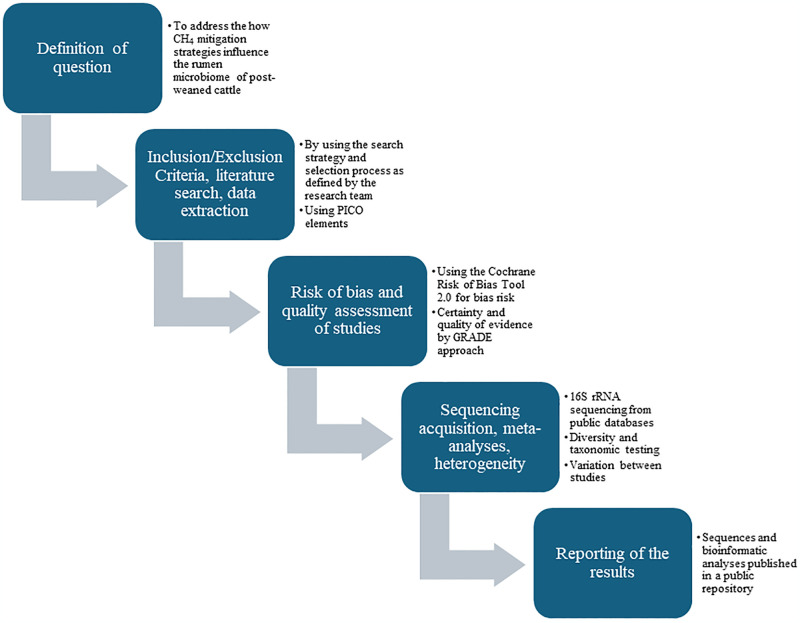
Recently, research has investigated the role of the ruminant native microbiome, and the role microbes play in methane (CH4) production and mitigation. However, the variation across microbiome studies makes implementing impactful strategies difficult. The first objective of this study is to identify, summarize, compile, and discuss the current literature on CH4 mitigation strategies and how they interact with the native ruminant microbiome. The second objective is to perform a meta-analysis on the identified16S rRNA sequencing data. A literature search using Web of Science, Scopus, AGRIS, and Google Scholar will be implemented. Eligible criteria will be defined using PICO (population, intervention, comparator, and outcomes) elements. Two independent reviewers will be utilized for both the literature search and data compilation. Risk of bias will be assessed using the Cochrane Risk Bias 2.0 tool. Publicly available 16S rRNA amplicon gene sequencing data will be downloaded from NCBI Sequence Read Archive, European Nucleotide Archive or similar database using appropriate extraction methods. Data processing will be performed using QIIME2 following a standardized protocol. Meta-analyses will be performed on both alpha and beta diversity as well as taxonomic analyses. Alpha diversity metrics will be tested using a Kruskal-Wallis test with a Benjamini-Hochberg multiple testing correction. Beta diversity will be statistically tested using PERMANOVA testing with multiple test corrections. Hedge's g standardized mean difference statistic will be used to calculate fixed and random effects model estimates using a 95% confidence interval. Heterogeneity between studies will be assessed using the I2 statistic. Potential publication bias will be further assessed using Begg's correlation test and Egger's regression test. The GRADE approach will be used to assess the certainty of evidence. The following protocol will be used to guide future research and meta-analyses for investigating CH4 mitigation strategies and ruminant microbial ecology. The future work could be used to enhance livestock management techniques for GHG control. This protocol is registered in Open Science Framework (https://osf.io/vt56c) and available in the Systematic Reviews for Animals and Food (https://www.syreaf.org/contact).
最近,研究已经探讨了反刍动物原生微生物组的作用,以及微生物在甲烷(CH4)产生和减排中的作用。然而,由于微生物组研究的变化,实施有影响力的策略变得困难。本研究的第一个目标是确定、总结、编译和讨论关于 CH4 减排策略的当前文献,以及它们与原生反刍动物微生物组的相互作用。第二个目标是对确定的 16S rRNA 测序数据进行荟萃分析。将使用 Web of Science、Scopus、AGRIS 和 Google Scholar 进行文献检索。将使用 PICO(人群、干预、比较和结果)元素来定义合格标准。将使用两名独立的审查员进行文献检索和数据编译。将使用 Cochrane Risk Bias 2.0 工具评估偏倚风险。将使用适当的提取方法从 NCBI Sequence Read Archive、European Nucleotide Archive 或类似数据库中下载公开可用的 16S rRNA 扩增子基因测序数据。将按照标准化协议使用 QIIME2 进行数据处理。将对 alpha 和 beta 多样性以及分类分析进行荟萃分析。将使用 Kruskal-Wallis 检验和 Benjamini-Hochberg 多重检验校正对 alpha 多样性指标进行检验。将使用 PERMANOVA 检验和多重检验校正对 beta 多样性进行统计检验。将使用 Hedge's g 标准化平均差异统计量使用 95%置信区间计算固定和随机效应模型估计值。将使用 I2 统计量评估研究之间的异质性。将进一步使用 Begg 相关性检验和 Egger 回归检验评估潜在的发表偏倚。将使用 GRADE 方法评估证据的确定性。该方案将用于指导未来研究和荟萃分析,以调查 CH4 减排策略和反刍动物微生物生态学。未来的工作可以用于增强牲畜管理技术以控制温室气体排放。该方案已在 Open Science Framework(https://osf.io/vt56c)中注册,并可在 Animals and Food(https://www.syreaf.org/contact)的系统评价中获得。