Torres-Ruiz Sandra, Garrido-Cano Iris, Lameirinhas Ana, Burgués Octavio, Hernando Cristina, Martínez María Teresa, Rojo Federico, Bermejo Begoña, Tapia Marta, Carbonell-Asins Juan Antonio, Peña Carlos Javier, Lluch Ana, Cejalvo Juan Miguel, Tormo Eduardo, Eroles Pilar
INCLIVA Biomedical Research Institute, Valencia, Spain.
Interuniversity Research Institute for Molecular Recognition and Technological Development (IDM), Universidad politécnica de Valencia, Universidad de Valencia, Valencia, Spain.
Cell Death Discov. 2024 Aug 22;10(1):372. doi: 10.1038/s41420-024-02128-7.
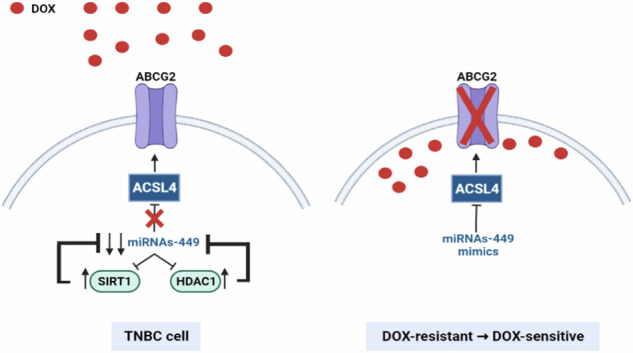
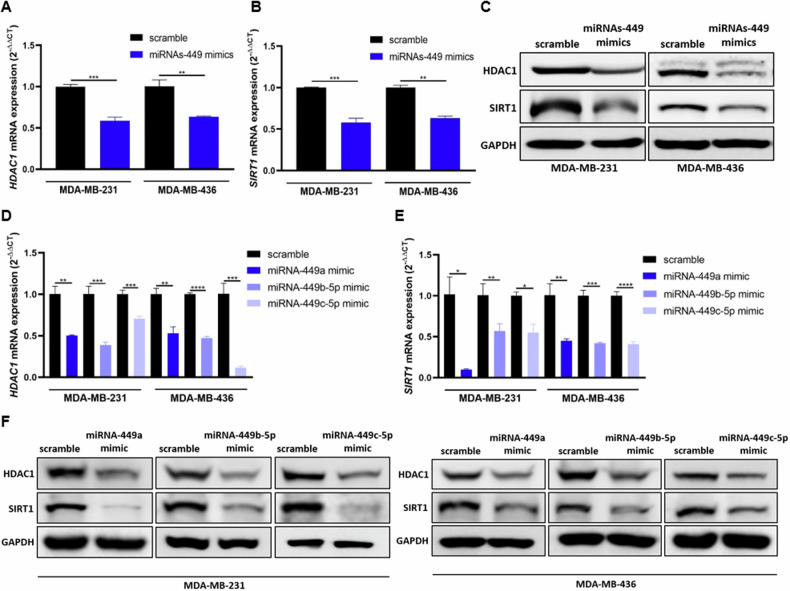
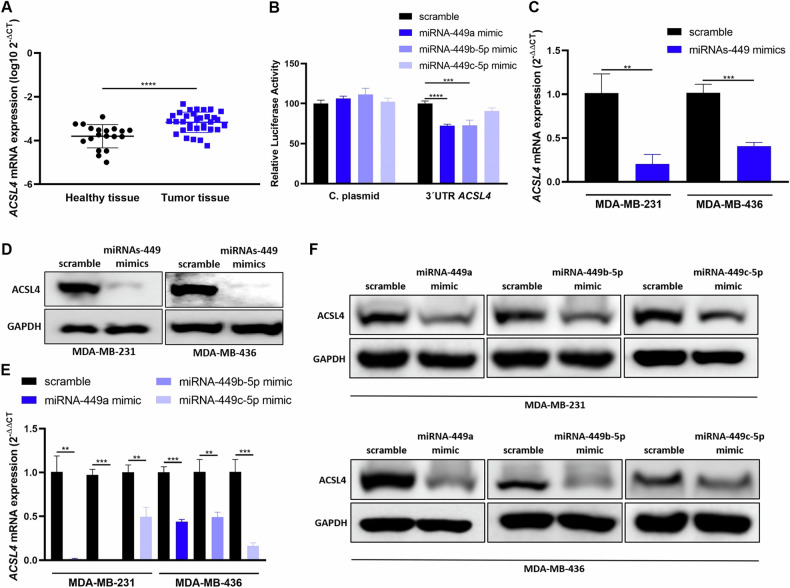
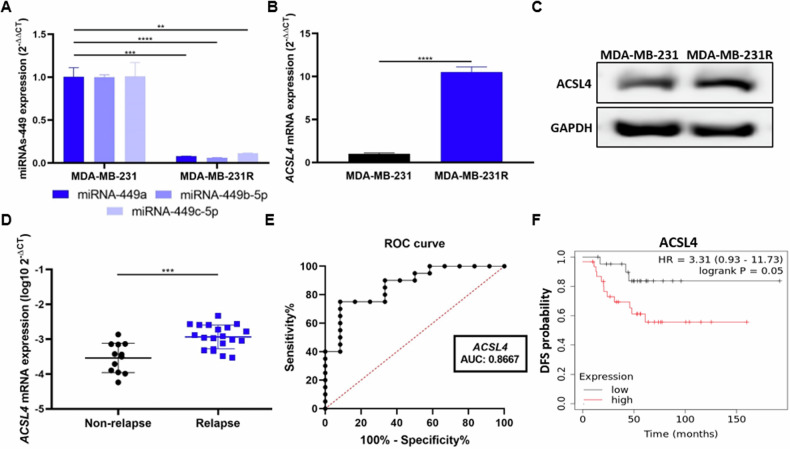
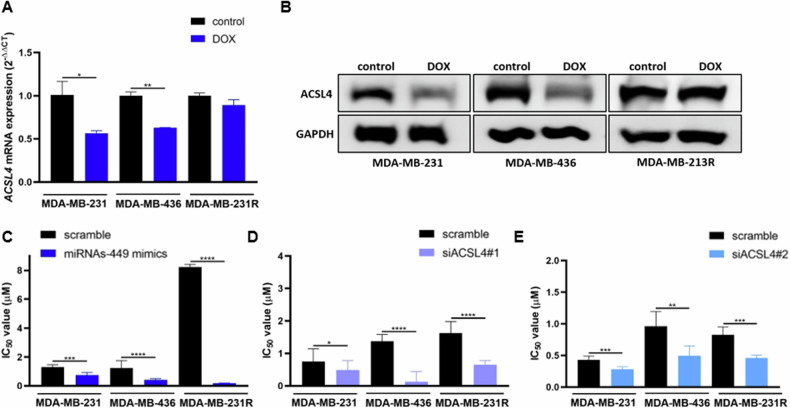
Despite progress in breast cancer treatment, a significant portion of patients still relapse because of drug resistance. The involvement of microRNAs in cancer progression and chemotherapy response is well established. Therefore, this study aimed to elucidate the dysregulation of the microRNA-449 family (specifically, microRNA-449a, microRNA-449b-5p, and microRNA-449c-5p) and its impact on resistance to doxorubicin, a commonly used chemotherapeutic drug for the treatment of triple-negative breast cancer. We found that the microRNA-449 family is downregulated in triple-negative breast cancer and demonstrated its potential as a diagnostic biomarker. Besides, our findings indicate that the downregulation of the microRNA-449 family is mediated by the microRNAs-449/SIRT1-HDAC1 negative feedback loop. Moreover, it was found that the microRNA-449 family dysregulates the fatty acid metabolism by targeting ACSL4, which is a potential prognostic biomarker that mediates doxorubicin response through regulation of the drug extrusion pump ABCG2. Altogether, our results suggest that the microRNA-449 family might be a potential therapeutic target for the treatment of triple-negative breast cancer since it is implicated in doxorubicin response through ACSL4/ABCG2 axis regulation. Ultimately, our results also highlight the value of microRNAs-449 and ACSL4 as diagnostic and prognostic biomarkers in triple-negative breast cancer. Proposed model of miRNAs-449 downregulation in TNBC and doxorubicin response. MiRNAs-449 are downregulated in TNBC through a negative feedback loop with SIRT1 and HDAC1. Moreover, ACSL4 increases ABCG2 expression, thus diminishing the intracellular doxorubicin concentration and promoting doxorubicin resistance. MiRNAs-449 overexpression downregulates the ACSL4/ABCG2 axis and sensitizes doxorubicin-resistant cells to doxorubicin. Created with BioRender. TNBC: triple-negative breast cancer; DOX: doxorubicin; SIRT1: Sirtuin 1; HDAC1: Histone deacetylase 1; ACSL4: Acyl-CoA Synthetase Long-Chain Family Member 4; ABCG2: ATP-binding cassette superfamily G member 2.
尽管乳腺癌治疗取得了进展,但仍有很大一部分患者因耐药而复发。微小RNA参与癌症进展和化疗反应已得到充分证实。因此,本研究旨在阐明微小RNA-449家族(具体为微小RNA-449a、微小RNA-449b-5p和微小RNA-449c-5p)的失调及其对多柔比星耐药性的影响,多柔比星是一种常用于治疗三阴性乳腺癌的化疗药物。我们发现微小RNA-449家族在三阴性乳腺癌中表达下调,并证明了其作为诊断生物标志物的潜力。此外,我们的研究结果表明,微小RNA-449家族的下调是由微小RNA-449/SIRT1-HDAC1负反馈环介导的。此外,还发现微小RNA-449家族通过靶向ACSL4来调节脂肪酸代谢,ACSL4是一种潜在的预后生物标志物,通过调节药物外排泵ABCG2来介导多柔比星反应。总之,我们的结果表明,微小RNA-449家族可能是治疗三阴性乳腺癌的潜在治疗靶点,因为它通过ACSL4/ABCG2轴调节参与多柔比星反应。最终,我们的结果还突出了微小RNA-449和ACSL4作为三阴性乳腺癌诊断和预后生物标志物的价值。三阴性乳腺癌中微小RNA-449下调及多柔比星反应的模型示意图。微小RNA-449在三阴性乳腺癌中通过与SIRT1和HDAC1的负反馈环而下调。此外,ACSL4增加ABCG2的表达,从而降低细胞内多柔比星浓度并促进多柔比星耐药性。微小RNA-449的过表达下调ACSL4/ABCG2轴,并使多柔比星耐药细胞对多柔比星敏感。由BioRender制作。TNBC:三阴性乳腺癌;DOX:多柔比星;SIRT1:沉默调节蛋白1;HDAC1:组蛋白去乙酰化酶1;ACSL4:酰基辅酶A合成酶长链家族成员4;ABCG2:ATP结合盒超家族G成员2