Public Health Clinical Center, Shandong University, Wen hua xi lu 44#, Jinan, 250100, Shandong Province, People's Republic of China.
Department of Orthopedics, The Second People's Hospital of Wenshang, Jining, 272500, People's Republic of China.
Ann Clin Microbiol Antimicrob. 2024 Aug 22;23(1):77. doi: 10.1186/s12941-024-00733-z.
Bone and joint tuberculosis (BJTB) is a distinct variant of tuberculosis in which clinical diagnosis often leads to relative misdiagnosis and missed diagnoses. This study aimed to evaluate the diagnostic accuracy of the targeted nanopore sequencing (TNPseq) assay for BJTB patients in China.
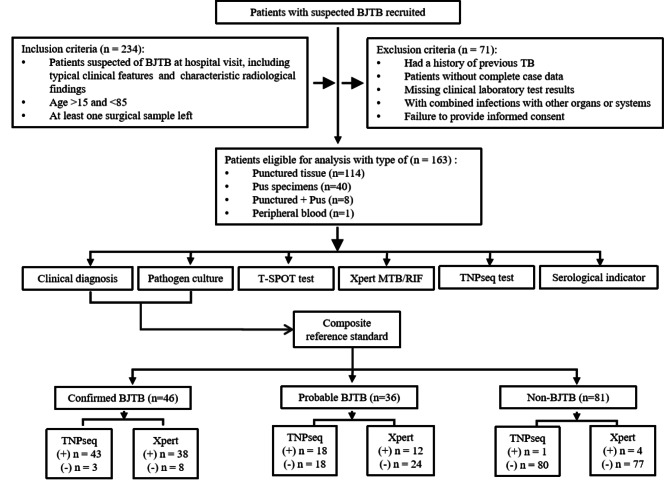
The study enrolled a cohort of 163 patients with suspected BJTB. Diagnostic testing was performed using the TNPseq assay on samples including punctured tissue, pus, and blood. The diagnostic accuracy of the TNPseq assay was then compared with that of the T-SPOT and Xpert MTB/RIF assays.
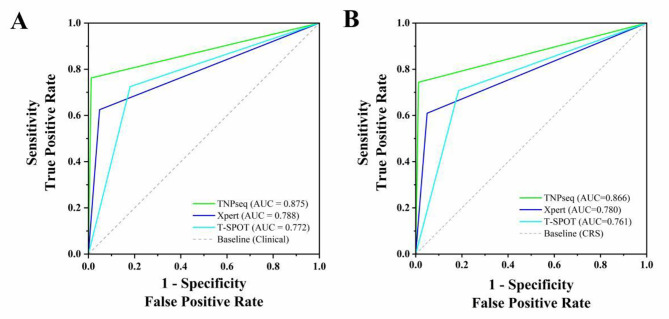
TNPseq exhibited superior performance in terms of accuracy, demonstrating a sensitivity of 76.3% (95% CI: 71.0-81.6%) and a specificity of 98.8% (95% CI: 93.5-100%) in clinical diagnosis. When evaluated against a composite reference standard, TNPseq demonstrated a sensitivity of 74.4% (95% CI: 69.3-79.5%) and a specificity of 98.8% (95% CI: 93.7-100%). These results exceed the performance of both the T-SPOT and Xpert MTB/RIF tests. Notably, TNPseq demonstrated high specificity and accuracy in puncture specimens, with a sensitivity of 75.0% (95% CI: 70.2-79.8%) and a specificity of 98.3% (95% CI: 92.7-100%), as well as in pus samples, with a sensitivity of 83.3% (95% CI: 78.6-88.1%) and a specificity of 100% (95% CI: 100-100%). Additionally, TNPseq facilitated the detection of mixed infection scenarios, identifying 20 cases of bacterial-fungal co-infection, 17 cases of bacterial-viral co-infection, and two cases of simultaneous bacterial-fungal-viral co-infection.
TNPseq demonstrated great potential in the diagnosis of BJTB due to its high sensitivity and specificity. The ability of TNPseq to diagnose pathogens and detect drug resistance genes can also guide subsequent treatment. Expanding the application scenarios and scope of TNPseq will enable it to benefit more clinical treatments.
骨关节结核(BJTB)是结核病的一种特殊类型,其临床诊断往往导致相对误诊和漏诊。本研究旨在评估靶向纳米孔测序(TNPseq)检测在中国 BJTB 患者中的诊断准确性。
该研究纳入了 163 例疑似 BJTB 患者。对包括穿刺组织、脓液和血液在内的样本进行 TNPseq 检测。然后,将 TNPseq 检测的诊断准确性与 T-SPOT 和 Xpert MTB/RIF 检测进行比较。
TNPseq 在准确性方面表现出色,其临床诊断的敏感性为 76.3%(95%CI:71.0-81.6%),特异性为 98.8%(95%CI:93.5-100%)。与综合参考标准相比,TNPseq 的敏感性为 74.4%(95%CI:69.3-79.5%),特异性为 98.8%(95%CI:93.7-100%)。这些结果优于 T-SPOT 和 Xpert MTB/RIF 检测。值得注意的是,TNPseq 在穿刺标本中的特异性和准确性较高,敏感性为 75.0%(95%CI:70.2-79.8%),特异性为 98.3%(95%CI:92.7-100%),在脓液标本中的敏感性为 83.3%(95%CI:78.6-88.1%),特异性为 100%(95%CI:100-100%)。此外,TNPseq 还能够检测混合感染情况,共发现 20 例细菌-真菌混合感染、17 例细菌-病毒混合感染和 2 例细菌-真菌-病毒混合感染。
TNPseq 具有较高的敏感性和特异性,在 BJTB 诊断中具有很大的潜力。TNPseq 诊断病原体和检测耐药基因的能力也可以指导后续治疗。扩大 TNPseq 的应用场景和范围将使其能够为更多的临床治疗带来益处。