School of Chemistry and Biochemistry, Georgia Institute of Technology, Atlanta, Georgia 30332, United States.
School of Biological Sciences, Georgia Institute of Technology, Atlanta, Georgia 30332, United States.
Biochemistry. 2024 Sep 17;63(18):2240-2244. doi: 10.1021/acs.biochem.4c00249. Epub 2024 Aug 26.
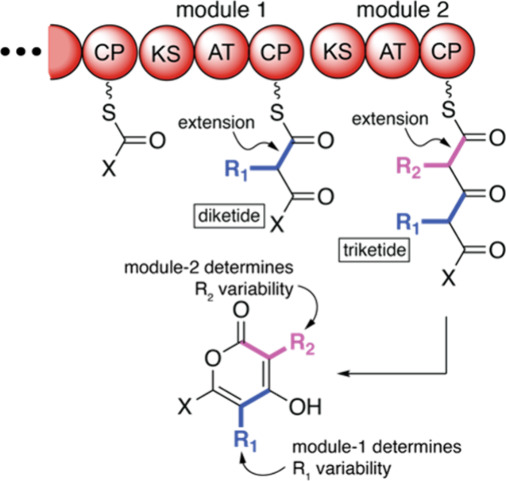
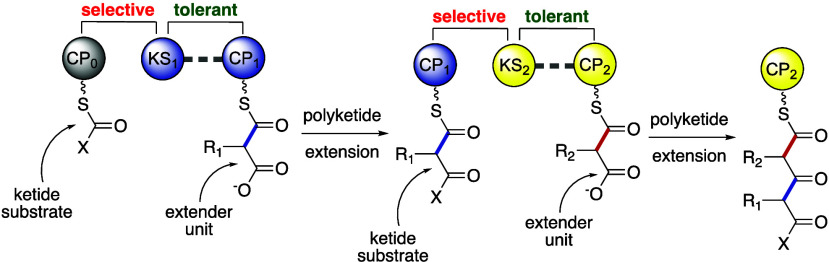
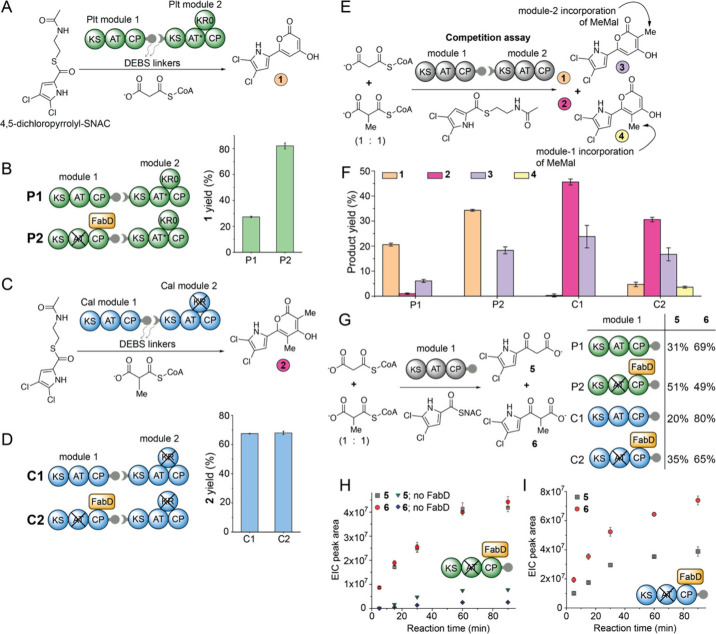
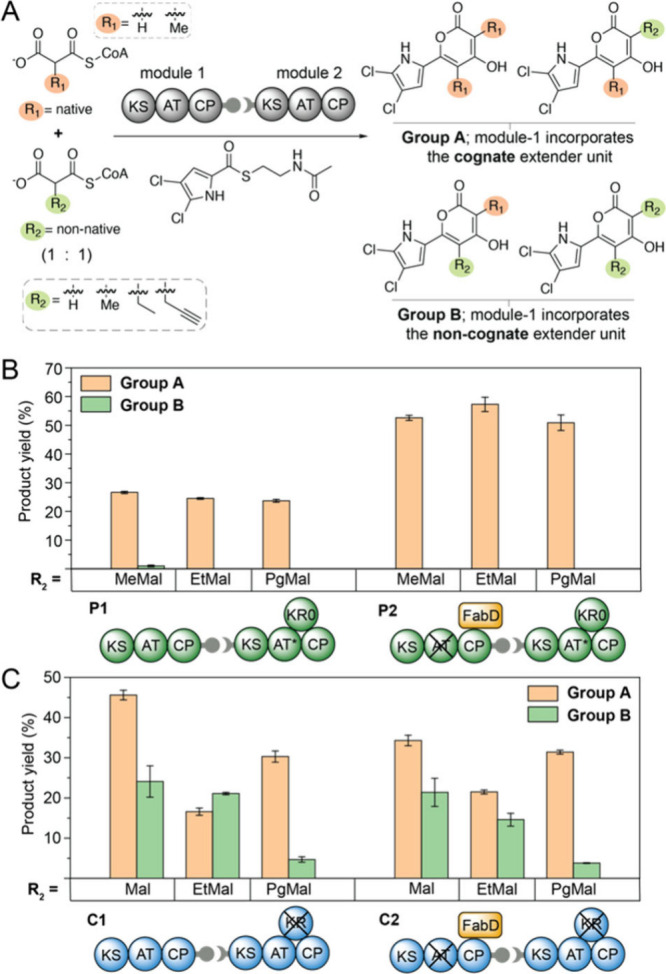
Engineered type I polyketide synthases (type I PKSs) can enable access to diverse polyketide pharmacophores and generate non-natural natural products. However, the promise of type I PKS engineering remains modestly realized at best. Here, we report that ketosynthase (KS) domains, the key carbon-carbon bond-forming catalysts, control which intermediates are allowed to progress along the PKS assembly lines and which intermediates are excluded. Using bimodular PKSs, we demonstrate that KSs can be exquisitely selective for the upstream polyketide substrate while retaining promiscuity for the extender unit that they incorporate. It is then the downstream KS that acts as a gatekeeper to ensure the fidelity of the extender unit incorporation by the upstream KS. We also demonstrate that these findings are not universally applicable; substrate-tolerant KSs do allow engineered polyketide intermediates to be extended. Our results demonstrate the utility for evaluating the KS-induced bottlenecks to gauge the feasibility of engineering PKS assembly lines.
工程化的 I 型聚酮合酶(type I PKSs)可以使我们获得多种多样的聚酮药效团,并生成非天然的天然产物。然而,I 型 PKS 工程的前景最多也只是适度实现。在这里,我们报告说酮合酶(KS)结构域,即关键的碳-碳键形成催化剂,控制着哪些中间体被允许沿着聚酮装配线前进,哪些中间体被排除在外。我们利用双模块 PKS 证明,KS 可以对上游聚酮底物进行高度选择性,同时保持对其掺入的延伸单元的混杂性。然后,下游 KS 充当守门员,以确保上游 KS 掺入延伸单元的保真度。我们还证明,这些发现并非普遍适用;底物耐受的 KS 确实允许工程化的聚酮中间体进行延伸。我们的结果表明,评估 KS 诱导的瓶颈对于评估 PKS 装配线的工程可行性具有实用价值。