Unit of Neurology, IRCCS Neuromed, Pozzilli (IS), Italy.
Faculty of Psychology, International Telematic University UNINETTUNO, Rome, Italy.
Sci Rep. 2024 Aug 27;14(1):19796. doi: 10.1038/s41598-024-67165-9.
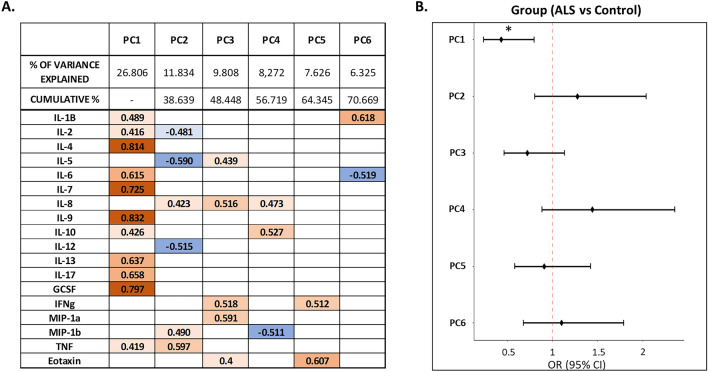
Experimental studies identified a role of neuroinflammation in the pathogenesis of neurodegenerative diseases, including amyotrophic lateral sclerosis (ALS). However, the role of inflammatory molecules as diagnostic and prognostic biomarkers in patients with ALS is unclear. In this cross-sectional study, the cerebrospinal fluid (CSF) levels of a set of inflammatory cytokines and chemokines were analyzed in 56 newly diagnosed ALS patients and in 47 age- and sex-matched control patients without inflammatory or degenerative neurological disorders. The molecules analyzed included: interleukin (IL)-1β, IL-2, IL-4, IL-5, IL-6, IL-7, IL-8, IL-9, IL-10, IL-12, IL-13, IL-17, granulocyte colony stimulating factor (GCSF), macrophage inflammatory protein (MIP)-1a, MIP-1b, tumor necrosis factors (TNF), eotaxin. Principal component analysis (PCA) was used to explore possible associations between CSF molecules and ALS diagnosis. In addition, we analyzed the association between CSF cytokine profiles and clinical characteristics, including the disease progression rate score, and peripheral inflammation assessed using the Neutrophil-to-lymphocyte ratio (NLR). PCA identified six principal components (PCs) explaining 70.67% of the total variance in the CSF cytokine set. The principal component (PC1) explained 26.8% of variance and showed a positive load with CSF levels of IL-9, IL-4, GCSF, IL-7, IL-17, IL-13, IL-6, IL-1β, TNF, and IL-2. Logistic regression showed a significant association between PC1 and ALS diagnosis. In addition, in ALS patients, the same component was significantly associated with higher disease progression rate score and positively correlated with NLR. CSF inflammatory activation in present in ALS at the time of diagnosis and may characterize patients at higher risk for disease progression.
实验研究表明,神经炎症在神经退行性疾病(包括肌萎缩侧索硬化症)的发病机制中起作用。然而,炎症分子作为肌萎缩侧索硬化症患者的诊断和预后生物标志物的作用尚不清楚。在这项横断面研究中,分析了 56 例新诊断的肌萎缩侧索硬化症患者和 47 例年龄和性别匹配的无炎症或退行性神经疾病的对照患者的脑脊液(CSF)中一组炎症细胞因子和趋化因子的水平。分析的分子包括:白细胞介素(IL)-1β、IL-2、IL-4、IL-5、IL-6、IL-7、IL-8、IL-9、IL-10、IL-12、IL-13、IL-17、粒细胞集落刺激因子(GCSF)、巨噬细胞炎症蛋白(MIP)-1a、MIP-1b、肿瘤坏死因子(TNF)、嗜酸性粒细胞趋化因子。主成分分析(PCA)用于探索 CSF 分子与肌萎缩侧索硬化症诊断之间的可能关联。此外,我们还分析了 CSF 细胞因子谱与临床特征(包括疾病进展率评分和使用中性粒细胞与淋巴细胞比值(NLR)评估的外周炎症)之间的关联。PCA 确定了六个主成分(PC),解释了 CSF 细胞因子集总方差的 70.67%。主成分(PC1)解释了 26.8%的方差,与 CSF 中 IL-9、IL-4、GCSF、IL-7、IL-17、IL-13、IL-6、IL-1β、TNF 和 IL-2 的水平呈正相关。逻辑回归显示 PC1 与肌萎缩侧索硬化症诊断显著相关。此外,在肌萎缩侧索硬化症患者中,同一成分与更高的疾病进展率评分显著相关,与 NLR 呈正相关。在诊断时,肌萎缩侧索硬化症患者的 CSF 炎症激活,可能会使病情进展风险更高的患者具有特征性。