Jin Fang-Xin, Wang Yan, Li Min-Ne, Li Ru-Jiang, Guo Jun-Tang
Department of Histology and Embryology, Key Laboratory of Universities in Shandong Province, Shandong Second Medical University, Weifang 261053, Shandong Province, China.
Department of Pathological Physiology, Shandong Second Medical University, Weifang 261053, Shandong Province, China.
World J Diabetes. 2024 Aug 15;15(8):1764-1777. doi: 10.4239/wjd.v15.i8.1764.
Impaired hypoglycaemic counterregulation has emerged as a critical concern for diabetic patients who may be hesitant to medically lower their blood glucose levels due to the fear of potential hypoglycaemic reactions. However, the patho-genesis of hypoglycaemic counterregulation is still unclear. Glucagon-like peptide-1 (GLP-1) and its analogues have been used as adjunctive therapies for type 1 diabetes mellitus (T1DM). The role of GLP-1 in counterregulatory dys-function during hypoglycaemia in patients with T1DM has not been reported.
To explore the impact of intestinal GLP-1 on impaired hypoglycaemic counterregulation in type 1 diabetic mice.
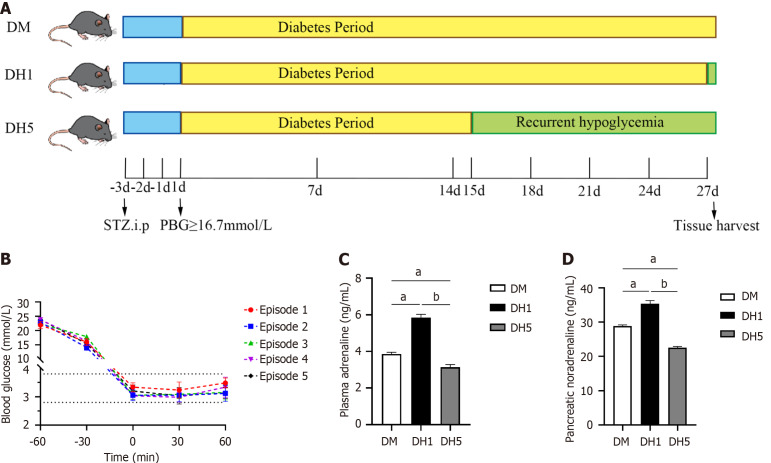
T1DM was induced in C57BL/6J mice using streptozotocin, followed by intraperitoneal insulin injections to create T1DM models with either a single episode of hypoglycaemia or recurrent episodes of hypoglycaemia (DH5). Immunofluorescence, Western blot, and enzyme-linked immunosorbent assay were employed to evaluate the influence of intestinal GLP-1 on the sympathetic-adrenal reflex and glucagon (GCG) secretion. The GLP-1 receptor agonist GLP-1(7-36) or the antagonist exendin (9-39) were infused into the terminal ileum or injected intraperitoneally to further investigate the role of intestinal GLP-1 in hypoglycaemic counterregulation in the model mice.
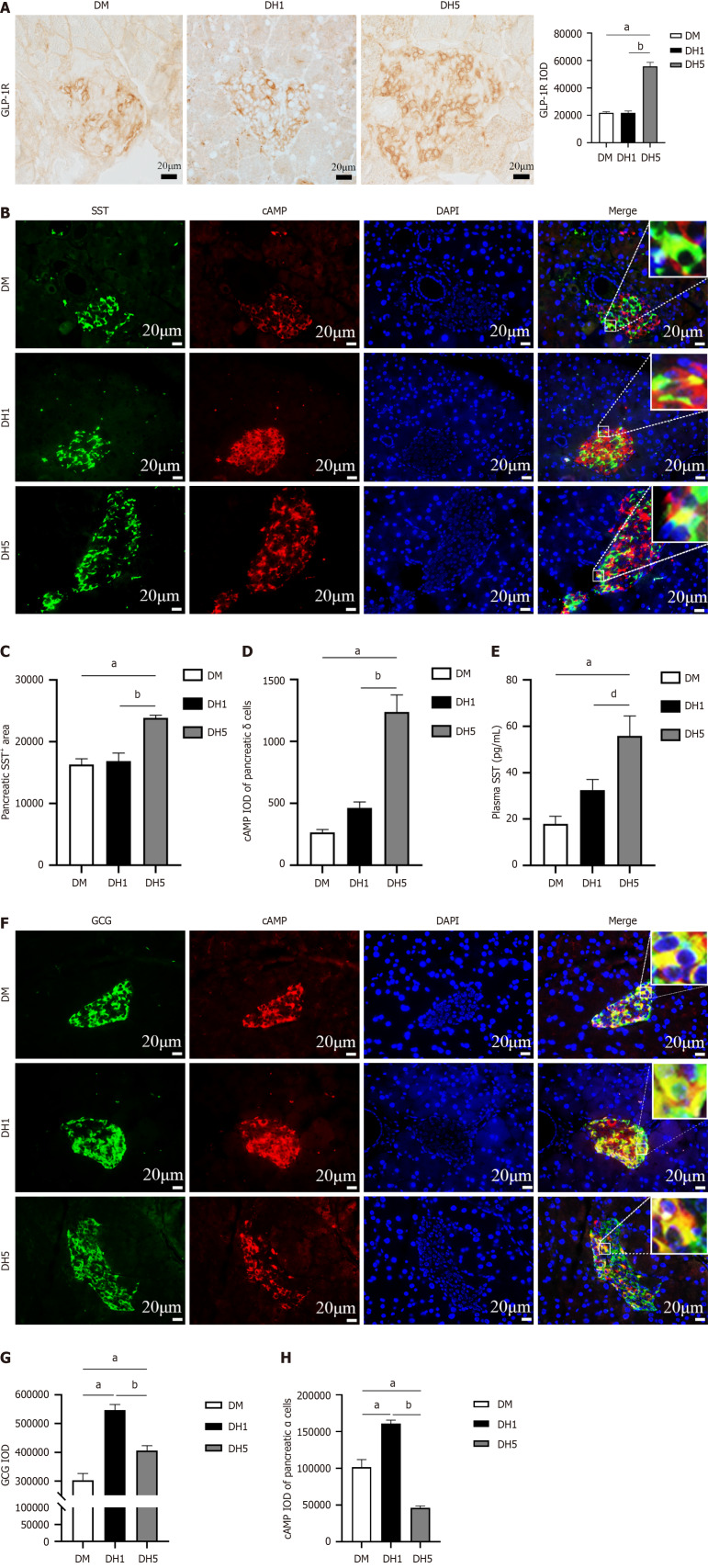
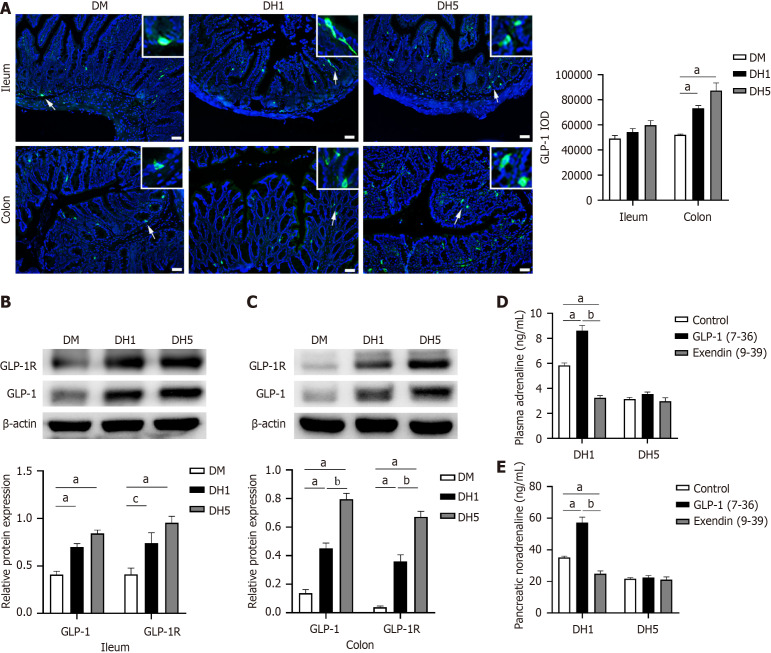
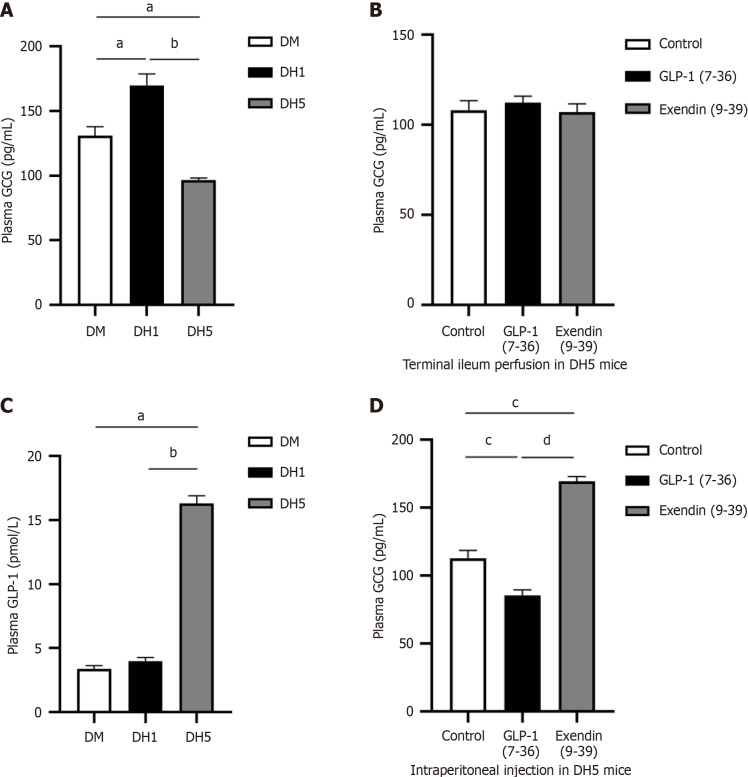
The expression levels of intestinal GLP-1 and its receptor (GLP-1R) were significantly increased in DH5 mice. Consecutive instances of excess of intestinal GLP-1 weakens the sympathetic-adrenal reflex, leading to dysfunction of adrenal counterregulation during hypoglycaemia. DH5 mice showed increased pancreatic δ-cell mass, cAMP levels in δ cells, and plasma somatostatin concentrations, while cAMP levels in pancreatic α cells and plasma GCG levels decreased. Furthermore, GLP-1R expression in islet cells and plasma active GLP-1 levels were significantly increased in the DH5 group. Further experiments involving terminal ileal infusion and intraperitoneal injection in the model mice demonstrated that intestinal GLP-1 during recurrent hypoglycaemia hindered the secretion of the counterregulatory hormone GCG the endocrine pathway.
Excessive intestinal GLP-1 is strongly associated with impaired counterregulatory responses to hypoglycaemia, leading to reduced appetite and compromised secretion of adrenaline, noradrenaline, and GCG during hypo-glycaemia.
低血糖反调节受损已成为糖尿病患者的一个关键问题,这些患者可能因担心潜在的低血糖反应而对通过药物降低血糖水平犹豫不决。然而,低血糖反调节的发病机制仍不清楚。胰高血糖素样肽-1(GLP-1)及其类似物已被用作1型糖尿病(T1DM)的辅助治疗药物。GLP-1在T1DM患者低血糖期间反调节功能障碍中的作用尚未见报道。
探讨肠道GLP-1对1型糖尿病小鼠低血糖反调节受损的影响。
用链脲佐菌素诱导C57BL/6J小鼠发生T1DM,随后腹腔注射胰岛素,建立单次低血糖发作或反复低血糖发作(DH5)的T1DM模型。采用免疫荧光、蛋白质印迹和酶联免疫吸附测定法评估肠道GLP-1对交感-肾上腺反射和胰高血糖素(GCG)分泌的影响。将GLP-1受体激动剂GLP-1(7-36)或拮抗剂艾塞那肽(9-39)注入回肠末端或腹腔注射,以进一步研究肠道GLP-1在模型小鼠低血糖反调节中的作用。
DH5小鼠肠道GLP-1及其受体(GLP-1R)的表达水平显著升高。连续出现的肠道GLP-1过量削弱了交感-肾上腺反射,导致低血糖期间肾上腺反调节功能障碍。DH5小鼠胰腺δ细胞质量、δ细胞中cAMP水平和血浆生长抑素浓度升高,而胰腺α细胞中cAMP水平和血浆GCG水平降低。此外,DH5组胰岛细胞中GLP-1R表达和血浆活性GLP-1水平显著升高。在模型小鼠中进行的涉及回肠末端灌注和腹腔注射的进一步实验表明,反复低血糖期间肠道GLP-1阻碍了反调节激素GCG的内分泌途径分泌。
肠道GLP-1过量与低血糖反调节反应受损密切相关,导致低血糖期间食欲下降以及肾上腺素、去甲肾上腺素和GCG分泌受损。