Institute for Endocrinology & Diabetes, University of Lübeck, Lübeck, Germany.
German Center for Diabetes Research (DZD), München-Neuherberg, Germany.
Diabetologia. 2022 Jul;65(7):1212-1221. doi: 10.1007/s00125-022-05702-9. Epub 2022 Apr 21.
AIMS/HYPOTHESIS: Attenuated counterregulation after recurrent hypoglycaemia is a major complication of diabetes treatment. As there is previous evidence for the relevance of sleep in metabolic control, we assessed the acute contribution of sleep to the counterregulatory adaptation to recurrent hypoglycaemia.
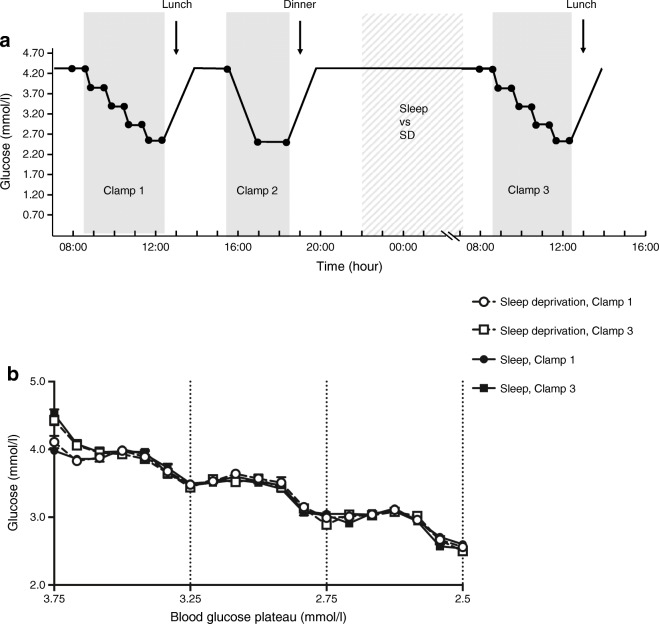
Within a balanced crossover design, 15 healthy, normal-weight male participants aged 18-35 years underwent three hyperinsulinaemic-hypoglycaemic clamps with a glucose nadir of 2.5 mmol/l, under two experimental conditions, sleep and sleep deprivation. Participants were exposed to two hypoglycaemic episodes, followed by a third hypoglycaemic clamp after one night of regular 8 h sleep vs sleep deprivation. The counterregulatory response of relevant hormones (glucagon, growth hormone [GH], ACTH, cortisol, adrenaline [epinephrine] and noradrenaline [norepinephrine]) was measured, and autonomic and neuroglycopenic symptoms were assessed.
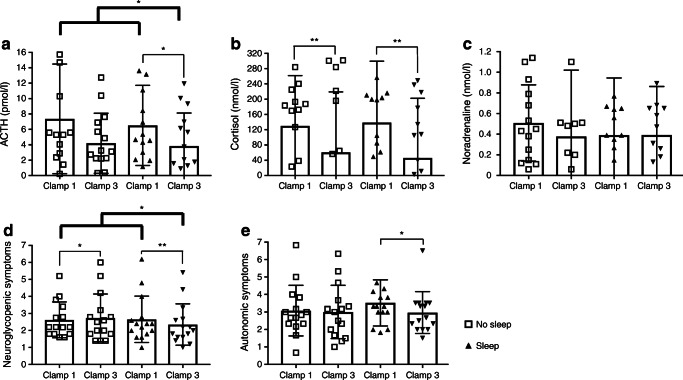
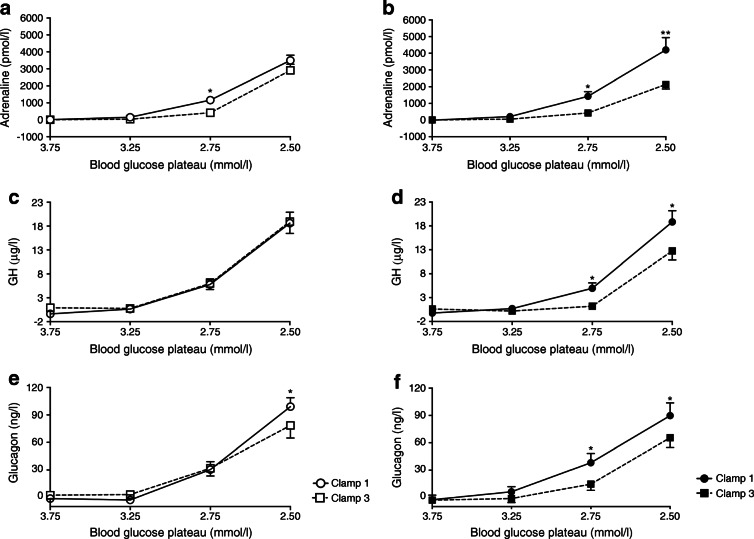
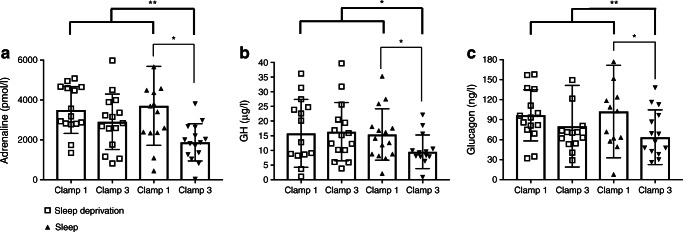
Sleep deprivation compared with sleep dampened the adaptation to recurrent hypoglycaemia for adrenaline (p=0.004), and this pattern also emerged in an overall analysis including adrenaline, GH and glucagon (p=0.064). After regular sleep, the counterregulatory responses of adrenaline (p=0.005), GH (p=0.029) and glucagon (p=0.009) were attenuated during the 3rd clamp compared with the 1st clamp, but were preserved after sleep deprivation (all p>0.225). Neuroglycopenic and autonomic symptoms during the 3rd clamp compared with the 1st clamp were likewise reduced after sleep (p=0.005 and p=0.019, respectively). In sleep deprivation, neuroglycopenic symptoms increased (p=0.014) and autonomic symptoms were unchanged (p=0.859).
CONCLUSIONS/INTERPRETATION: The counterregulatory adaptation to recurrent hypoglycaemia is compromised by sleep deprivation between hypoglycaemic episodes, indicating that sleep is essential for the formation of a neurometabolic memory, and may be a potential target of interventions to treat hypoglycaemia unawareness syndrome.
目的/假设:反复发作性低血糖后的衰减性代偿反应是糖尿病治疗的主要并发症。由于先前有证据表明睡眠与代谢控制有关,我们评估了睡眠对反复低血糖时代偿反应的急性影响。
在平衡交叉设计中,15 名年龄在 18-35 岁的健康、正常体重的男性参与者接受了三次高胰岛素-低血糖夹,血糖谷值为 2.5mmol/l,在两种实验条件下,睡眠和睡眠剥夺。参与者经历了两次低血糖发作,然后在一夜正常 8 小时睡眠后或睡眠剥夺后进行第三次低血糖夹。测量了相关激素(胰高血糖素、生长激素[GH]、促肾上腺皮质激素[ACTH]、皮质醇、肾上腺素[去甲肾上腺素]和去甲肾上腺素[去甲肾上腺素])的代偿反应,并评估了自主神经和神经低血糖症状。
与睡眠相比,睡眠剥夺削弱了对反复发作性低血糖的适应,肾上腺素(p=0.004),这种模式在包括肾上腺素、GH 和胰高血糖素的综合分析中也出现(p=0.064)。在正常睡眠后,与第一次夹相比,第三次夹时肾上腺素(p=0.005)、GH(p=0.029)和胰高血糖素(p=0.009)的代偿反应减弱,但在睡眠剥夺后仍得到保留(所有 p>0.225)。与第一次夹相比,第三次夹时的神经低血糖和自主神经症状在睡眠后也减少(p=0.005 和 p=0.019)。在睡眠剥夺中,神经低血糖症状增加(p=0.014),自主神经症状不变(p=0.859)。
结论/解释:反复发作性低血糖后的代偿反应因低血糖发作之间的睡眠剥夺而受损,这表明睡眠对于形成神经代谢记忆是必要的,并且可能是治疗低血糖意识障碍综合征的潜在干预靶点。