Ying Qi, Dong Weihua, Fabrikant Sara Irina
Faculty of Geographical Science, Beijing Normal University, China.
Department of Geography, University of Zurich, Switzerland.
Ann Am Assoc Geogr. 2024 Jul 1;114(7):1483-1504. doi: 10.1080/24694452.2024.2356858. eCollection 2024.
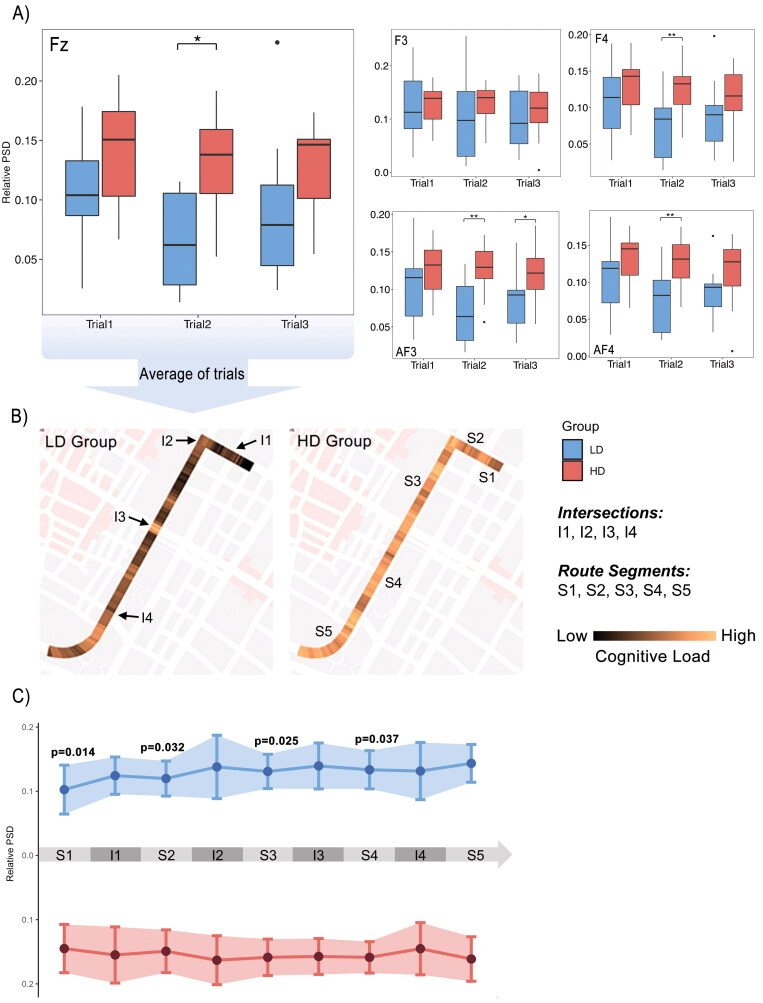
Reliance on digital navigation aids has already shown negative impacts on navigators' innate spatial abilities. How this happens is still an open research question. We report on an empirical study with twenty-four experienced (male) taxi drivers to evaluate the long-term impacts of in-car navigation system use on the spatial learning ability of these navigation experts. Specifically, we measured cognitive load by means of electroencephalography (EEG) coupled with eye tracking to assess their visuospatial attention allocation during a video-based route-following task while driving through an unknown urban environment. We found that long-term reliance on in-car navigation aids did not affect participants' visual attention allocation during spatial learning but rather limited their ability to encode viewed geographic information into memory, which, in turn, led to greater cognitive load, especially along route segments between intersections. Participants with greater dependence on in-car navigation aids performed worse on the spatial knowledge tests. Our combined behavioral and neuropsychological findings provide evidence for the impairment of expert navigators' spatial learning ability when exposed to long-term use of digital in-car navigation aids.
对数字导航辅助工具的依赖已经对导航者天生的空间能力产生了负面影响。这种情况是如何发生的仍是一个有待研究的开放性问题。我们报告了一项针对24名经验丰富的(男性)出租车司机的实证研究,以评估车内导航系统的使用对这些导航专家空间学习能力的长期影响。具体而言,我们通过脑电图(EEG)结合眼动追踪来测量认知负荷,以评估他们在驾驶通过未知城市环境时,在基于视频的路线跟随任务中视觉空间注意力的分配情况。我们发现,长期依赖车内导航辅助工具并没有影响参与者在空间学习过程中的视觉注意力分配,而是限制了他们将所看到的地理信息编码到记忆中的能力,这反过来又导致了更大的认知负荷,尤其是在十字路口之间的路段。对车内导航辅助工具依赖程度较高的参与者在空间知识测试中的表现更差。我们结合行为学和神经心理学的研究结果证明,长期使用数字车内导航辅助工具会损害专家导航者的空间学习能力。