Ocean Climate Response and Ecosystem Research Department, Korea Institute of Ocean Science and Technology, Busan 49111, Republic of Korea.
Department of Convergence Study on the Ocean Science and Technology, Ocean Science and Technology School, Korea Maritime and Ocean University, Busan 49112, Republic of Korea.
Toxins (Basel). 2024 Jul 31;16(8):338. doi: 10.3390/toxins16080338.
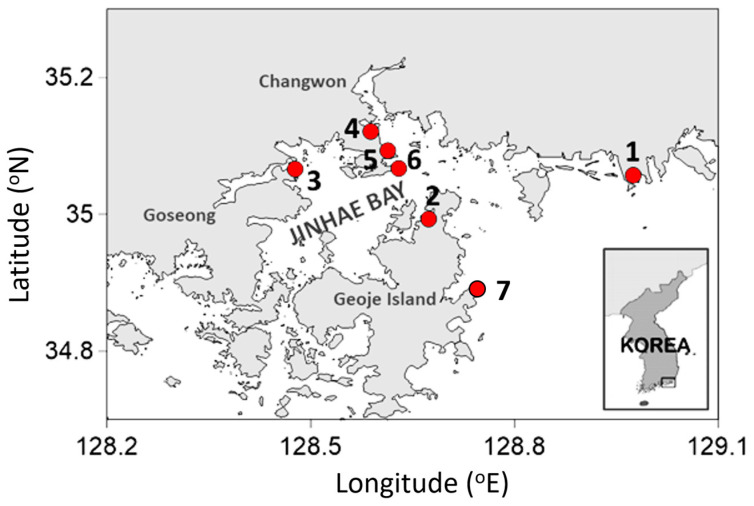
Paralytic shellfish toxins (PSTs) are potent neurotoxins produced by certain microalgae, particularly dinoflagellates, and they can accumulate in shellfish in coastal seawater and thus pose significant health risks to humans. To explore the relationship between toxicity and PST profiles in seawater and mussels, the spatiotemporal variations in PST concentrations and profiles were investigated along the southern coast of Korea under peak PST levels during spring. Seawater and mussel samples were collected biweekly from multiple stations, and the toxin concentrations in the samples were measured. Moreover, the dinoflagellate community composition was analyzed using next-generation sequencing to identify potential PST-producing species. The PST concentrations and toxin profiles showed substantial spatiotemporal variability, with GTX1 and GTX4 representing the dominant toxins in both samples, and C1/2 tending to be higher in seawater. species were identified as the primary sources of PSTs. Environmental factors such as water temperature and salinity influenced PST production. This study demonstrates that variability in the amount and composition of PSTs is due to intricate ecological interactions. To mitigate shellfish poisoning, continuous monitoring must be conducted to gain a deeper understanding of these interactions.
麻痹性贝类毒素(PSTs)是某些微藻,特别是甲藻产生的强效神经毒素,它们可以在沿海水域的贝类中积累,因此对人类健康构成重大威胁。为了探究海水中贝类毒素特征与毒性之间的关系,本研究在春末麻痹性贝类毒素浓度峰值期间,沿韩国南部海岸调查了 PST 浓度和特征的时空变化。每隔两周从多个站位采集海水和贻贝样本,并测量样本中的毒素浓度。此外,还使用下一代测序分析甲藻群落组成,以鉴定潜在的 PST 产生物种。结果表明,PST 浓度和毒素特征具有显著的时空变异性,GTX1 和 GTX4 是两种样品中的主要毒素,C1/2 在海水中的含量往往更高。甲藻被鉴定为 PST 的主要来源。水温和盐度等环境因素影响 PST 的产生。本研究表明,PST 数量和组成的变化是由于复杂的生态相互作用所致。为了减轻贝类中毒,必须进行持续监测,以更深入地了解这些相互作用。