State Key Laboratory of Ophthalmology, Zhongshan Ophthalmic Center, Sun Yat-Sen University, Guangdong Provincial Key Laboratory of Ophthalmology and Visual Science, Guangdong Provincial Clinical Research Center for Ocular Diseases, Guangzhou, China.
Research School of Biology, College of Medicine, Biology and Environment, Australia National University, Canberra, Australia.
Invest Ophthalmol Vis Sci. 2024 Aug 1;65(10):42. doi: 10.1167/iovs.65.10.42.
The purpose of this study was to investigate the changes in spherical equivalent (SE) and axial length (AL) and cumulative incidence of myopia and high myopia in Chinese 15-year-old adolescents entering a non-academic stream of senior high school education.
A total of 880 first-born twins with a baseline age range of 7 to 15 years were enrolled and followed annually until 18 years of age. Cycloplegic refractions and AL were examined. Educational exposure was divided into academic high school (AHS) and vocational high school (VHS) streams. A piecewise linear mixed-effects model was used to estimate the effect of education exposures on SE development, the slope before the age of 15 years (β2), and the slope change at the age of 15 years (β3) was compared between the 2 groups.
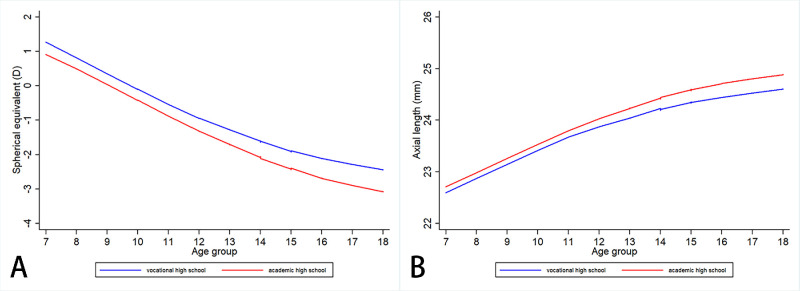
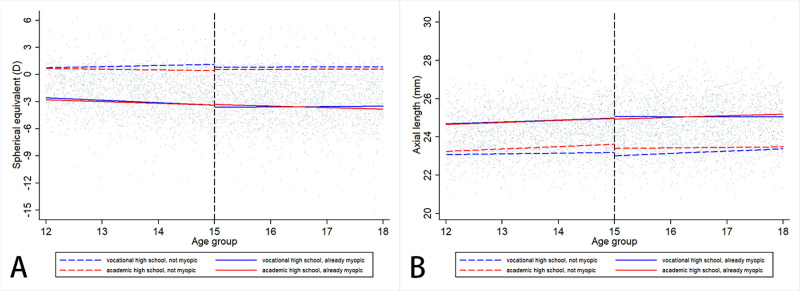
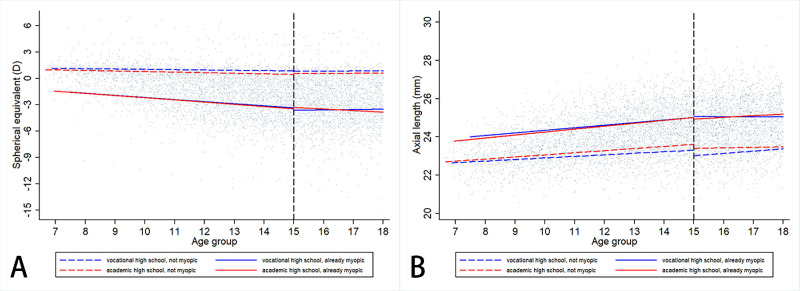
The curves of refractive development in a myopic direction changed in parallel in the AHS and VHS group before 15 years. For nonmyopic children, β2 was -0.19 and -0.20 diopters (D)/year (P = 0.270), and β3 was 0.16 and 0.14 D/year (P = 0.270), in the AHS and VHS groups, respectively. Among patients with myopia, β2 was -0.52 and -0.54 D/year (P = 0.500), and β3 was 0.37 and 0.32 D/year (P = 0.004), in the AHS and VHS groups, respectively. The trends in AL were similar. The 3-year cumulative incidence of myopia was 35.3% (AHS) versus 14.7% (VHS; P < 0.001), and that of high myopia was 5.7% and 3.3% (P = 0.129).
Students undertaking a VHS rather than an AHS education have slower myopic shifts in refraction and less incident myopia after the age of 15 years.
本研究旨在探讨进入非学术性高中教育的中国 15 岁青少年的等效球镜(SE)和眼轴(AL)变化以及近视和高度近视的累积发病率。
共纳入 880 对初产双胞胎,基线年龄为 7 至 15 岁,每年随访至 18 岁。检查睫状肌麻痹验光和 AL。教育暴露分为学术性高中(AHS)和职业高中(VHS)。采用分段线性混合效应模型估计教育暴露对 SE 发育的影响,比较两组在 15 岁前的斜率(β2)和 15 岁时的斜率变化(β3)。
在 AHS 和 VHS 组,近视方向的屈光发育曲线在 15 岁前平行变化。对于非近视儿童,β2 分别为 -0.19 和 -0.20 屈光度(D)/年(P = 0.270),β3 分别为 0.16 和 0.14 D/年(P = 0.270),在 AHS 和 VHS 组中。在近视患者中,β2 分别为 -0.52 和 -0.54 D/年(P = 0.500),β3 分别为 0.37 和 0.32 D/年(P = 0.004),在 AHS 和 VHS 组中。AL 的趋势相似。3 年近视累积发病率为 35.3%(AHS)与 14.7%(VHS;P < 0.001),高度近视发病率为 5.7%和 3.3%(P = 0.129)。
接受 VHS 教育而非 AHS 教育的学生在 15 岁后近视屈光度变化较慢,近视发生率较低。